Definitions [14]
Define interconversion of states of matter.
The process by which matter changes from one state to another and back to the original state, without any change in its chemical composition.
Define matter
Anything that has mass and occupies space is called matter.
Define the term polarizability
Polarizability is defined as the ability of an atom or a molecule to form momentary dipoles, which means, the ability of the atom or molecule to become polar by redistributing its electrons.
Define the term Aqueous tension
The pressure exerted by saturated water vapour is called aqueous tension.
Define the term Hydrogen bond
The electrostatic force of attraction between a positively polarised hydrogen atom of one molecule and a highly electronegative atom (which may be negatively charged) of another molecule is called a hydrogen bond.
Define the term Dipole moment
Dipole moment (μ) is the product of the magnitude of the charge (Q) and the distance between the centres of positive and negative charge (r). It is designated by a Greek Letter (μ) and its unit is Debye (D).
A temperature scale with absolute zero (zero kelvin) as the starting point is called the absolute scale or the kelvin scale.
The volume of a given mass of a dry gas varies inversely as the pressure and directly as the absolute temperature.
V ∝ \[\frac {1}{P}\] × T or \[\frac {PV}{T}\] = k (constant)
If volume changes from V1 to V2, pressure from P1 to P2, and temperature from T1 to T2, then:
\[\frac {P_1V_1}{T_1}\] = \[\frac {P_2V_2}{T_2}\] = k (constant)
State Gay-Lussac’s law of combining volumes.
When gases react, they do so in volumes that bear a simple ratio to one another and to the volume of the gaseous product, provided all volumes are measured at the same temperature and pressure.
The reactant which is completely used up in a reaction is known as Limiting reagent or Limiting reactant.
A molecule is the smallest particle of an element or a compound that can exist by itself; it never breaks up except for taking part in a chemical reaction.
An atom is the smallest particle of an element that can take part in a chemical reaction; however, it may or may not exist independently.
“The relation between three properties of a gas, i.e., pressure, volume and temperature, is called the ideal gas equation.”
OR
The relation between the three properties of a gas – pressure (P), volume (V), and temperature (T) – expressed as PV = nRT is called the ideal gas equation.
The process of converting a gas into a liquid by applying pressure and/or reducing temperature is called liquefaction. The essential conditions are low temperature and high pressure.
Formulae [1]
\[\frac{P_1V_1}{T_1}=\frac{P_2V_2}{T_2}\]
Theorems and Laws [10]
The total pressure of a gaseous mixture equals the sum of the partial pressures of all individual gases.
Partial pressure of a gas: Pi = xi × PTotal, where xi = mole fraction of gas i
Pressure of pure dry gas: Pdry gas = PTotal − Paq, where Paq = aqueous tension (vapour pressure of water)
Rate of diffusion of a gas is inversely proportional to the square root of its molar mass.
\[\frac{r_1}{r_2}=\sqrt{\frac{M_2}{M_1}}\]
\[\text{Rate of diffusion}=\frac{\text{Volume of gas diffused}}{\text{Time required for diffusion}}\]
Statement: For a given mass of gas at constant temperature, the volume of a gas is inversely proportional to its pressure.
- Constants held: mass of gas, temperature.
- P-V graph: Hyperbolic curve; P vs 1/V graph: straight line through origin.
- P increases → V decreases proportionally.
Charles' Law (Temperature–Volume Relationship)
At constant pressure (P) and number of moles (n), the volume of a gas is directly proportional to its absolute temperature.
\[V\propto T\quad\Rightarrow\quad\frac{V_1}{T_1}=\frac{V_2}{T_2}\]
The V–T curve at constant pressure is called an isobar
Absolute zero = 0 K = –273.15°C — the temperature at which gas volume theoretically becomes zero. It cannot be attained in practice (temperatures of ~0.000001 K have been achieved in labs)
or
Statement:
The volume of a fixed mass of gas is directly proportional to its absolute temperature if the pressure is kept constant.
Mathematically, V ∝ T ⇒ \[\frac {V}{T}\] = constant
Graph: V vs T (Isobar)
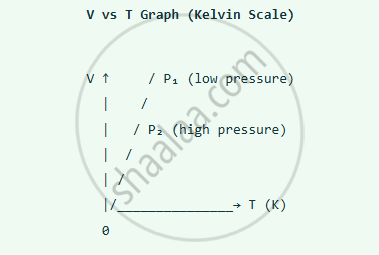 A straight line through the origin when using Kelvin. All lines converge at 0 K (absolute zero).
"When gases combine or are produced in a chemical reaction, they do so in a simple ratio by volume, provided all gases are at the same temperature and pressure."
- Proposed by Gay-Lussac in 1808.
- e.g. 100 mL H₂ + 50 mL O₂ → 100 mL H₂O vapour (ratio = 2 : 1 : 2).
- The volume ratio of gaseous reactants to products agrees with their molar ratio.
- Volume of a gas is directly proportional to the number of moles (not inversely).
Statement: The volume remaining constant, the pressure of a given mass of gas increases or decreases by 1/273.15 of its pressure at 0°C for each 1°C rise or fall in temperature.
where β = pressure expansion coefficient = 1/273 per °C.
"Equal volumes of all gases at the same temperature and pressure contain equal numbers of molecules."
- Proposed by Avogadro in 1811.
- 1 mole of any gas at STP = 22.4 L (at 0°C, 1 atm) or 22.71 L (at 0°C, 1 bar — new IUPAC STP).
- 1 mole of any substance = 6.022 × 10²³ particles.
Avogadro's Law (Volume–Moles Relationship):
At constant temperature (T) and pressure (P), volume is directly proportional to number of moles.
When temperature is constant, the product of the pressure and volume of a gas remains constant.
When volume is constant, the ratio of pressure to temperature of a gas remains constant.
When pressure is constant, the ratio of volume to temperature of a gas remains constant.
Key Points
| Property | Solid | Liquid | Gas |
|---|---|---|---|
| Mean molecular separation | ~3–5 Å | ~3–10 Å | >5 Å |
| Particle arrangement | Tightly packed, regular | Loosely packed, irregular | Highly irregular |
| Particle movement | Fixed positions, cannot move freely | Moves a small distance within liquid | Continuous random motion |
| Shape & volume | Definite shape and volume | Takes shape of container, definite volume | Takes shape and volume of container |
| Intermolecular space | Very small | Moderate | Large |
| Effect of temperature | Small volume change | Moderate volume change | Significant volume change |
| Compressibility | Practically incompressible | Slightly compressible | Highly compressible |
| Example | A piece of iron | Water, spirit, oil | Air |
Intermolecular forces are attractive (and repulsive) forces acting between neighbouring molecules. They are weaker than covalent or ionic bonds but determine the physical state of matter.
As intermolecular forces increase: Gas → Liquid → Solid (thermal energy decreases in the same direction).
Types of Intermolecular Forces:
| Type | Occurrence | Strength | Key Point | Example |
|---|---|---|---|---|
| Dipole–Dipole | Between polar molecules | Medium (3–4 kJ mol⁻¹) | +ve end attracts –ve end | HCl |
| Ion–Dipole | Between ion & polar molecule | Stronger than dipole–dipole | Depends on charge & size of ion | Na⁺ – H₂O |
| Dipole–Induced Dipole | Polar + non-polar molecule | Weak | Polar molecule induces dipole | NH₃ + C₆H₆ |
| London Dispersion | Non-polar molecules, noble gases | Weakest | Due to temporary dipoles | N₂, O₂, noble gases |
| Hydrogen Bonding | H with N, O, F | Strong (but < covalent) | Special dipole–dipole | HF, H₂O |
- Gases are highly compressible and fill any container completely
- Gases have much lower densities than solids/liquids — expressed in g/L (not g/mL)
- Gas pressure arises from bombardment of molecules against container walls
- Gases mix freely with each other in all proportions
- Temperature must always be in Kelvin when applying gas laws
Pressure Conversions:
- SI unit of pressure: Pascal (Pa) = N m⁻² = 1 kg m⁻¹ s⁻²
- 1 bar = 1.00 × 10⁵ Pa
- 1 atm = 76 cm of Hg = 760 mm of Hg = 760 torr = 101325 Pa = 1.01325 × 10⁵ Nm⁻²
- An ideal gas has point-mass molecules, no intermolecular forces, and perfectly elastic collisions.
- The Ideal Gas Equation, PV = nRT, combines all three laws into a single universal relationship.
- The Universal Gas Constant R = 8.314 J mol⁻¹ K⁻¹ is the same for all ideal gases.
- Real gases approximate ideal behaviour at low pressure and high temperature.
- Always use absolute temperature (Kelvin) in gas law calculations. T(K) = T(°C) + 273.15
- A gas consists of an extremely large number of tiny, discrete molecules whose actual volume is negligible compared to the total volume of the gas
- Gas molecules are in constant, random motion moving in straight lines; they change direction upon collisions with other molecules or container walls
- Intermolecular forces are negligible — molecules neither attract nor repel each other
- Effect of gravity on molecules is negligible
- All molecular collisions are perfectly elastic — total kinetic energy is conserved (though energy can be redistributed)
- Gas pressure is caused by molecular bombardment against the walls of the container
- Different molecules have different kinetic energies, but the average KE is directly proportional to absolute temperature: Average KE ∝ T
A gas that obeys all gas laws at all conditions of temperature and pressure is an ideal gas. All real gases deviate from ideal behaviour, especially at low temperature and high pressure.
Causes of Deviation:
- At low temperature and high pressure, the actual volume of gas molecules is no longer negligible
- Intermolecular forces become significant and cannot be ignored
Compressibility Factor (Z):
\[Z=\frac{pV}{nRT}=\frac{V_\mathrm{real}}{V_\mathrm{ideal}}\]
| Value of Z | Meaning |
|---|---|
| Z = 1 | Gas behaves as ideal at all temperatures and pressures |
| Z > 1 | Gas is less compressible than ideal — positive deviation (usually at high pressure); pV > RT |
| Z < 1 | Gas is more compressible than ideal — negative deviation (usually at low pressure); pV < RT |
The more Z deviates from 1, the greater the departure from ideal behaviour.
Critical Constants:
| Constant | Meaning |
|---|---|
| Critical Temperature (Tc) | The temperature below which a gas can be liquefied by increasing pressure alone; above Tc, liquefaction is not possible regardless of pressure |
| Critical Pressure (Pc) | The minimum pressure required to liquefy 1 mole of gas placed at its critical temperature |
| Critical Volume (Vc) | The volume occupied by 1 mole of gas at its critical temperature |
A gas below its critical temperature is called vapour; above it is called a gas.
In the liquid state, molecules are held close together but can execute random motion through the spaces between them. Most physical properties are governed by the strength of intermolecular forces.
Properties of Liquids:
(i) Vapour Pressure
- In a closed vessel, liquid and its vapour establish a dynamic equilibrium; the pressure at equilibrium is called saturated vapour pressure
- Vapour pressure is a kinetic phenomenon — depends on temperature and nature of liquid
- Vapour pressure ∝ Temperature (increases with rise in temperature)
- Vapour pressure ∝ 1 / Intermolecular forces (weaker forces → higher vapour pressure)
- Unit: mm Hg or torr
(ii) Viscosity
- The property that determines the ease with which a fluid flows (resistance to flow)
- Arises due to internal friction between layers of fluid in motion
- Viscosity ∝ 1 / Temperature (viscosity decreases as temperature increases)
- Viscosity ∝ Intermolecular forces (stronger forces → more viscous)
- SI unit of viscosity coefficient: N m⁻² s (pascal-second); CGS unit: poise (g cm⁻¹ s⁻¹)
(iii) Surface Tension
- The force acting along the surface of a liquid at right angles to any line per unit length
- Arises because molecules at the surface experience a net inward pull
- Surface tension ∝ 1 / Temperature (decreases as temperature rises)
- Surface tension ∝ Intermolecular forces (stronger forces → higher surface tension)
- SI unit: N m⁻¹
Concepts [13]
- States of Matter
- Intermolecular Forces
- Characteristic Properties of Gases
- Gas Laws
- Boyle’s Law (Pressure - Volume Relationship)
- Charles’ Law (Temperature - Volume Relationship)
- Gay-Lussac's Law
- Avogadro's Law
- Ideal Gas Equation
- Kinetic Molecular Theory of Gases
- Deviation from Ideal Behaviour
- Liquefaction of Gases and Critical Constant
- Liquid State
