Definitions [2]
Define Allotrophy
When an element possess 2 or more different forms in the same state, they are called allotropes and the phenomenon is known as allotropy. Diamond and graphite are the 2 allotropes of carbon.
Define Allotrophy
When an element possess 2 or more different forms in the same state, they are called allotropes and the phenomenon is known as allotropy. Diamond and graphite are the 2 allotropes of carbon.
Key Points
Key Points: Group 13 Elements - The Boron Family
General electronic configuration: ns² np¹.
| Element | Symbol | Electronic Configuration |
|---|---|---|
| Boron | B | [He] 2s² 2p¹ |
| Aluminium | Al | [Ne] 3s² 3p¹ |
| Gallium | Ga | [Ar] 3d¹⁰ 4s² 4p¹ |
| Indium | In | [Kr] 4d¹⁰ 5s² 5p¹ |
| Thallium | Tl | [Xe] 4f¹⁴ 5d¹⁰ 6s² 6p¹ |
- All group 13 elements predominantly show a +3 oxidation state.
- Aluminium is the third most abundant element in Earth's crust (after oxygen and silicon).
- Boron is non-metallic; it does not react with non-oxidising acids but dissolves in strong oxidising acids like HNO₃ (conc.) and H₂SO₄ (conc.).
Key Points: Important Trends and Anomalous Properties of Boron
Trends in Physical Properties:
| Property | Down the Group | Exceptions |
|---|---|---|
| Atomic/ionic radii | Increases | Atomic size of Ga < Al |
| Ionisation enthalpy | Decreases | IE₁ of Tl > In; IE₁ of Ga = Al |
| Tendency to show +1 oxidation state | Increases (inert pair effect) | — |
| Melting point | Decreases (Ga to Tl) | B has very high melting point |
| Lewis acid strength | Increases | — |
| Tendency to form ionic compounds | Increases | — |
| Tendency to form covalent compounds | Decreases | — |
Trends in Chemical Properties:
- Group 13 elements are less reactive than Group 1 and 2 elements.
- All Group 13 elements form ionic compounds except boron, which forms covalent compounds.
- Reaction with oxygen: Boron forms a mixture of oxide (B₂O₃) and nitride (BN) when heated at 700°C in air. Oxygen has no effect on aluminium in normal conditions, but in moist air, a thin protective oxide layer forms on its surface.
- Reaction with water: Except for boron, Group 13 elements decompose in boiling water to produce hydrogen gas. Example: 2Al + 6H2O → 2Al(OH)3 + 3H2↑
- Reaction with halogens: All Group 13 elements react with halogens to form trihalides (MX₃), except thallium (which prefers monohalides due to the inert pair effect).
Anomalous Properties of Boron:
Boron behaves differently from the rest of Group 13 because of:
- Small size – high polarising power
- High ionisation energy – does not form B³⁺ ions easily
- High electronegativity
- Absence of vacant d-orbitals – cannot expand its coordination number beyond 4
Key Points: Important Compounds of Boron
| Compound Name | Molecular Formula | Structural Feature | Important Uses |
|---|---|---|---|
| Borax | Na₂[B₄O₅(OH)₄]·8H₂O | 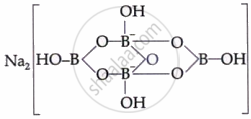 |
|
| Boric Acid | H₃BO₃ | 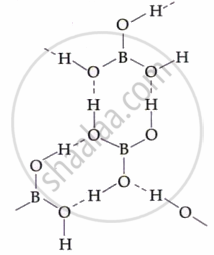 |
|
| Diborane | B₂H₆ | 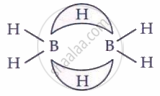 |
|
Key Points: Group 14 Elements - The Carbon Family
General electronic configuration: ns² np²
| Element | Symbol | Configuration |
|---|---|---|
| Carbon | C | [He] 2s² 2p² |
| Silicon | Si | [Ne] 3s² 3p² |
| Germanium | Ge | [Ar] 3d¹⁰ 4s² 4p² |
| Tin | Sn | [Kr] 4d¹⁰ 5s² 5p² |
| Lead | Pb | [Xe] 4f¹⁴ 5d¹⁰ 6s² 6p² |
- Size & Energy Trends: Down the group, atomic and ionic radii increase, while ionisation energy decreases.
- Oxidation States: Show +4 and +2 states → +4 stable at top (C, Si), +2 becomes stable down the group (Sn, Pb) due to inert pair effect.
- Metallic Character: Increases down the group → C is non-metal, Si/Ge metalloids, Sn/Pb metals.
- Covalent Nature: Tendency to form covalent compounds decreases down the group as metallic character increases.
- Anomalous Behaviour of Carbon: Due to small size, high electronegativity, absence of d-orbitals, and high catenation.
- Catenation & Bonding: Carbon shows maximum catenation and strong covalent bonding, forming chains and rings.
Allotropes of Carbon:
- Crystalline: Diamond (hardest), Graphite (conducts electricity), Fullerene (spherical)
- Amorphous: Coke, Charcoal (adsorbent), Lampblack (~98–99% carbon)
Concepts [17]
- Introduction to p-block Elements
- Group 13 Elements - The Boron Family
- Important Trends and Anomalous Properties of Boron
- Important Compounds of Boron
- Uses of Boron and Aluminium
- Group 14 Elements - The Carbon Family
- Important Trends and Anomalous Behaviour of Carbon
- Allotropes of Carbon > Diamond
- Allotropes of Carbon > Graphite
- Allotropes of Carbon > Fullerene
- Allotropes of Carbon > Diamond
- Some Important Compounds of Carbon and Silicon - Carbon Monoxide
- Some Important Compounds of Carbon and Silicon - Carbon Dioxide
- Some Important Compounds of Carbon and Silicon - Silicon Dioxide
- Some Important Compounds of Carbon and Silicon - Silicones
- Some Important Compounds of Carbon and Silicon - Silicates
- Some Important Compounds of Carbon and Silicon - Zeolites
