Definitions [16]
In three-dimensional geometry, the vector drawn from the origin O(0, 0, 0) to a point P(x, y, z) is called the position vector of the point P. It is written as \[\vec{OP}\]. If point P(x, y, z) is given, then the magnitude of its position vector is:
A scalar quantity is a physical quantity that has magnitude only.
A vector quantity is a physical quantity that has magnitude as well as direction.
A vector is a quantity that has magnitude as well as direction. Geometrically, a vector is represented by a directed line segment such as \[\vec{AB}\], where A is the initial point and B is the terminal point.
The magnitude of vector \[\vec{AB}\] is the length of the directed line segment AB. It is written as \[|\vec{AB}|\], \[|\vec{a}|\], or simply a. The magnitude of a vector is never negative because it represents length.
A vector having the same magnitude as the original vector but having an opposite direction is called the negative of a vector.
A vector that has zero magnitude and an arbitrary direction, represented by \[\vec 0\], is called a zero vector or null vector.
A vector is any quantity that needs both magnitude (size) and direction to be completely described.
OR
The physical quantities which have both magnitude and direction, obey the laws of vector addition, and are specified by a number with a unit and its direction (e.g., displacement, velocity, force, momentum) are called vector quantities or vectors.
A vector of unit magnitude drawn in the direction of a given vector is called a unit vector.
The length or the magnitude of a vector is called the modulus of a vector.
The vectors which act in the same plane are called co-planar vectors.
If P(x, y, z) is a point, then its position vector is
This is called the component form of a vector.
General Component Form:
If \[ \vec{a} = a_{1}\hat{i} + a_{2}\hat{j} + a_{3}\hat{k}, \]
then \[ a_{1}, a_{2}, a_{3} \] are called the components of \[ \vec{a}. \]
If \[P_1(x_1, y_1, z_1)\] and \[P_2(x_2, y_2, z_2)\] are two points in space, then the vector joining \[P_1\] to \[P_2\] is the vector \[\vec{P_1P_2}\]
representing the displacement from \[P_1\] (initial point) to \[P_2\] (terminal point).
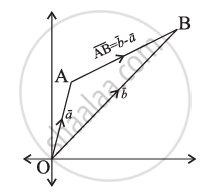
If \[ \overrightarrow{OA} = \vec{a} \] and \[ \overrightarrow{OB} = \vec{b}, \] then the vector joining \[ A \] to \[ B \] is
\[ \overrightarrow{AB} = \vec{b} - \vec{a} \]
Magnitude of vector:
Projection is the part of one vector in the direction of another vector.
Scalar projection of \[\vec{a}\] on \[\vec{b}\]
Vector projection of \[\vec{a}\] on \[\vec{b}\]
If \[\vec{a}\] and \[\vec{b}\] are two vectors and \[\theta\] is the angle between them, then their scalar product is given by:
The scalar triple product of three vectors a, b, and c is defined as
(a × b) · c = |a| |b| |c| sinθ cosφ,
where θ is the angle between a and b, and φ is the angle between a × b and c. It is also defined as [a b c].
Formulae [2]
\[P\left(\frac{m_1x_2+m_2x_1}{m_1+m_2},\frac{m_1y_2+m_2y_1}{m_1+m_2}\right)\]
Parallelepiped: Volume = [a b c]
Tetrahedron: \[\frac{1}{6}\] [a b c]
Theorems and Laws [10]
If a number of vectors are represented both in magnitude and direction by the sides of an open polygon taken in the same order, then their resultant is represented both in magnitude and direction by the closing side of the polygon taken in opposite order — this is called the Polygon Law of Vector Addition.
If two vectors are represented by two sides of a triangle taken in order, then their sum is represented by the third side of the triangle taken in the opposite order.
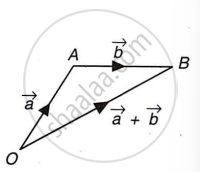
If two vectors are represented by two adjacent sides of a parallelogram, then their resultant is represented by the diagonal passing through their common initial point.
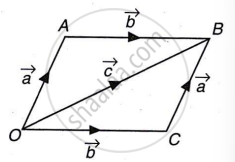
The difference of two vectors is obtained by adding the negative of one vector.
If D, E, F are the midpoints of the sides BC, CA, AB of a triangle ABC, prove that `bar(AD) + bar(BE) + bar(CF) = bar0`.
Let `bara, barb, barc, bard, bare, barf` be the position vectors of the points A, B, C, D, E, F respectively.
Since D, E, F are the midpoints of BC, CA, AB respectively, by the midpoint formula
`bard = (barb + barc)/2, bare = (barc + bara)/2, barf = (bara + barb)/2`
∴ `bar(AD) + bar(BE) + bar(CF) = (bard - bara) + (bare - barb) + (barf - barc)`
= `((barb + barc)/2 - bara) + ((barc + bara)/2 - barb) + ((bara + barb)/2 - barc)`
= `1/2barb + 1/2barc - bara + 1/2barc + 1/2bara - barb + 1/2bara + 1/2barb - barc`
= `1/2(barb + barc - 2bara + bar c + bara - 2barb + bara + barb - 2barc)`
= `(bara + barb + barc) - (bara + barb + barc) = bar0`.
Let `A(bara)` and `B(barb)` be any two points in the space and `R(barr)` be the third point on the line AB dividing the segment AB externally in the ratio m : n, then prove that `barr = (mbarb - nbara)/(m - n)`.
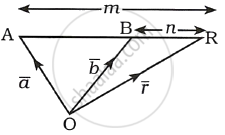
As the point R divides the line segment AB externally, we have either A-B-R or R-A-B.
Assume that A-B-R and `bar(AR) : bar(BR)` = m : n
∴ `(AR)/(BR) = m/n` so n(AR) = m(BR)
As `n(bar(AR))` and `m(bar(BR))` have same magnitude and direction,
∴ `n(bar(AR)) = m(bar(BR))`
∴ `n(barr - bara) = m(barr - barb)`
∴ `nbarr - nbara = mbarr - mbarb`
∴ `mbarr - nbarr = mbarb - nbara`
∴ `(m - n)barr = mbarb - nbara`
∴ `barr = (mbarb - nbara)/(m - n)`
Hence proved.
Let `A(bara)` and `B(barb)` are any two points in the space and `R(barr)` be a point on the line segment AB dividing it internally in the ratio m : n, then prove that `barr = (mbarb + nbara)/(m + n)`.
R is a point on the line segment AB(A – R – B) and `bar(AR)` and `bar(RB)` are in the same direction.
Point R divides AB internally in the ratio m : n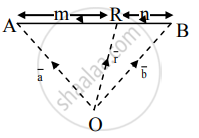
∴ `(AR)/(RB) = m/n`
∴ n(AR) = m(RB)
As `n(bar(AR))` and `m(bar(RB))` have same direction and magnitude,
`n(bar(AR)) = m(bar(RB))`
∴ `n(bar(OR) - bar(OA)) = m(bar(OB) - bar(OR))`
∴ `n(vecr - veca) = m(vecb - vecr)`
∴ `nvecr - nveca = mvecb - mvecr`
∴ `mvecr + nvecr = mvecb + nveca`
∴ `(m + n)vecr = mvecb + nveca`
∴ `vecr = (mvecb + nveca)/(m + n)`
By vector method prove that the medians of a triangle are concurrent.

Let A, B and C be vertices of a triangle.
Let D, E and F be the mid-points of the sides BC, AC and AB respectively.
Let `bara, barb, barc, bard, bare` and `barf` be position vectors of points A, B, C, D, E and F respectively.
Therefore, by mid-point formula,
∴ `bard = (barb + barc)/2, bare = (bara + barc)/2` and `barf = (bara + barb)/2`
∴ `2bard = barb + barc, 2bare = bara + barc` and `2barf = bara + barb`
∴ `2bard + bara = bara + barb + barc`, similarly `2bare + barb = 2barf + barc = bara + barb + barc`
∴ `(2bard + bara)/3 = (2bare + barb)/3 = (2barf + barc)/3 = (bara + barb + barc)/3 = barg` ...(Say)
Then we have `barg = (bara + barb + barc)/3 = ((2)bard + (1)bara)/(2 + 1) = ((2)bare + (1)barb)/(2 + 1) = ((2)barf + (1)barc)/(2 + 1)`
If G is the point whose position vector is `barg`, then from the above equation it is clear that the point G lies on the medians AD, BE, CF and it divides each of the medians AD, BE, CF internally in the ratio 2 : 1.
Therefore, three medians are concurrent.
Using properties of scalar triple product, prove that `[(bara + barb, barb + barc, barc + bara)] = 2[(bara, barb, barc)]`.
L.H.S = `[(bara + barb, barb + barc, barc + bara)]`
= `(bara + barb) . [(barb + barc) xx (barc + bara)]`
= `(bara + barb) . [barb xx barc + barb xx bara + barc xx barc + barc xx bara]`
= `(bara + barb) . [barb xx barc + barb xx bara + barc xx bara] ...[∵ barc xx barc = bar0]`
= `bara . [(barb xx barc) + (barb xx bara) + (barc xx bara)] + barb . [(barb xx barc) + (barb xx bara) + (barc xx bara)]`
= `bara . (barb xx barc) + bara . (barb xx bara) + bara . (barc xx bara) + barb . (barb xx barc) + barb(barb xx bara) + barb(barc xx bara)`
= `[bara barb barc] + [bara barb bara] + [bara barc bara] + [barb barb barc] + [barb barb bara] + [barb barc bara]`
= `[bara barb barc] + 0 + 0 + 0 + 0 + [bara barb barc]`
= `2[bara barb barc]`
= R.H.S
Prove by vector method, that the angle subtended on semicircle is a right angle.
Let seg AB be a diameter of a circle with centre C and P be any point on the circle other than A and B.
Then ∠APB is an angle subtended on a semicircle.
Let `bar"AC" = bar"CB" = bar"a"` and `bar"CP" = bar"r"`
Then `|bar"a"| = |bar"r"|` ....(1)

`bar"AP" = bar"AC" + bar"CP"`
= `bar"a" + bar"r"`
= `bar"r" + bar"a"`
`bar"BP" = bar"BC" + bar"CP"`
= `- bar"CB" + bar"CP"`
= `- bar"a" + bar"r"`
∴ `bar"AP".bar"BP" = (bar"r" + bar"a").(bar"r" - bar"a")`
= `bar"r".bar"r" - bar"r".bar"a" + bar"a".bar"r" - bar"a".bar"a"`
= `|bar"r"|^2 - |bar"a"|^2`
= 0 ....`(∵ bar"r".bar"a" = bar"a".bar"r")`
∴ `bar"AP" ⊥ bar"BP"`
∴ ∠APB is a right angle.
Hence, the angle subtended on a semicircle is the right angle.
Consider the circle with the centre at O and AB is the diameter.
Let `bar(OA) = bar a, bar(OB) = bar b, bar(OC) = bar c`

∴ `|bar a| =|bar b| = |bar c| = r` ...(1)
and `bar a = -bar b` ...(2)
Consider:
`bar (AC) * bar (BC) = (bar c - bar a) * (bar c - bar b)`
= `(bar c - bar a) * (bar c + bar a)` ...[From (2)]
= `|bar c|^2 - |bar a|^2`
= r2 − r2 ...[From (1)]
= 0
∴ `bar(AC) * bar(BC) = 0`
∴ `bar(AC)` is perpendicular to `bar(BC)`
∴ ∠ACB = 90°
∴ Angle subtended on semi-circle is a right angle.
Key Points
-
Scalars have only magnitude.
-
Vectors have magnitude and direction.
-
Vectors are represented by directed line segments.
-
\[\vec{AB}\] represents a vector from A to B.
-
Magnitude of a vector is its length and is always non-negative.
-
\[\vec{OP}\] is the position vector of point \[P(x, y, z)\].
-
\[|\vec{OP}| = \sqrt{x^2 + y^2 + z^2}\].
-
Component Method: Resultant R = A + B is found as Rx = Ax + Bx, Ry = Ay + By, Rz = Az + Bz, giving R = Rx\[\hat i\] + Ry\[\hat j\] + Rz\[\hat k\].
-
Laws of Addition: Triangle law (head-to-tail), Parallelogram law (tail-to-tail, diagonal = resultant), and Polygon law (for multiple vectors, closing side = resultant).
-
Magnitude (Addition): When A and B are at angle θ, R = \[\sqrt{A^2+B^2+2AB\cos\theta}\].
-
Magnitude (Subtraction): Change the sign to minus — ∣R∣ = .
-
Direction of Resultant: tanα = \[\frac{B\sin\theta}{A+B\cos\theta}\] for addition; tanβ = \[\frac{B\sin\theta}{A-B\cos\theta}\] for subtraction.
-
A vector has both magnitude and direction.
-
Resultant means the combined effect of two or more vectors.
-
Triangle law uses head-to-tail arrangement.
-
Parallelogram law uses adjacent sides from the same initial point.
-
Vector addition is commutative and associative.
-
Zero vector is the identity element for vector addition.
-
Difference of vectors is obtained by adding the negative of a vector.
-
Initial point: starting point of vector; terminal point: ending point.
-
Vector joining \[P_1(x_1, y_1, z_1)\] to \[P_2(x_2, y_2, z_2)\]:
\[\vec{P_1P_2} = (x_2 - x_1)\hat{i} + (y_2 - y_1)\hat{j} + (z_2 - z_1)\hat{k}\] -
Order matters: \[\vec{P_1P_2} = -\vec{P_2P_1}\]
-
Magnitude equals distance between points:
\[|\vec{P_1P_2}| = \sqrt{(x_2 - x_1)^2 + (y_2 - y_1)^2 + (z_2 - z_1)^2}\]
- The dot product of two vectors is a scalar quantity.
- The dot product uses the cosine of the angle between the vectors.
\[ \vec{a} \cdot \vec{b} = |\vec{a}||\vec{b}| \cos\theta \] - The dot product is useful in finding the angle between two vectors and projection.
- For two non-zero vectors, \[ \vec{a} \cdot \vec{b} = 0 \] indicates that the vectors are perpendicular.
Concepts [12]
- Basic Concepts of Vector Algebra
- Vector
- Vector Operations>Addition and Subtraction of Vectors
- Algebra of Vectors > Addition & Subtraction of Two Vectors
- Components of Vector in Algebra
- Vector Joining Two Points in Algebra
- Section Formula in Coordinate Geometry
- Product of Two Vectors > Scalar (Dot) Product
- Projection of a Vector on a Line
- Magnitude and Direction of a Vector
- Position Vector of a Point Dividing a Line Segment in a Given Ratio
- Scalar Triple Product
