Definitions [5]
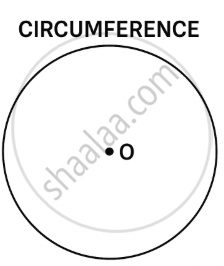
A circle is a closed curve where all points on the boundary (called the circumference) are at the same distance from a fixed point inside it.
-
The fixed point inside the circle is called the center (O)
The radius is a straight line segment that connects the center of the circle to any point on its circumference.
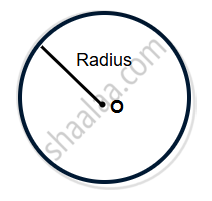
Characteristics:
-
Symbol: Usually represented as r
-
All radii of a circle have the same length
-
A circle has infinite radii (one to every point on the circumference)
-
The radius is always half the diameter
- Radius = `"Diameter"/"2"`
The diameter is a straight line segment that passes through the center of the circle and has both endpoints on the circumference.
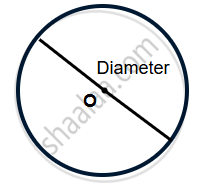
Characteristics:
-
The diameter passes through the center
-
A circle has infinite diameters
-
The diameter is the longest possible chord of a circle
-
The diameter is twice the radius
- Diameter = 2 × Radius and
A chord is a straight line segment that connects any two points on the circumference of the circle.
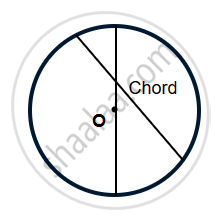
Characteristics:
-
A circle has infinite chords
-
The diameter is the longest chord in any circle
-
Chords closer to the centre are longer than chords farther from the center
The line segment, joining any two points on the circumference of the circle, is called a chord.
Theorems and Laws [16]
Two tangents TP and TQ are drawn to a circle with centre O from an external point T. Prove that ∠PTQ = 2∠OPQ.
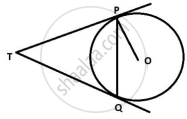
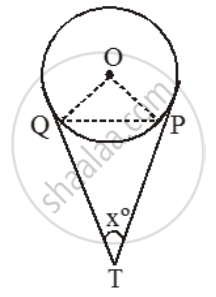
Given: A circle with centre O and an external point T from which tangents TP and TQ are drawn to touch the circle at P and Q.
To prove: ∠PTQ = 2∠OPQ.
Proof: Let ∠PTQ = xº.
Then, ∠TQP + ∠TPQ + ∠PTQ = 180º ...[∵ Sum of the ∠s of a triangle is 180º]
⇒ ∠TQP + ∠TPQ = (180º – x) ...(i)
We know that the lengths of tangent drawn from an external point to a circle are equal.
So, TP = TQ.
Now, TP = TQ
⇒ ∠TQP = ∠TPQ
`= \frac{1}{2}(180^\text{o} - x)`
`= ( 90^\text{o} - \frac{x}{2})`
∴ ∠OPQ = (∠OPT – ∠TPQ)
`= 90^\text{o} - ( 90^\text{o} - \frac{x}{2})`
`= \frac{x}{2} `
`⇒ ∠OPQ = \frac { 1 }{ 2 } ∠PTQ`
⇒ 2∠OPQ = ∠PTQ
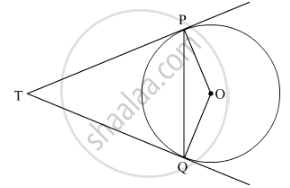
Given: TP and TQ are two tangents of a circle with centre O and P and Q are points of contact.
To prove: ∠PTQ = 2∠OPQ
Suppose ∠PTQ = θ.
Now by theorem, “The lengths of a tangents drawn from an external point to a circle are equal”.
So, TPQ is an isoceles triangle.
Therefore, ∠TPQ = ∠TQP
`= 1/2 (180^circ - θ)`
`= 90^circ - θ/2`
Also by theorem “The tangents at any point of a circle is perpendicular to the radius through the point of contact” ∠OPT = 90°.
Therefore, ∠OPQ = ∠OPT – ∠TPQ
`= 90^@ - (90^@ - 1/2theta)`
`= 1/2 theta`
= `1/2` ∠PTQ
Hence, 2∠OPQ = ∠PTQ.
Prove that the line segment joining the points of contact of two parallel tangents of a circle, passes through its centre.

Suppose CD and AB are two parallel tangents of a circle with center O
Construction: Draw a line parallel to CD passing through O i.e. OP
We know that the radius and tangent are perpendicular at their point of contact.
∠OQC = ∠ORA = 90°
Now, ∠OQC + ∠POQ = 180° (co-interior angles)
⇒ ∠POQ = 180° - 90° = 90°
Similarly, Now, ∠ORA +∠POR =180° (co-interior angles)
⇒ ∠POQ = 180° - 90° = 90°
Now,∠POR + ∠POQ = 90° + 90° =180°
Since, ∠POR and ∠POQare linear pair angles whose sum is 180°
Hence, QR is a straight line passing through center O.
In the given figure, two tangents RQ and RP are drawn from an external point R to the circle with centre O. If ∠PRQ = 120°, then prove that OR = PR + RQ.
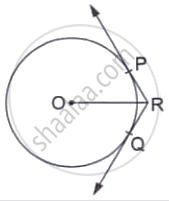

Construction Join PO and OQ
In ΔPOR and ΔQOR
OP = OQ(Radii)
RP = RQ(Tangents from the external point are congruent)
OR = OR (Common)
By SSS congruency, ΔPOR ≅ ΔQOR
∠PRO = ∠QRO(C.P.C.T)
Now,∠PRO+ ∠QRO= ∠PRQ
⇒ 2 ∠PRO = 120°
⇒ ∠PRO = 60°
Now. In ΔPOR
cos 60° `=(PR)/(OR)`
⇒ `1/2 =(PR)/(OR)`
⇒ OR = 2PR
⇒ OR = PR + PR
⇒ OR = PR +RQ
A quadrilateral is drawn to circumscribe a circle. Prove that the sums of opposite sides are equal.
Let ABCD be the quadrilateral circumscribing the circle.
Let E, F, G and H be the points of contact of the quadrilateral to the circle.
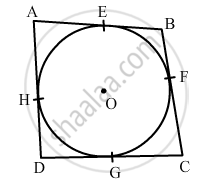
To Prove: AB + DC = AD + BC
Proof:
AB = AE + EB
AD = AH + HD
DC = DG + GC
BC = BF + FC
We have:
AE = AH (Tangents drawn from an external point to the circle are equal.)
Similarly, we have:
BE = BF
DH = DG
CG = CF
Now, we have:
AB + DC = AE + EB + DG + GC
= AH + BF + DH + CF
= (AH + DH) + (BF + CF)
= AD + BC
⇒ AB + DC = AD + BC
Thus, if a quadrilateral is drawn to circumscribe a circle, the sums of opposite sides are equal.
Hence, proved.
In the given figure, an isosceles triangle ABC, with AB = AC, circumscribes a circle. Prove that point of contact P bisects the base BC.
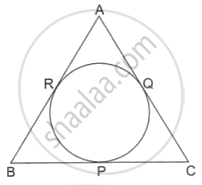
We know that tangent segments to a circle from the same external point are congruent
Now, we have
AR = AO, BR = BP and CP = CQ
Now, AB = AC
⇒ AR+ RB= AQ+ QC
⇒ AR + RB = AR + OC
⇒ RB = QC
⇒ BP = CP
Hence, P bisects BC at P.
A circle touches the side BC of a ΔABC at a point P and touches AB and AC when produced at Q and R respectively. As shown in the figure that AQ = `1/2` (Perimeter of ΔABC).

We have to prove that
AQ = `1/2` (perimeter of ΔABC)
Perimeter of ΔABC = AB + BC + CA
= AB + BP + PC + CA
= AB + BQ + CR + CA
(∵ Length of tangents from an external point to a circle are equal ∴ BP = BQ and PC = CR)
= AQ + AR ...(∵ AB + BQ = AQ and CR + CA = AR)
= AQ + AQ ...(∵ Length of tangents from an external point are equal)
= 2AQ
⇒ AQ = `1/2` (Perimeter of ΔABC)
Hence proved.
In the figure, segment PQ is the diameter of the circle with center O. The tangent to the tangent circle drawn from point C on it, intersects the tangents drawn from points P and Q at points A and B respectively, prove that ∠AOB = 90°
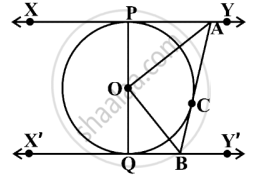
Given: PQ is the diameter of the circle. Point P, Q, C are points of contact of the respective tangents.
To prove: ∠AOB = 90°
Construction: Draw seg OC
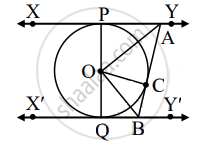
Proof:
In ∆OPA and ∆OCA,
side OP ≅ side OC ...[Radii of the same circle]
side OA ≅ side OA ...[Common side]
side PA ≅ side CA ...[Tangent segment theorem]
∴ ∆OPA ≅ ∠OCA ...[SSS test of congruency]
∴ ∠AOP ≅ ∠AOC ...[C.A.C.T.]
Let m∠AOP = m∠AOC = x ...(i)
Similarly, we can prove that ∠BOC ≅ ∠BOQ.
Let m∠BOC = m∠BOQ = y ...(ii)
m∠AOP + m∠AOC + m∠BOC + m∠BOQ = 180° ...[Linear angles]
∴ x + x + y + y = 180° ...[From (i) and (ii)]
∴ 2x + 2y = 180°
∴ 2(x + y) = 180°
∴ x + y = 90° ...(iii)
Now ∠AOB = ∠AOC + ∠BOC
= x + y ...[From (i) and (ii)]
∴ ∠AOB = ∠AOC + ∠BOC
= x + y
∴ ∠AOB = 90° ...[From (iii)]
Given: A circle inscribed in a right angled ΔABC. If ∠ACB = 90° and the radius of the circle is r.
To prove: 2r = a + b – c
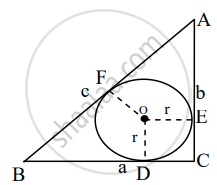
In given figure,
`{:(AF = AE),(FB = BD),(EC = DC):}}` ...(i) [Tangent Segment theorem]
In ▢ODCE,
∠ECD = 90° ...[∠ACB = 90°, A–E–C, B–D–C]
`{:(∠ODC = 90^circ),(∠OEC = 90^circ):}}` ...[Tangent theorem]
∴ ∠EOD = 90° ...[Remaining angle of ▢ODCE]
∴ ▢ODCE is a rectangle.
Also, OE = OD = r ...[Radii of the same circle]
∴ ▢ODCE is a square ...`[("A Rectangle is square if it's"),("adjcent sides are congruent")]`
∴ OE = OD = CD = CE = r ...(ii) [Sides of the square]
Consider R.H.S. = a + b – c
= BC + AC – AB
= (BD + DC) + (AE + EC) – (AF + FB) ...[B–D–C, A–E–C, A–F–B]
= (FB + r) + (AF + r) – (AF + FB) ...[From (i) and (ii)]
= FB + r + AF + r – AF – FB
= 2r
= L.H.S.
∴ 2r = a + b – c
In the given figure, the chord AB of the larger of the two concentric circles, with center O, touches the smaller circle at C. Prove that AC = CB.
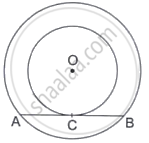
Construction: Join OA, OC and OB

We know that the radius and tangent are perpendicular at their point of contact
∴ ∠OCA = ∠OCB = 90°
Now, In Δ OCA and ΔOCB
∠OCA = ∠OCB = 90°
OA = OB (Radii of the larger circle)
OC = OC (Common)
By RHS congruency
Δ OCA ≅ Δ OCB
∴ CA =CB
In the given figure, common tangents AB and CD to the two circles with centres O1 and O2 intersect at E. Prove that AB = CD.
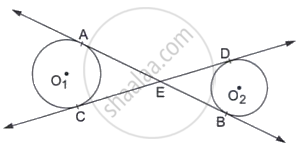
We know that tangent segments to a circle from the same external point are congruent.
So, we have
EA = EC for the circle having center O1
and
ED = EB for the circle having center O1
Now, Adding ED on both sides in EA = EC. we get
EA+ ED = EC + ED
⇒ EA + EB = EC + ED
⇒ AB = CD
In Fig., if AB = AC, prove that BE = EC
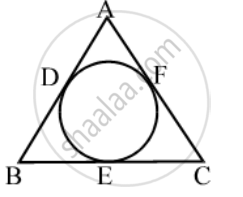
Since tangents from an exterior point to a circle are equal in length.
∴ AD = AF [Tangents from A]
BD = BE [Tangents from B]
CE = CF [Tangents from C]
Now,
AB = AC
⇒ AB – AD = AC – AD [Subtracting AD from both sides]
⇒ AB – AD = AC – AF [Using (i)]
⇒ BD = CF ⇒ BE = CF [Using (ii)]
⇒ BE = CE [Using (iii)]
Prove that the parallelogram, inscribed in a circle, is a rectangle.
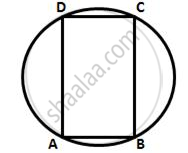
Let ABCD be a parallelogram inscribed in a circle.
Now, ∠BAD + ∠BCD
(Opposite angles of a parallelogram are equal.)
And ∠BAD + ∠BCD = 180°
(A pair of opposite angles in a cyclic quadrilateral are supplementary.)
∠BAD + ∠BCD = `(180^circ)/2` = 90°
The other two angles are 90°, and the opposite pair of sides are equal.
∴ ABCD is a rectangle.
Statement:
The angle in a semicircle is a right angle.
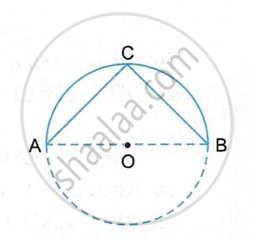
Result:
∠ACB = 90∘
Short Proof (Idea):
-
Diameter subtends an angle of 180° at the centre.
-
The angle at the circle is half of it.
-
Therefore, angle = 90°.
Statement:
Angles in the same segment of a circle are equal.
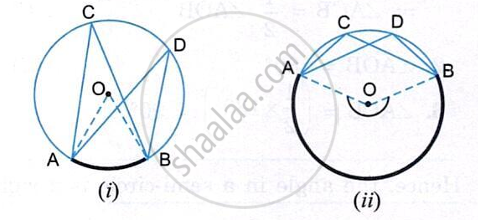
Result:
∠ACB = ∠ADB
Short Proof (Idea):
-
Both angles stand on the same arc.
-
The angle at the centre is double each of them.
-
Hence, both angles are equal.
Statement:
The angle subtended by an arc at the centre of a circle is double the angle subtended by it at any point on the remaining part of the circle.
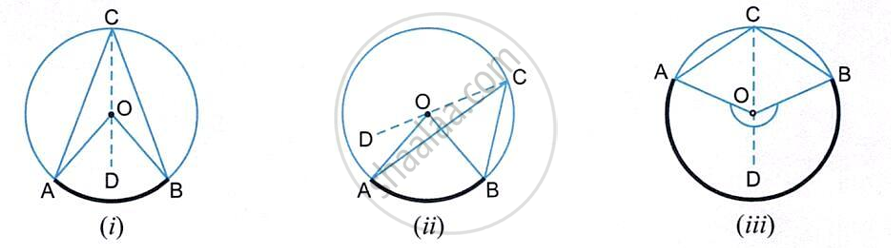
Result:
∠AOB = 2∠ACB
Short Proof (Idea):
-
Join the centre to the points on the circle.
-
Radii form isosceles triangles.
-
Angle at centre = sum of angles at the circle.
-
Hence, the angle at the centre is double the angle at the circle.
Statement:
If an arc of a circle subtends a right angle at any point on the remaining part of the circle, then the arc is a semicircle.
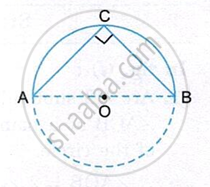
Result:
Arc AB is a semicircle
(or AB is a diameter)
Short Proof (Idea):
-
Given angle at the circle ∠ACB = 90°.
-
The angle at the centre is double the angle at the circle.
-
Therefore, ∠AOB = 2 × 90° = 180°.
-
Hence, A, O, and B lie on a straight line, so AB is a diameter.
-
Therefore, arc AB is a semicircle.
Key Points
-
Diameter → Longest chord of a circle
-
Perpendicular from centre to a chord → Bisects the chord
-
Line joining centre to midpoint of a chord → Perpendicular to the chord
-
The greater the chord → Nearer to the centre
-
The smaller the chord, → farther from the centre
-
Equal chords → Equidistant from the centre
-
Chords equidistant from centre → Equal in length
-
Only one circle passes through three non-collinear points
-
Arc Definition: An arc is a curved portion of a circle's circumference between two points.
-
Two Types: Minor arc (< 180°) and Major arc (> 180°).
-
Semicircle: When the arc angle is exactly 180°, it's called a semicircle.
-
Complete Circle: Minor arc + Major arc = 360° (complete circumference).
Definition: A segment is a region of a circle bounded by a chord and its arc
Two Main Types:
-
Minor Segment = smaller piece
-
Major Segment = larger piece
Semicircle Special Case:
-
Formed when chord = diameter
-
Creates two perfectly equal segments
-
Each semicircle = half the circle's area
