Definitions [1]
Area of a circle: The area of a circle is the region occupied by the circle in a two-dimensional plane.
Formulae [5]
Area of parallelogram = base x height
- Area of a rhombus = `1/2` x product of lengths of diagonals.
Area of the trapezium = `1/2` × sum of the lengths of parallel sides × height.
Area of triangle = `(1/2) × "base" × "height" = 1/2 × b × h`.
Area of the circle = πr2
Theorems and Laws [10]
Prove that the points A(a, 0), B(0, b) and C(1, 1) are collinear, if `(1/a + 1/b) = 1`.
Consider the points A (a,0), B( 0,b) and C (1,1) .
` Here (x_1=a,y_1=0).(x_2 = 0,y_2=b) and (x_3=1,y_3=1).`
It is given that the points are collinear. So,
`x_1 (y_2-y_3)+x_2(y_3-y_1) +x_3(y_1-y_2) =0`
`⇒ a(b-1)+0(1-0)+1(0-b)=0`
`⇒ ab-a-b=0`
Dividing the equation by ab:
`⇒ 1-1/b-1/a=0`
`⇒ 1-(1/a+1/b)=0`
`⇒(1/a+1/b)=1`
Therefore, the given points are collinear if `(1/a+1/b)=1`
Prove that (2, –2) (–2, 1) and (5, 2) are the vertices of a right-angled triangle. Find the area of the triangle and the length of the hypotenuse.
The distance d between two points `(x_1, y_1)` and `(x_2, y_2)` is given by the formula
`d = sqrt((x_1 - x_2)^2 + (y_1- y_2)^2)`
In a right-angled triangle, by Pythagoras theorem, the square of the longest side is equal to the sum of squares of the other two sides in the triangle.
Here the three points are A(2, −2), B(−2, 1) and C(5, 2).
Let us find out the lengths of all the sides of the triangle.
`AB = sqrt((2 + 2)^2 + (-2-1)^2)`
`= sqrt((4)^2 + (-3)^2)`
`= sqrt(16 + 9)`
`AB = sqrt25`
`BC = sqrt((-2-5)^2 + (1 - 2)^2)`
`= sqrt((-3)^2 + (-4)^2)`
`= sqrt(9 + 16)`
`AC = sqrt(25)`
Here we have
`BC^2 = AB^2 + AC^2`
50 = 25 + 25
Since the square of the longest side is equal to the sum of squares of the other two sides the given triangle is a right-angled triangle.
In a right-angled triangle, the area of the triangle ‘A’ is given by,
A = `1/2` (Product of both the sides containing the right angle)
In a right-angled triangle, the sides containing the right angle will not be the longest side.
Hence the area of the given right-angled triangle is,
`A = ((sqrt(25))(sqrt(25)))/2`
= `25/5`
A = 12.5
Hence the area of the given right-angled triangle is 12.5 square units.
In a right-angled triangle, the hypotenuse will be the longest side. Here the longest side is 'BC'.
Hence the hypotenuse of the given right-angled triangle is `5sqrt2` units.
If a ≠ b ≠ c, prove that the points (a, a2), (b, b2), (c, c2) can never be collinear.
GIVEN: If `a≠ b≠ c`
TO PROVE: that the points (a, a2), (b, b2), (c, c2), can never be collinear.
PROOF:
We know three points (x1, y1), (x2, y2) and (x3, y3) are collinear when
`1/2[x_1(y_2-y_3)+x_2(y_3-y_1)+x_3(y_1-y_2)]=0`
Now taking three point (a, a2), (b, b2), (c, c2),
Area `=1/2[a(b^2-c^2)+b(c^2-a^2)+c(a^2-b^2)`
`=1/2[ab^2-ac^2+bc^2+ba^2+ca^2+cb^2]`
`=1/2[(a^2c-a^2b)+(ab2-ac^2)+(bc2-b^2c)]`
`=1/2[-a^2(b-c))+(a(b^2-c^2))-(bc(b-c))]`
`=1/2[(b-c)(-a^2)+(a(b+c))-bc]`
`=1/2[(b-c)(-a^2)+ab+ac-bc]`
`=1/2[(b-c)(-a)(a-b)+c(a-b)]`
`=1/2(b-c)(a-b)(c-a)`
Also it is given that
a ≠ b ≠ c
Hence area of triangle made by these points is never zero. Hence given points are never collinear.
Prove that the points A(7, 10), B(–2, 5) and C(3, –4) are the vertices of an isosceles right triangle.
The given points are A (7, 10), B(-2, 5) and C(3, -4).
`AB= sqrt((-2-7)^2 +(5-10)^2) = sqrt((-9)^2 +(-5)^2) = sqrt((81+25)) = sqrt(106)`
`BC = sqrt((3-(-2))^2 +(-4-5)^2) = sqrt((5)^2 +(-9)^2 )= sqrt((25+81) )= sqrt(106)`
`AC = sqrt((3-7)^2 +(-4-10)^2) = sqrt(( -4)^2 +(-14)^2) = sqrt(16+196) = sqrt(212)`
Since, AB and BC are equal, they form the vertices of an isosceles triangle
Also,`(AB)^2 + (BC)^2 = ( sqrt(106))^2 +( sqrt(106)^2) = 212`
and `(AC)^2 = (sqrt(212))^2 = 212.
`Thus , (AB)^2 + (BC)^2 = (AC)^2`
This show that ΔABC is right- angled at B. Therefore, the pointsA (7, 10), B(-2, 5) and C(3, -4). are the vertices of an isosceles rightangled triangle.
Prove that the points A(2, 4), B(2, 6) and `C(2 + sqrt(3), 5)` are the vertices of an equilateral triangle.
The given points are A(2, 4), B(2, 6) and C(2 +`sqrt(3)`,5) Now
`AB =sqrt(((2-2)^2 +(4-6)^2 )) = sqrt((0)^2 +(-2)^2)`
`= sqrt((0+4) =2`
`BC = sqrt((2-2- sqrt(3))^2 + (6-5)^2 ) = sqrt((- sqrt(3))^2 +(1)^2)`
`= sqrt(3+1) = 2`
`AC = sqrt((2-2-sqrt(3))^2 + (4-5)^2 ) = sqrt((- sqrt(3))^2 +(-1)^2)`
`= sqrt(3+1) =2`
Hence, the points A(2, 4), B(2, 6) and C(2 +`sqrt(3)`,5) are the vertices of an equilateral triangle
A(7, –3), B(5, 3) and C(3, –1) are the vertices of a ΔABC and AD is its median. Prove that the median AD divides ΔABC into two triangles of equal areas.
The vertices of the triangle are A(7, -3), B(5,3) and C(3,-1)
`"Coordinates of" D = ((5+3)/2,(3-1)/2) = (4,1)`
For the area of the triangle ADC, let
`A (x_1,y_1)=A(7,-3), D(x_2,y_2) =D(4,1) and C (x_3,y_3) = C(3,-1)`. Then
`"Area of" Δ ADC = 1/2 [ x_1(y_2-y_3)+x_2(y_3-y_1)+x_3(y_1-y_2)]`
`=1/2 [7(1+1)+4(-1+3)+3(-3-1)]`
`=1/2[14+8-12}=5` sq. unit
Now, for the area of triangle ABD, let
`A(x_1,y_1) = A(7,-3), B(x_2,y_2) = B(5,3) and D (x_3,y_3) = D (4,1). `Then
`"Area of" Δ ADC = 1/2 [ x_1(y_2-y_3)+x_2(y_3-y_1)+x_3(y_1-y_2)]`
`=1/2 [7(3-1)+5(1+3)+4(-3-3)]`
`=1/2[14+20-24] = 5` sq. unit
Thus, Area (ΔADC) = Area (ΔABD) = 5. sq units
Hence, AD divides ΔABC into two triangles of equal areas.
Prove that the points (2, 3), (-4, -6) and `(1, 3/2)` do not form a triangle.
The distance d between two points `(x_1,y_1)` and `(x_2,y_2)` is given by the formula
`d = sqrt((x_1 - x_2)^2 + (y_1 - y_2)^2)`
In any triangle the sum of lengths of any two sides need to be greater than the third side.
Here the three points are A(2, 3), B(-4, -6) and C`(1, 3/2)`
Let us now find out the lengths of all the three sides of the given triangle.
`AB = sqrt((2 + 4)^2 + (3 + 6)^2)`
`= sqrt((6)^2 + (9)^2)`
`= sqrt(36 + 81)`
`AB = sqrt(117)`
`BC = sqrt((-4 -1)^2 + (-6 - 3/2)^2)`
`= sqrt((-5)^2 + ((-15)/2)^2)`
`= sqrt(25 + 225/4)`
`BC = sqrt(81.24)`
`AC = sqrt((2 - 1)^2 + (3 - 3/2)^2)`
` = sqrt((1)^2 + (3/2)^2)`
`= sqrt(1 + 9/4)`
`AC = sqrt(3.25)`
Here we see that, BC + AC not greater than AB
This is in violation of the basic property of any triangle to exist. Therefore these points cannot give rise to a triangle.
Hence we have proved that the given three points do not form a triangle.
Figure, shows a sector of a circle, centre O, containing an angle θ°. Prove that perimeter of the shaded region is `r(tan θ + sec θ + (πtheta)/180^circ - 1)`.

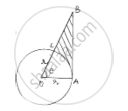
Given angle subtended at centre of circle = 𝜃
∠OAB = 90° [At joint of contact, tangent is perpendicular to radius]
OAB is right angle triangle
Cos 𝜃 =`(adj.side)/(hypotenuse) =r/OB`⇒ 𝑂𝐵 = 𝑟 sec 𝜃 … … (𝑖)
tan 𝜃 =`(opp.side)/(adju.side)=AB/r`⇒ 𝐴𝐵 = 𝑟 tan 𝜃 … … . (𝑖𝑖)
Perimeter of shaded region = AB + BC + (CA arc)
= 𝑟 tan 𝜃 + (𝑂𝐵 − 𝑂𝐶) +`theta/360^@`× 2𝜋𝑟
= 𝑟 tan 𝜃 + 𝑟 sec 𝜃 − 𝑟 +`(pithetar)/180^@`
= 𝑟 (tan 𝜃 + sec 𝜃 +`(pitheta)/180^@`− 1)
Figure, shows a sector of a circle, centre O, containing an angle 𝜃°. Prove that area of the shaded region is `r^2/2(tanθ - (πθ)/180^circ)`.

Given angle subtended at centre of circle = 𝜃
∠OAB = 90° [At joint of contact, tangent is perpendicular to radius]
OAB is right angle triangle
Cos 𝜃 =`(adj.side)/(hypotenuse) =r/OB`⇒ 𝑂𝐵 = 𝑟 sec 𝜃 … … (𝑖)
tan 𝜃 =`(opp.side)/(adju.side)=AB/r`⇒ 𝐴𝐵 = 𝑟 tan 𝜃 … … . (𝑖𝑖)
Area of shaded region = (area of triangle) – (area of sector)
`= (1/2× OA × AB) −theta/360^@× pir^2`
`=1/2× r × r tan theta −r^2/2[theta/180^@× pi]`
=`r^2/2[tantheta −(pitheta)/180^@]`
If three circles of radius a each, are drawn such that each touches the other two, prove that the area included between them is equal to `4/25 a^2`. [Take `sqrt(3) = 1.73` and π = 3.14.]

When three circles touch each other, their centres form an equilateral triangle, with each side being 2a.
Area of the triangle`=sqrt(3)/4xx2"a"xx2"a" = sqrt(3)"a"^2`
Total area of the three sectors of circles `=3xx60/360xx22/7xx"a"^2 = 1/2xx22/7 "a"^2 = 11/7"a" ^2`
Area of the region between the circles = Area of the triangle - Area of three sectors
`=(sqrt(3)-11/7)"a"^2`
= (1.73 - 1.57)a2
= 0.16 a2
= 0.16 a2
`=4/25"a"^2 `
Concepts [7]
- Area of a Parallelogram
- Area of a Rhombus
- Area of Trapezium
- Area of a Triangle
- Area of Figures Having Irregular Shape
- Circumference of a Circle
- Area of Circle
