Definitions [53]
A state of matter that has a definite volume, takes the shape of its container, and is generally considered to be incompressible (volume does not change significantly under pressure) is called a liquid.
A substance which begins to flow when external force is applied on it is called a fluid. (Liquids and gases are fluids.)
The normal force (or thrust) exerted by a liquid at rest per unit area of the surface in contact with it is called pressure of liquid or hydrostatic pressure.
The measure of a fluid's resistance to flow is called viscosity.
A state of matter that does not have a definite shape or definite volume, occupies the entire space of the container it is in, and is highly compressible is called a gas.
The pressure exerted by the atmosphere on the earth's surface is called atmospheric pressure.
The difference between the absolute pressure and the atmospheric pressure at a point in a liquid is called gauge pressure.
The total pressure exerted by a fluid, which includes both the atmospheric pressure as well as any other additional pressure due to the fluid itself, is called absolute pressure.
The phenomenon in which the liquid pressure at a point is independent of the quantity of liquid and depends only upon the depth of the point below the liquid surface is called hydrostatic paradox.
The gaseous envelope surrounding the earth is called the earth's atmosphere.
Define one atmosphere.
The pressure exerted by this mercury column is considered as the pressure of magnitude ‘one atmosphere’ (1 atm).
The force exerted by the air column on unit cross-sectional area at sea level (= 1.01 × 10⁵ Pa = 1.01 bar) is called atmospheric pressure.
Define Low pressure.
A low-pressure area is an area in the atmosphere where the pressure is lower than its surrounding areas. In this situation, the wind from the surroundings blows towards the center of low pressure.
Define High pressure
High pressure is an area of the atmosphere where the barometric pressure is higher than its surrounding areas. In this case, the wind from the center of high pressure blows towards the surrounding low-pressure areas.
Define the SI unit of pressure.
SI unit of pressure is the pascal (Pa) or Nm−2
One Pascal: When a force of one newton acts normally on an area of one square metre (1 m2) then the pressure acting on the surface acting on the surface is called one Pascal.
The instruments used to measure pressure are called pressure meters or pressure gauges or vacuum gauges.
An instrument that utilises Pascal's Law and the height of a mercury column to measure pressure difference, and gives gauge pressure, is called an open tube manometer.
An instrument invented by Torricelli in which the level of mercury in a glass tube gives the pressure is called a mercury barometer.
Define the surface tension of a liquid.
Surface tension is defined as the force acting on a unit length of an imaginary line drawn on the free surface of the liquid, the direction of the force being perpendicular to the line so drawn and acting parallel to the surface.
Define angle of contact.
When a liquid is in contact with a solid, the angle between the tangent drawn to the free surface of the liquid and the surface of solid at the point of contact measured inside the liquid is called the angle of contact.
Define surface tension.
Surface tension is defined as the force per unit length acting at right angles to an imaginary line drawn on the free surface of the liquid.
Define the angle of contact for a given pair of solid and liquid.
The angle between tangents drawn at the point of contact to the liquid surface and the solid surface inside the liquid is called the angle of contact for a pair of solid and liquid. It is denoted by θ.
Define the sphere of influence.
The sphere of influence of a molecule is defined as an imaginary sphere with the molecule at its centre and a radius equal to the range of molecular attraction.
The work per unit area done by the force that creates a new surface is called surface energy.
OR
The energy required to increase the surface area of a liquid is called surface energy.
A thin film of liquid near its surface having thickness equal to the molecular range of attraction is called surface film.
The property of a liquid due to which its free surface tries to have minimum surface area and behaves as if it were under tension somewhat like a stretched elastic membrane is called surface tension.
OR
The force acting along the surface of a liquid per unit length is called surface tension.
An imaginary sphere drawn round a molecule (taken as centre) with a radius equal to the range of molecular attraction is called the sphere of influence of that molecule.
Define the surface energy of the liquid.
The potential energy is greater for molecules at the surface film as compared to molecules well inside the liquid. This extra energy of the molecule on the surface layer of a liquid is called the surface energy of the liquid.
The difference of pressure between the two sides of a liquid surface, which arises in equilibrium because the pressure inside a bubble or drop is greater than outside, is called excess pressure.
When adhesive forces are stronger than cohesive forces, the curved liquid surface formed when the liquid is in contact with a solid is called a concave meniscus.
When cohesive forces are stronger than adhesive forces (e.g., mercury in glass), the curved liquid surface formed where cos θ is negative and the liquid level is lower is called a convex meniscus.
The angle between the surface of the solid and the tangent drawn to the surface of the liquid at the point of contact on the side of liquid is called the angle of contact of that liquid with that solid.
OR
The angle enclosed between the tangents to the liquid surface and the solid surface inside the liquid, both the tangents being drawn at the point of contact of the liquid with the solid, is called the angle of contact.
The difference of pressure between the two sides of a liquid surface (inside and outside a drop or bubble) due to the property of surface tension, which tends to contract the drop or bubble and compress the matter enclosed, is called Excess Pressure.
A tube with a hole of very small diameter is called a capillary tube or capillary.
The rise or fall of level of liquid in a capillary tube is called capillary action or capillarity.
The phenomenon where a liquid in a capillary tube either ascends or descends relative to the surrounding liquid when a tube of very narrow bore is dipped in it is called capillarity.
The phenomenon in which a liquid rises in a capillary tube when the angle of contact is acute, or falls when the angle of contact is obtuse, due to the interplay of pressure caused by the liquid column and pressure difference due to surface tension, is called capillary ascent (or descent).
The vertical height attained by a liquid in a capillary tube at equilibrium, which is independent of the shape of the capillary provided the radius of meniscus remains the same, is called the capillary rise height (h).
If a liquid is flowing over a horizontal surface with a steady flow and moves in the form of layers of different velocities which do not mix with each other, then the flow of liquid is called laminar flow.
The path, straight or curved, the tangent to which at any point gives the direction of the flow of liquid at that point is called a streamline.
That flow of a liquid in which each element of the liquid passing through a point travels along the same path and with the same velocity as the preceding element passes through that point is called streamline flow.
When a liquid moves with a velocity greater than its critical velocity, the motion of the particles of liquid becomes disordered or irregular. Such a flow is called turbulent flow.
The velocity of liquid flow up to which its flow is streamlined and above which its flow becomes turbulent is called critical velocity.
A pure number which determines the nature of flow of liquid through a pipe, defined as the ratio of the inertial force per unit area to the viscous force per unit area for a flowing fluid, is called Reynold's number.
The viscous force acting per unit area between two layers of liquid moving with unit velocity gradient is called the coefficient of viscosity (η).
The maximum limit of velocity of a body falling in a viscous fluid, at which the net force acting on the body becomes zero, is called terminal velocity.
The constant maximum velocity acquired by a body while falling through a viscous fluid is called terminal velocity.
A function f(x) is said to be discontinuous at x = a if it is not continuous at x = a, i.e.
- \[\lim_{x\to a}f\left(a\right)\] does not exist.
- The left-hand limit and the right-hand limit are not equal.
- \[\lim_{x\to a}f\left(x\right)\neq f\left(a\right)\].
Removable Discontinuity:
If \[\lim_{x\to a^{-}}f\left(x\right)=\lim_{x\to a^{+}}f\left(x\right)\neq f\left(a\right),\] then f(x) is said to be removable discontinuous.
Non Removable Discontinuity:
If \[\lim_{x\to a^{+}}f\left(x\right)\neq\lim_{x\to a^{-}}f\left(x\right),\] then f(x) is said to be non-removable discontinuous.
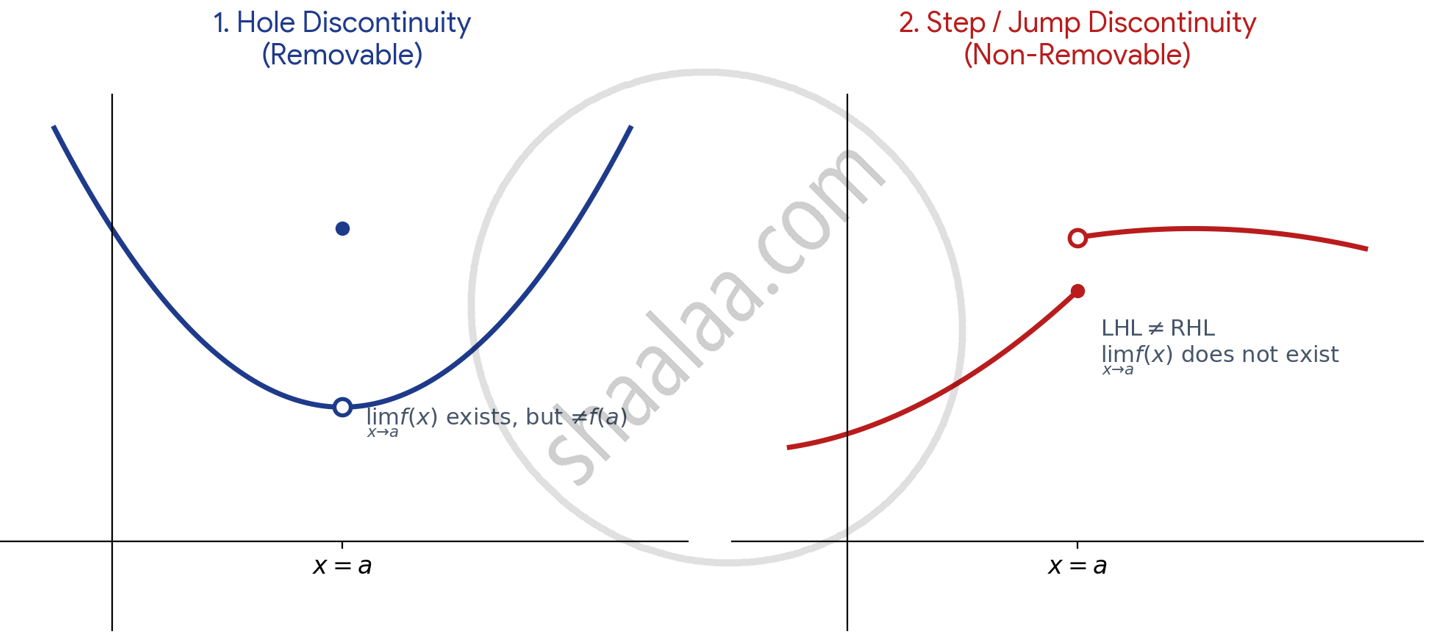
A real function \[f\] is said to be a continuous function if it is continuous at every point in its domain.
\[ \boxed{\lim_{x \to c} f(x) = f(c)} \] for every \[c\] in the domain of \[f\].
Continuity at End Points
If \[f\] is defined on a closed interval \[[a, b]\]:
At the left endpoint \[a\], \[ \boxed{\lim_{x \to a^+} f(x) = f(a)} \]
At the right endpoint \[b\], \[ \boxed{\lim_{x \to b^-} f(x) = f(b)} \]
Only the appropriate one-sided limit is considered at an endpoint.
A real-valued function \[f\] is said to be continuous at \[x = c\] if
\[ \boxed{\lim_{x \to c} f(x) = f(c)} \]
In terms of one-sided limits,
\[ \boxed{\lim_{x \to c^-} f(x) = \lim_{x \to c^+} f(x) = f(c)} \]
Thus, for continuity at \[x = c\]:
- \[f(c)\] must be defined.
- Left-hand limit must exist.
- Right-hand limit must exist.
- Both limits must be equal to \[f(c)\]
If any of these conditions fails, \[f\] is discontinuous at \[x = c\].
The resultant of all the forces exerted by a fluid on a body partly or wholly dipped in it, due to hydrostatic pressure, is called upthrust or buoyancy.
Formulae [14]
1 atm = 1.01 × 10⁵ Pa = 1.01 bar = 760 torr
Pgauge = Pabsolute − Patmospheric
| Surface | Excess Pressure |
|---|---|
| Plane surface | Δp = 0 |
| Convex surface | Δp = \[\frac {2T}{R}\] |
| Drop | Δp = \[\frac {2T}{R}\] |
| Bubble in liquid | Δp = \[\frac {2T}{R}\] |
| Bubble in air | Δp = \[\frac {4T}{R}\] |
| Bubble at depth h (density d) | Δp = \[\frac {2T}{R}\] + hdg |
| Cylindrical liquid surface | Δp = \[\frac {T}{R}\] |
Case 1: θ < 90° (Concave Meniscus)
Case 2: θ = 90° (Plane/Horizontal Meniscus)
ΔP = \[\frac {2T}{R}\] (only one liquid surface)
ΔP = 0 (no curvature, no excess pressure)
For a convex or concave surface and a liquid drop: ΔP = \[\frac {2T}{R}\] (one liquid surface)
ΔP = \[\frac {4T}{R}\] (two liquid surfaces — inner and outer)
For a drop on a solid surface: cosθ = \[\frac {T_2-T_1}{T_3}\],
where T1 = solid-liquid,
T2 = solid-air,
T3 = liquid-air surface tension
For two different liquids in the same tube:
\[\frac{h_1}{h_2}=\frac{\rho_2T_1}{\rho_1T_2}\]
For the same liquid in tubes of different radii:
h1r1 = h2r2
Principle: Pressure due to liquid column = Pressure difference due to surface tension
h = \[\frac {2T}{Rdg}\] = \[\frac {2T cos θ}{rdg}\]
where r = radius of capillary tube and θ = angle of contact.
\[R_n=\frac{v_c\rho D}{\eta}\]
where:
- vc = critical velocity of the liquid
- ρ = density of the liquid
- D = diameter of the pipe
- η = coefficient of viscosity of the liquid
\[v_t=\frac{2r^2(\rho-\sigma)g}{9\eta}\]
Where,
r = radius of sphere
ρ = density of sphere
σ = density of liquid
η = coefficient of viscosity
v = \[\frac{2}{9}\cdot\frac{r^2(\rho-\sigma)g}{\eta}\]
where:
- v = terminal velocity
- r = radius of the body
- ρ = density of the body
- σ = density of the fluid
- g = acceleration due to gravity
- η = coefficient of viscosity of the fluid
Theorems and Laws [8]
"In a liquid at the same level, the pressure will be the same at all points. If not, then due to pressure difference, the liquid cannot be at rest."
Statement: Pascal's Law states that when pressure is applied to a confined (enclosed) fluid, it is transmitted undiminished and equally in all directions throughout the fluid and to the walls of its container.
Mathematical Expression:
Key Points:
- Pressure changes by the same value at every point inside an incompressible, confined liquid.
- Used in hydraulic machines where a small force on a small area produces a large force on a large area.
- Applications: Hydraulic lift, hydraulic brake, hydraulic press, hydraulic jack.
Prove that, equivalent S.I. unit of surface tension is J/m2.
T = `F/L`
where F = Force (N), L = Length (m)
= SI unit of T = `N/m`
Surface tension can also be written as
T = `W/A`
where W = Work (J), A = Area (m2)
= SI unit of T = `J/m^2`
We know
1J=1N×1m
So,
`J/m^2 = (N * m)/m^2 = N/m`
Both units are the same
`1N/m equiv 1J/m^2`
The viscous drag force on a spherical body moving through a viscous fluid is used to calculate the coefficient of viscosity. Terminal velocity is reached when the gravitational force equals the viscous drag force.
Statement:
"The viscous force Fᵥ acting on a small sphere falling through a viscous medium is directly proportional to the radius of the sphere r, its velocity (v) through the fluid, and the coefficient of viscosity (η) of the fluid."
Formula:
where:
- F = viscous force
- η = coefficient of viscosity of the fluid
- r = radius of the sphere
- v = velocity of the sphere through the fluid
A solid sphere moves at a terminal velocity of 20 m s−1 in air at a place where g = 9.8 m s−2. The sphere is taken in a gravity-free hall having air at the same pressure and pushed down at a speed of 20 m s−1.
(a) Its initial acceleration will be 9.8 m s−2 downward.
(b) It initial acceleration will be 9.8 m s−2 upward.
(c) The magnitude of acceleration will decrease as the time passes.
(d) It will eventually stop
(b) There is no gravitational force acting downwards. However, when the starting velocity is 20 m/s, the viscous force, which is directly proportional to velocity, becomes maximum and tends to accelerate the ball upwards.
\[\text{ When the ball falls under gravity, }\]
\[\text{ neglecting the density of air: } \]
\[\text{ Mass of the sphere = m }\]
\[\text{ Radius = r }\]
\[\text{ Viscous drag coeff . }= \eta\]
\[\text{Terminal velocity is given by}: \]
\[\text{ mg }= 6\pi\eta r v_T \]
\[ \Rightarrow \frac{6\pi\eta r v_T}{m} = g . . . (1)\]
\[\text{ Now, at terminal velocity, the acceleration of the ball due to the viscous force is given by: } \]
\[a = \frac{6\pi\eta r v_T}{m}\]
\[\text{ Comparing equations (1) and (2), we find that : } \]
\[ \text{ a = g }\]
Thus, we see that the initial acceleration of the ball will be 9.8 ms - 2 .
(c) The velocity of the ball will decrease with time because of the upward viscous drag. As the force of viscosity is directly proportional to the velocity of the ball, the acceleration due to the viscous force will also decrease.
(d) When all the kinetic energy of the ball is radiated as heat due to the viscous force, the ball comes to rest.
Statement:
"According to this theorem, the total energy (pressure energy, potential energy and kinetic energy) per unit volume or mass of an incompressible and non-viscous fluid in steady flow through a pipe remains constant throughout the flow, provided there is no source or sink of the fluid along the length of the pipe."
Mathematical Form:
For unit volume of liquid flowing through a pipe:
\[P+\rho gh+\frac{1}{2}\rho v^2\] = constant
where:
- P = pressure energy per unit volume
- ρ = density of the fluid
- g = acceleration due to gravity
- h = height of the fluid (potential energy term)
- v = velocity of the fluid (kinetic energy term)
Applications of Bernoulli's Theorem:
- Speed of efflux
- Venturi tube
- Lifting up of aeroplane
- Working of an atomizer
- Blowing off of roofs by stormy wind
"When a body is partly or wholly dipped in a fluid, the fluid exerts a force on the body due to hydrostatic pressure. At any small portion of the surface of the body, the force exerted by the fluid is perpendicular to the surface and is equal to the pressure at that point multiplied by the area. The resultant of all these constant forces is called upthrust or buoyancy."
Key Points
- Pressure exerted by a liquid column depends on height and density of the liquid column.
- It is independent of the shape of the containing vessel or total mass of the liquid.
- Atmospheric pressure is maximum at the surface of the earth and decreases as we move up into the atmosphere.
- Hydraulic Press — Two cylinders (C & D) filled with liquid; small force applied on piston P₁ (smaller area A₁) is converted into a very large upward force on piston P₂ (larger area A₂), since A₂ > A₁.
- Hydraulic Lift — Works on Pascal's Law to lift or support heavy objects such as cars and trucks using liquid pressure.
- Hydraulic Brakes — Small force on the brake pedal is instantly transmitted equally through brake fluid to all cylinders, producing a large thrust on the wheels to stop the vehicle.
| Instrument | Working Principle | What It Measures |
|---|---|---|
| Mercury Barometer | Level of mercury in a glass tube | Atmospheric pressure (Torricelli's vacuum) |
| Pressure Gauges & Meters | Indirect method — bending of material or change in capacitance | Any pressure (more accurate) |
| Open Tube Manometer | Pascal's Law + height of mercury column | Pressure difference (gives gauge pressure) |
- A highly soluble impurity increases surface tension, while a partially soluble impurity (e.g., detergent) decreases it; a waterproofing agent increases it.
- Surface tension decreases with increase in temperature, given by T = T0(1 − αθ), where T0 is surface tension at 0°C and α is the temperature coefficient.
- When a soap bubble is charged (positively or negatively), force acts outward on the surface, increasing its radius — thus electrification always decreases surface tension.
- Surface tension depends only on the nature of liquid and is independent of area of surface or length of line considered.
- Surface tension of a liquid decreases with rise of temperature; it is zero at boiling point and vanishes at critical temperature.
- Due to surface tension, a drop or bubble tends to contract, which increases internal pressure — this difference between inside and outside pressure is called excess pressure.
- For a drop and bubble in liquid: Δp = \[\frac {2T}{R}\]; for a bubble in air: Δp = \[\frac {4T}{R}\](two free surfaces).
- When T₂ > T₁, cos θ is +ve, angle is acute — liquid partially wets the solid. (e.g., Kerosene on glass)
- When T₂ < T₁, cos θ is −ve, angle is obtuse — liquid does not wet the solid. (e.g., Mercury on glass)
- When T₂ − T₁ = T₃, cos θ = 1, θ = 0° — liquid completely wets and spreads over the solid. (e.g., Pure water on clean glass)
- When T₂ − T₁ > T₃, cos θ > 1, which is impossible — no drop forms, liquid simply spreads; equilibrium is not possible.
| Type of Flow | Key Characteristic |
|---|---|
| Streamline Flow | Each element follows same path with same velocity as the preceding element |
| Laminar Flow | Liquid moves in layers of different velocities; layers do not mix |
| Turbulent Flow | Occurs when velocity exceeds critical velocity; motion becomes disordered/irregular |
- Continuity at \[x = c\]: \[ \boxed{\lim_{x \to c} f(x) = f(c)} \]
- Practical test: \[ \boxed{\text{LHL} = \text{RHL} = f(c)} \]
If this condition fails, the function is discontinuous at \[c\]. - A function is continuous if it is continuous at every point in its domain.
- Constant, identity and polynomial functions are continuous on their domains.
- \[\dfrac{1}{x}\] is continuous for \[x \neq 0\].
- For a piecewise function, check continuity particularly at the point where the rule changes.
- The greatest integer function \[[x]\] is discontinuous at every integer.
Air flows faster over the curved upper surface of the wing (v large, P small) and slower below (v small, P large). This pressure difference generates an upward lift force on the wing.
Concepts [34]
- Fluid and Its Properties
- Pressure of liquid
- Pressure Due to a Liquid Column
- Atmospheric Pressure
- Absolute Pressure and Gouge Pressure
- Hydrostatic Paradox
- Pascal’s Law
- Applications of Pascal's Law > Hydraulic lift
- Applications of Pascal's Law > Hydraulic Brakes
- Pressure Measurement
- Mercury Barometer (Simple Barometer)
- Open Tube Manometer
- Surface Tension
- Molecular Theory of Surface Tension
- Surface Tension and Surface Energy
- Angle of Contact
- Effect of Impurity and Temperature on Surface Tension
- Excess Pressure Across the Free Surface of a Liquid
- Explanation of Formation of Drops and Bubbles
- Capillarity and Capillary Action
- Fluids in Motion
- Critical Velocity and Reynolds Number
- Viscosity
- Coefficient of viscosity
- Stokes’ Law
- Terminal Velocity
- Continuous and Discontinuous Functions
- Bernoulli's Equation
- Applications of Bernoulli's equation > Speed of efflux
- Applications of Bernoulli's Equation > Ventury Tube
- Applications of Bernoulli's Equation > Lifting up of on Aeroplane
- Applications of Bernoulli's Equation > Working of on Atomizer
- Applications of Bernoulli's Equation > Blowing off of Roofs by Stormy Wind
- Archimedes' Principle
