ISC (Commerce)
ISC (Science)
Academic Year: 2024-2025
Date & Time: 24th March 2025, 2:00 pm
Duration: 3h
Advertisements
Instructions to Candidates
- You are allowed an additional fifteen minutes for only reading the question paper.
- You must NOT start writing during the reading time.
- This question paper has 15 printed pages and one blank page.
- It is divided into two parts: Part I and Part II.
- It has 11 questions in all.
- Part 1 is compulsory and has two questions.
- While attempting Multiple Choice Questions in Part I, you are required to write only ONE option as the answer.
- Part II is divided into three sections: A, B and C.
- Each section in Part II has three questions. Any two questions have to be attempted from each section.
- The intended marks for questions are given in brackets [ ].
The complement of the Boolean expression (A • B') + (B' • C) is ______.
(A + B) • (B' + C)
(A' • B) + (B • C')
(A' + B) • (B + C')
(A • B') + (B • C')
Chapter:
Assertion: The expression ~ (X ∨ Y) is logically equivalent to (~X ∧ ~Y)
Reason: The commutative property of logical operators states that the order of the operands does not change the result of a binary operation.
Both Assertion and Reason are true and Reason is the correct explanation for Assertion.
Both Assertion and Reason are true but Reason is not the correct explanation for Assertion.
Assertion is true and Reason is false.
Both Assertion and Reason are false.
Chapter:
According to the Principle of Duality, the Boolean equation (1 + Y) • (X + Y) = Y + X' will be equivalent to ______.
(1 + Y') • (X' + Y') = Y' + X
(0 • Y) + (X • Y) = Y • X'
(0 + Y) • (X + Y) = Y + X'
(1 • Y) + (X • Y) = Y • X'
Chapter:
The Associative Law states that ______.
A • B = B • A
A = B = B + A
A • (B + C) = A • B + A • C
A + (B + C) = (A + B) + C
Chapter:
Consider the following code statement:
public class Person
{ int age;
  public Person (int age)
   {
    this.age = age;
   }
}
Which of the following statements are valid for the given code?
- The keyword this in the constructor refers to the current instance of the class.
- The keyword this differentiates between the instance variable age and the parameter age.
- The keyword this can be used only in constructors.
Only I and II
Only II and III
Only I and III
Only III
Chapter:
Consider the following code statement:
public class Person
{ int age;
  public Person (int age)
   {
    this.age = age;
   }
}
Which of the following statements are valid for the given code?
- The keyword this in the constructor refers to the current instance of the class.
- The keyword this differentiates between the instance variable age and the parameter age.
- The keyword this can be used only in constructors.
Only I and II
Only II and III
Only I and III
Only III
Chapter:
The canonical expression of F(P, Q, R) = π (2, 5, 7) is ______.
(P + Q' + R) • (P' + Q + R') • (P' + Q' + R')
(P • Q' • R) + (P' • Q • R') + (P' • Q' • R')
(P' + Q + R') • (P + Q' + R) • (P + Q + R)
(P' • Q • R') + (P • Q' • R) + (P • Q • R)
Chapter:
P - It is a holiday
Q - It is a Sunday
Assertion: If it is not a Sunday, then it is not a holiday. (Q' ⇒ P')
Reason: Inverse is formed when antecedent and consequent are interchanged.
Both Assertion and Reason are true and Reason is the correct explanation for Assertion.
Both Assertion and Reason are true but Reason is not the correct explanation for Assertion.
Assertion is true and Reason is false.
Both Assertion and Reason are false.
Chapter:
For the given code segment, write Big O notation for worst case complexity.
for (int i=1; i<=P; i++)
 { Statements }
   for (int j=1; j<=P; ++j)
     for (int k=1; k<=Q; k++)
{ Statements }Chapter:
Write the minterms in canonical form for the Boolean Function X (A, B), from the truth table given below:
| A | B | X |
| 0 | 0 | 1 |
| 0 | 1 | 0 |
| 1 | 0 | 0 |
| 1 | 1 | 1 |
Chapter:
Convert the following infix notation to postfix form.
(A − B / C) + (D * E / F) * G
Chapter:
Advertisements
A matrix M[–1...10, 4....13] is stored in the memory with each element requiring 2 bytes of storage. If the base address is 1200, find the address of M[2][7] when the matrix is stored Row Major Wise.
Chapter:
The following function int solve() is a part of some class. Assume ‘m’ and ‘n’ are positive integers. Answer the question given below with dry run/working.
int solve(int m, int n)
  {
    int k=1;
    if(m<0)
      return −k;
    else if(m==0)
      return m;
    else
      return k+(solve(m−n, n+2));
}
What will the function solve() return if:
- m = 16, n = 1
- m = 9, n = 1
Chapter:
The following function int solve() is a part of some class. Assume ‘m’ and ‘n’ are positive integers. Answer the question given below with dry run/working.
int solve(int m, int n)
  {
    int k=1;
    if(m<0)
      return −k;
    else if(m==0)
      return m;
    else
      return k+(solve(m−n, n+2));
}
What is the function solve() performing apart from recursion?
Chapter:
The following function duck () is a part of some class which is used to check if a given number is a duck number or not. There are some places in the code marked by ?1?, ?2?, ?3? which may be replaced by a statement/expression so that the function works properly.
A number is said to be Duck if the digit zero (0) is present in it.
boolean duck(int a)
{ int f=−1;
  if(a==0)
    return true;
  for(int i=a; i!=0;?1?)
{ int c = i%10;
  if(c==?2?)
    { f=1; break; }
}
return (f==?3?)? false:true;
}- What is the expression or statement at ?1? [1]
- What is the expression or statement at ?2? [1]
- What is the expression or statement at ?3? [1]
Chapter:
A superhero is allowed access to a secure Avengers facility if he/she meets any of the following criteria:
- The superhero has Avengers’ membership and possesses a high-security clearance badge
OR - The superhero does not have Avengers membership but holds a special permit issued by S.H.I.E.L.D. along with a high-security clearance badge
OR - The superhero is not a recognised ally but holds a special permit issued by S.H.I.E.L.D. along with a high-security clearance badge
The inputs are:
| INPUTS | |
| A | Superhero has Avengers membership. |
| S | Superhero holds a special permit issued by S.H.I.E.L.D. |
| C | Superhero possesses a high-security clearance badge |
| L | Superhero is a recognised ally |
(In all the above cases, 1 indicates YES and 0 indicates NO)
Output: X - Denotes allowed access [1 indicates YES and 0 indicates NO in all cases]
Draw the truth table for the inputs and outputs given above. Write the POS expression for X (A, S, C, L).
Chapter:
Reduce the above expression X (A, S, C, L) by using 4-variable Karnaugh map, showing the various groups (i.e., octal, quads and pairs). Draw the logic gate diagram using NOR gates only for the reduced expression. Assume that the variables and their complements are available as inputs.
Chapter:
Reduce the Boolean function F(P, Q, R, S) = ∑(0, 1, 2, 5, 7, 8, 9, 10, 13, 15) by using 4-variable Karnaugh map, showing the various groups (i.e., octal, quads and pairs).
Chapter:
Draw the logic gate diagram using NAND gates only for the reduced expression. Assume that the variables and their complements are available as inputs.
Chapter:
From the logic gate diagram given below:
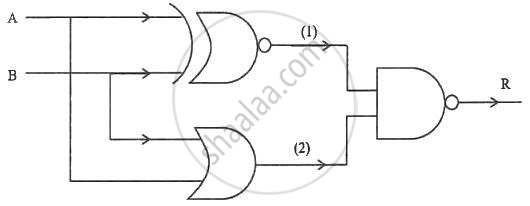
- Derive Boolean expression for (1), (2) and R. Reduce the derived expression. [4]
- Name the logic gate that represents the reduced expression. [1]
Chapter:
Draw the logic gate diagram for an octal to binary encoder.
Chapter:
Advertisements
By using truth table, verify if the following proposition is valid or not.
(~X ⇒ Y) ∧ X = (X ∧ ~Y) ∨ (X ∧ Y)
Chapter:
Study the logic gate diagram given below and answer the questions that follow:

What will be the output of the above gate when:
- A = 1, B = 0 [1]
- A = 1, B = 1 [1]
Chapter:
A class Perni has been defined to accept a positive integer in binary number system from the user and display if it is a Pernicious number or not.
[A pernicious number is a binary number that has minimum of two digits and has prime number of 1’s in it.]
Examples:
- 101 is a pernicious number as the number of 1’s in 101 = 2 and 2 is prime number.
- 10110 is a pernicious number as the number of 1’s in 10110 = 3 and 3 is prime number.
- 1111 is a NOT a pernicious number as the number of 1’s in 1111 = 4 and 4 is NOT a prime number.
The details of the members of the class are given below:
| Class name | Perni |
| Data member/instance varibale: | |
| num: | to store a binary number |
| Methods/Member functions: | |
| Perni( ): | constructor to initialise the data member with 0 |
| void accept( ): | to accept a binary number (containing 0’s and 1’s only) |
| int countOne(int k): | to count and return the number of 1’s in ‘k’ using recursive technique |
| void check( ): | to check whether the given number is a pernicious number by invoking the function countOne( ) and to display an appropriate message |
Specify the class Perni giving the details of the constructor( ), void accept( ), int countOne(int) and void check( ). Define a main( ) function to create an object and call the functions accordingly to enable the task.
Chapter:
Design a class Colsum to check if the sum of elements in each corresponding column of two matrices is equal or not. Assume that the two matrices have the same dimensions.
Example:
Input:
| MATRIX A | MATRIX B | ||||||
| 2 | 3 | 1 | 7 | 4 | 2 | ||
| 7 | 5 | 6 | 1 | 3 | 1 | ||
| 1 | 4 | 2 | 2 | 5 | 6 | ||
Output: Sum of corresponding columns is equal.
The details of the members of the class are given below:
| Class name: | Colsum |
| Data members/instance variables: | |
| mat[] []: | to store the integer array elements |
| m: | to store the number of rows |
| n: | to store the number of columns |
| Member functions/methods: | |
| Colsum(int mm, int nn): | parameterised constructor to initialise the data members m = mm and n = nn |
| void readArray( ): | to accept the elements into the array |
| boolean check(Colsum A, Colsum B): | to check if the sum of elements in each column of the objects A and B is equal and return true otherwise, return false |
| void print( ): | to display the elements into the array |
Specify the class Colsum giving details of the constructor(int, int), void readArray( ), boolean check(Colsum, Colsum), and void print( ). Define the main() function to create objects and call the functions accordingly to enable the task.
Chapter:
A class Flipgram has been defined to flip the letters of the left and right halves of a non-heterogram word. If the word has odd number of characters, then the middle letter remains at its own position.
A heterogram is a word where no letter appears more than once.
Example 1: INPUT : BETTER
OUTPUT: TERBET
Example 2: INPUT : NEVER
OUTPUT: ERVNE
Example 3: INPUT : THAN
OUTPUT: HETEROGRAM
The details of the members of the class are given belwo:
| Class name: | Flipgram |
| Data member/instance variable: | |
| word: | to store a word |
| Methods/member functions: | |
| Flipgram(String s): | parameterised constructor to assign word = s |
| boolean ishetero( ): | to return true if word is a heterogram else return false |
| String flip ( ): | to interchange the left and right sides of a non-heterogram word and return the resultant word |
| void display ( ): | to print the flipped word for a non-heterogram word by invoking the method flip( ). An appropriate message should be printed for a heterogram word |
Specify the class Flipgram giving the details of the constructor(String), boolean ishetero( ), String flip( ) and void display( ). Define a main( ) function to create an object and call the functions accordingly to enable the task.
Chapter:
A circular queue is a linear data structure that allows data insertion at the rear and removal from the front, with the rear end connected to the front end forming a circular arrangement.
The details of the members of the class are given below:
| Class name: | CirQueue |
| Data members/instance variables: | |
| Q[ ]: | array to hold integer values |
| cap: | maximum capacity of the circular queue |
| front: | to point the index of the front |
| rear: | to point the index of the rear |
| Methods/Member functions: | |
| CirQueue(int n): | constructor to initialise cap = n, front = 0 and rear = 0 |
| void pushi(int v): | to add integers from the rear index if possible else display the message "QUEUE IS FULL" |
| int remove( ); | to remove and return the integer from front if any, else return −999 |
| void print( ): | to display the elements of the circular queue in the order of front to rear |
Specify the class CirQueue giving the details of the functions void push(int) and int remove( ). Assume that the other functions have been defined.
The main( ) function and algorithm need NOT be written.
Chapter:
A superclass Flight has been defined to store the details of a flight. Define a subclass Passenger to calculate the fare for a passenger.
The details of the members of both the classes are given below:
| Class name: | Flight |
| Data members/instance variables: | |
| flightno: | to store the flight number in string |
| dep_time: | to store the departure time in string |
| arr_time: | to store the arrival time in string |
| basefare: | to store the base fare in decimal |
| Methods/Member functions: | |
| Flight(...): | parameterised constructor to assign values to the data members |
| void show( ): | to display the flight details |
| Class name | Passenger |
| Data members/instance variables: | |
| id: | to store the ID of the passenger |
| name: | to store the name of the passenger |
| tax: | to store the tax to be paid in decimal |
| tot: | to store the total amount to be paid in decimal |
| Methods/Member functions: | |
| Passenger(...): | parameterised constructor to assign values to the data members of both the classes |
| void cal( ): | to calculate the tax as 5% of base fare and total amount (base fare + tax) |
| void show( ): | to display the flight details along with the passenger details and total amount to be paid |
Assume that the super class Flight has been defined. Using the concepts of Inheritance, specify the class Passenger giving the details of constructor(...), void cal( ) and void show().
The super class, main function and algorithm need NOT be written.
Chapter:
A linked list is formed from the objects of the class Cell. The class structure of the Cell is given below:
class Cell
{
    char m;
    Cell right;
}
Write an Algorithm OR a Method to print the sum of the ASCII values of the lower case alphabets present in the linked list.
The method declaration is as follows:
void lowercase(Cell str)
Chapter:
Answer the following questions based on the Binary Tree given below:
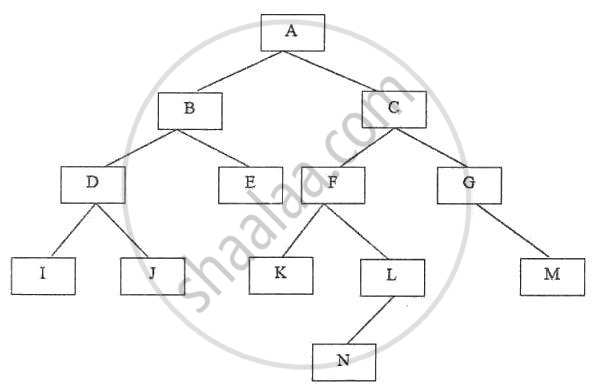
- Write the in-order traversal of the right subtree. [1]
- State the depth of the entire binary tree and depth of node E. [1]
- Name the external nodes of the left subtree and internal nodes of the right subtree. [1]
Chapter:
Other Solutions
Submit Question Paper
Help us maintain new question papers on Shaalaa.com, so we can continue to help studentsonly jpg, png and pdf files
CISCE previous year question papers Class 12 Computer Science (Theory) with solutions 2024 - 2025
Previous year Question paper for CISCE Class 12 -2025 is solved by experts. Solved question papers gives you the chance to check yourself after your mock test.
By referring the question paper Solutions for Computer Science (Theory), you can scale your preparation level and work on your weak areas. It will also help the candidates in developing the time-management skills. Practice makes perfect, and there is no better way to practice than to attempt previous year question paper solutions of CISCE Class 12.
How CISCE Class 12 Question Paper solutions Help Students ?
• Question paper solutions for Computer Science (Theory) will helps students to prepare for exam.
• Question paper with answer will boost students confidence in exam time and also give you an idea About the important questions and topics to be prepared for the board exam.
• For finding solution of question papers no need to refer so multiple sources like textbook or guides.
