(English Medium)
Academic Year: 2024-2025
Date & Time: 12th March 2025, 11:00 am
Duration: 2h
Advertisements
- Answers to this paper must be written on the answer sheet provided separately.
- You will not be allowed to write during the first 15 minutes.
- This time is to be spent in reading the question paper.
- The time given at the head of this Paper is the time allowed for writing the answers.
- Part I is compulsory. All questions from Part I are to be attempted.
- A total of five questions are to be attempted from Part II.
- The intended marks for questions or parts of questions are given in brackets [ ].
To be supplied with this paper: Survey of India Map Sheet No. G43S10 and 20 cm of twine.
Note:
- In all map work, make wise use of arrows to avoid overcrowding of the map.
- The extract of Survey of India Map Sheet No. G43S10 must not be taken out of the examination hall. It must be handed over to the Supervising Examiner on completion of the paper.
- The map given at the end of this question paper must be detached, and after marking, must be fastened to your answer booklet.
- All sub-sections of the questions attempted must be answered in the correct serial order.
- All working including rough work should be done on the same answer sheet which is used to answer the rest of the paper.
Give the six-figure grid reference for spot height .437 in the southeastern part of the map extract.
Chapter:
Aman, a local craftsman, wants to sell his product to a large gathering to earn money instantly.
- Which settlement should he go to?
- Name the month in which he should visit the settlement named by you above.
Chapter:
On which bank of the Sukli nadi is the settlement of Pamera situated?
Chapter:
Identify the settlement pattern seen in the grid square 6732.
Chapter:
Roshan, while travelling from Sirori to Tokra, observed that the surface water sources are dry except for the reservoir near Tokra.
- What according to you may be the reason for the presence of water in the reservoir in 6832 near Tokra settlement?
- State whether this reservoir is artificial or natural source of water.
Chapter:
What is the direct distance between Gulabganj to Pithapura? Give your answer in kilometre.
Chapter:
Mention the compass direction of Pithapura from Gulabganj.
Chapter:
Name two man-made features seen in the grid square 6534.
Chapter:
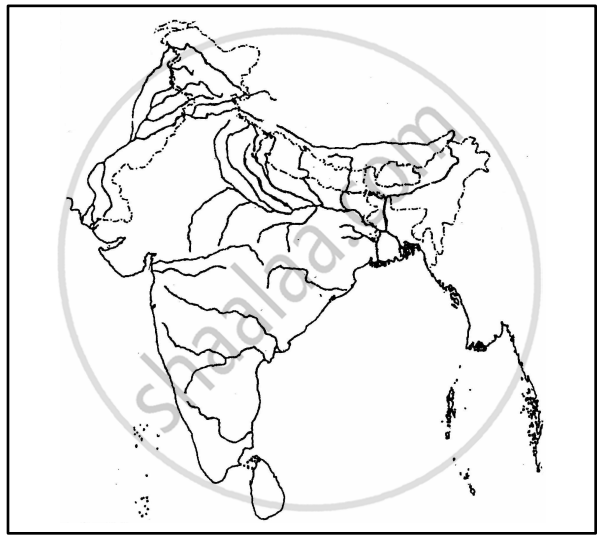
On the outline map of India provided:
- Mark and label the Nathu-La pass. [1]
- Shade and name the coastal plain that occupies a large part of Kerala. [1]
- Mark and label Digboi. [1]
- Mark and label Chilka lake. [1]
- Mark with arrows and name the wind that brings rainfall to Tamil Nadu coast during winter. [1]
- Mark and label the river Sutlej. [1]
- Mark and label the Standard Meridian of India. [1]
- Mark and label Satpura range. [1]
- Shade and label the Chota Nagpur plateau. [1]
- Mark and label Visakhapatnam. [1]
Chapter:
Assertion(A): Mumbai receives more rainfall than Pune.
Reason(R): Mumbai gets rain from Arabian Sea branch of southwest monsoon.
Both (A) and (R) are true and (R) is the correct explanation for (A).
Both (A) and (R) are true and (R) is not the correct explanation for (A).
(A) is true and (R) is false.
(A) is false and (R) is true.
Chapter:
Which of the following pairs of soils displays similar characteristics in terms of their colour and texture?
Alluvial soil and laterite soil
Black soil and red soil
Red soil and laterite soil
Alluvial soil and black soil
Chapter:
The type of natural vegetation shown in the picture given below is found in:
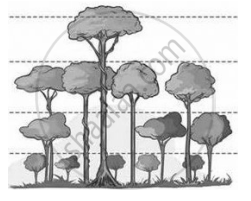
Tropical desert
Tropical deciduous
Tropical evergreen
Littoral forest
Chapter:
Which of the following prevents wastage of water?
Canal
Well
Sprinkler
Tube well
Chapter:
Balaghat : Manganese : : Mumbai High : ______
Copper
Coal
Iron Ore
Petroleum
Chapter:
A microbiological process that loosens the bark of a crop and facilitates removal of fibre from the stalk:
Rolling
Ratooning
Retting
Fermentation
Chapter:
Which industry amongst the following has revolutionised the lifestyle of the Indian masses in recent years?
Cotton Textile
Electronic
Iron and Steel
Sugar
Chapter:
Which of the following household products is associated with the petrochemical industry?
Glass bottle
Wooden chopping board
Kitchen knife
Plastic mug
Chapter:
Raman, a dairy farmer in Ludhiana, supplies milk within the city on a daily basis. Which mode of transport is he most likely to use?
Railway
Roadway
Airway
Waterway
Chapter:
The collection of discarded materials and converting them into useful products is ______.
Recycling
Processing
Reducing
Composting
Chapter:
| ‘Severe cyclonic storms are often formed over the Bay of Bengal during the retreating monsoon season.’ |
- Name two states that are affected by tropical cyclones on the eastern coast of India.
- The temperate cyclones cause less damage than the tropical cyclones. Give any two points to support this statement.
Chapter:
Name the local wind that causes rainfall in the states of Assam and West Bengal in the month of April.
How is this rainfall beneficial for the states mentioned above?
Chapter:
With reference to Figure A and Figure B given below, answer the questions that follow:
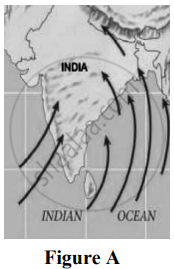
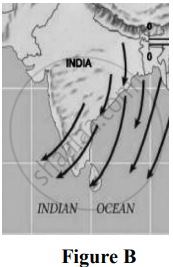
- Name the winds shown by arrows in Figure A and Figure B.
- How is the wind shown in Figure A different from the one shown in Figure B?
Chapter:
Study the climate data of station X and answer the following questions:
| Month | Jan | Feb | Mar | Apr | May | June | July | Aug | Sep | Oct | Nov | Dec |
| Temp (°C) | 24.0 | 25.4 | 26.7 | 28.3 | 30.0 | 28.9 | 27.6 | 27.4 | 27.3 | 27.1 | 27.0 | 25.0 |
| rainfall(cm) | 0.25 | 0.25 | - | - | 1.75 | 50.2 | 61.0 | 37.0 | 27.0 | 4.75 | 1.50 | - |
- What is the annual range of temperature for station X?
- Which is the wettest month?
- Name the wind which brings rainfall for station X during the rainy season.
Chapter:
| The Ganga Plain is known for its fertile soil. It is often referred to as the food bowl of India. This region supports a variety of crops such as rice, wheat, pulses, jute and sugarcane. |
- Name the soil that is found in large parts of Ganga plain.
- Give two properties of this soil which helps it to produce a variety of crops.
Chapter:
Advertisements
Give a geographical reason to explain the following:
Soil conservation is the need of the hour.
Chapter:
Give a geographical reason to explain the following:
Red soil has a poor water retention capacity.
Chapter:
Give a geographical reason to explain the following:
Laterite soils are infertile.
Chapter:
With reference to the black soil of India, answer the following question:
How is this soil formed?
Chapter:
With reference to the black soil of India, answer the following question:
How is this soil able to retain moisture for a long period?
Chapter:
With reference to the black soil of India, answer the following question:
Mention any two minerals present in this soil.
Chapter:
|
India has lost 2.33 million hectares of tree cover since the year 2000. This is equivalent to a six percent decrease in tree cover during this period. Source: The Indian Express, Date: 12.04.2024 |
- Mention any two causes of the decrease in the forest cover of India.
- Name a conservation method that may be used to help in increasing the forest cover.
Chapter:
Mention the climatic condition suitable for the development of tropical evergreen forest.
Chapter:
State any three differences between tropical deciduous and tropical desert vegetation.
Chapter:
Give any two reasons for the great diversity of natural vegetation in India.
Chapter:
How do the forests help in maintenance of air quality?
Chapter:
Mention any three advantages of well irrigation in India.
Chapter:
Suggest any two measures to overcome scarcity of water in the metropolitan cities of India.
Chapter:
Give one reason to explain the following:
Tank irrigation is NOT common in Northern India.
Chapter:
Give one reason to explain the following:
Canal irrigation is important in Punjab.
Chapter:
Give one reason to explain the following:
All farmers do not use tube well irrigation even if the geographical condition is favourable.
Chapter:
Mention two objectives of rainwater harvesting.
Chapter:
|
With the rising price of fossil fuel every passing day, it is very important to develop non-conventional energy resource. – Bulletin – Department of non-conventional sources of energy |
- Name a non-conventional energy source that can be harnessed by taking advantage of India’s vast coastline.
- State one advantage of using geothermal energy.
Chapter:
Mention any one advantage of Biogas over other non-conventional energy resources.
Chapter:
Give a reason for the following.
Iron ore is called a versatile mineral.
Chapter:
Give a reason for the following.
Windmills set up on agricultural lands are beneficial to farmers.
Chapter:
Give a reason for the following.
Coal is the most preferred source of energy in Indian industries.
Chapter:
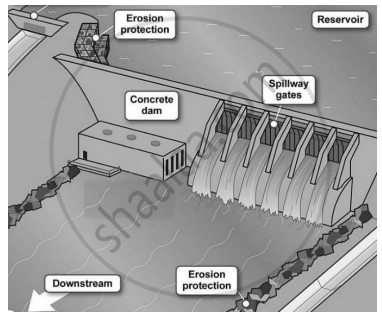
- Identify the type of energy being generated in the picture given above.
- State why this type of energy is cheaper in the long run.
- Name a power project associated with the generation of this energy in the northern part of India.
Chapter:
Advertisements
Mention two climatic conditions that favour the cultivation of groundnut.
Chapter:
Give any two reasons why Maharashtra has emerged as an important sugarcane producing state.
Chapter:
Give one reason to explain the following:
Trees are planted in between the rows of coffee plants.
Chapter:
Give one reason to explain the following:
Cotton cultivation requires plenty of cheap labour.
Chapter:
Give one reason to explain the following:
Hill slopes are best suited for tea cultivation.
Chapter:
State any two factors that are responsible for the growth of the cotton textile industry in Kolkata.
Chapter:
‘Karnataka is the leading state for silk production in India.’
Give any two reasons to justify the above statement.
Chapter:
- Name the Iron and Steel industry located at Chhattisgarh.
- From where does the industry named by you above get its supply of the following?
- Iron ore
- Coal
Chapter:
| Raghav has been given a project by his teacher in which he has to write about the by-products of an industry that is used for preparing shoe polish, carbon paper and cardboard. |
- Which industry will he be writing about?
- Name any two by-products of the industry mentioned by you.
Chapter:
Why is a well-developed transport network important for India?
Chapter:
Name the following:
The mode of transport that ensures comfortable journey, especially for elders and children.
Chapter:
Name the following:
The highway connecting Silchar in Assam to Porbandar in Gujarat.
Chapter:
Name the following:
The cheapest means of transport for bulky goods.
Chapter:
Give a reason for the following.
Airways are the most efficient mode of transport to connect Northeast India with the rest of the country.
Chapter:
Give a reason for the following.
Railways are easily developed in the Northern Plains of India.
Chapter:
Give a geographical reason for the following:
The Peninsular rivers are not ideal for inland water transport.
Chapter:
Give a reason for a substantial rise of E-waste in India.
Chapter:
What do you mean by the following term?
Dumping
Chapter:
|
‘You cannot protect environment unless you empower people, you inform them and help them to understand that these resources are their own, that they must protect them.’ , Wangari Maathai (recipient of Nobel Prize 2004 for Sustainable Development) |
As a responsible student how would you contribute to reduce and manage the waste generated in your surroundings. Explain by giving suitable examples.
Chapter:
With reference to the 3Rs, give a term that best describes the following:
An empty soft drink can is used as a pen stand.
Chapter:
With reference to the 3Rs, give a term that best describes the following:
Old scrap papers are used to manufacture handmade paper.
Chapter:
With reference to the 3Rs, give a term that best describes the following:
No food is wasted in the household.
Chapter:
Give a reason for the following statement:
Organic manure should replace chemical fertilisers.
Chapter:
Give a reason for the following statement:
Manual handling of waste must be avoided.
Chapter:
Other Solutions
Submit Question Paper
Help us maintain new question papers on Shaalaa.com, so we can continue to help studentsonly jpg, png and pdf files
CISCE previous year question papers ICSE Class 10 Geography with solutions 2024 - 2025
Previous year Question paper for CISCE ICSE Class 10 -2025 is solved by experts. Solved question papers gives you the chance to check yourself after your mock test.
By referring the question paper Solutions for Geography, you can scale your preparation level and work on your weak areas. It will also help the candidates in developing the time-management skills. Practice makes perfect, and there is no better way to practice than to attempt previous year question paper solutions of CISCE ICSE Class 10 .
How CISCE ICSE Class 10 Question Paper solutions Help Students ?
• Question paper solutions for Geography will helps students to prepare for exam.
• Question paper with answer will boost students confidence in exam time and also give you an idea About the important questions and topics to be prepared for the board exam.
• For finding solution of question papers no need to refer so multiple sources like textbook or guides.
