Advertisements
Advertisements
Question
Zinc sulphide : Roasting : : zinc carbonate : _______
Advertisements
Solution
Zinc sulphide : Roasting : : zinc carbonate : calcination
APPEARS IN
RELATED QUESTIONS
Define the Ore.
M is a metal above hydrogen in the activity series and its oxide has the formula M2O. This oxide when dissolved in water forms the corresponding hydroxide which is a good conductor of electricity. In the above context, answer the following:
1) What kind of combination exists between M and O?
2)How many electrons are there in the outermost shell of M?
3) Name the group to which M belongs.
4) State the reaction taking place at the cathode.
5) Name the product at the anode.
In the extraction of aluminium: Draw the diagram for the extraction of aluminium.
Write the composition of the alloy called bronze.
Explain why, carbon cannot reduce oxides of sodium or magnesium.
How is copper extracted from its sulphide ore (copper glance), Cu2S? Explain with equations of the reactions involved.
The metal which can be extracted from the bauxite ore is ______.
The two metals which are extracted by means of electrolytic reduction of their molten salts are ______.
The metal which can be extracted simply by heating the cinnabar ore in air is ______.
Give reasons, why aluminum is used in:
painting electric and telegraphic poles
What is passive iron?
X is an element in the form of a powder. X burns in oxygen and the product is soluble in water. The solution is tested with litmus. Write down only the word which will correctly complete each of the following sentences:
(a) If X is a metal, then the litmus will turn ______.
(b) If X is a non-metal, then the litmus will turn ______.
(c) If X is a reactive metal, then ______ will be evolved, when X reacts with dilute sulphuric acid.
(d) If X is a non -metal, it will form _ oxide, which will form ______ solution with water.
(e) If X is a non -metal, it will not conduct electricity unless it is carbon in the form of ______.
Which one of the following is not true of metal :
Metals are malleable and ductile
Define calcination.
Explain the following reaction with the balanced equation.
Zinc sulphide is heated strongly in excess of air
Explain concept with example/explain with the help of a balanced equation.
Roasting
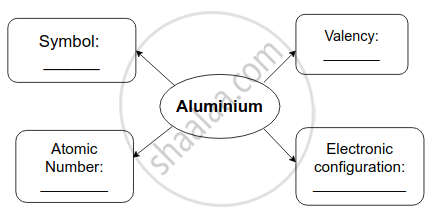
Complete flow chart given below.
Observe the figure and answer the following.
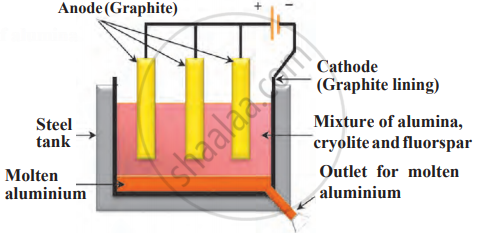
- Write the name of the method.
- What is used as anode and cathode in this method?
- Write the molecular formula and use of cryolite.
- Write anode reaction.
- Write cathode reaction.
Electrical wires have a coating of an insulting material. The material, generally used is
Two ores A and B were taken. On heating ore A gives CO2 whereas, ore B gives SO2. What steps will you take to convert them into metals?
