Advertisements
Advertisements
Question
Write whether the following statement vary directly, vary inversely with each other, or neither of the two.
Sales Tax and the amount of the bill.
Advertisements
Solution
Sales tax and the amount of the bill are directly proportional to each other.
E.g. Let bill amount = ₹ 1000
Sales tax = 10%
Then, sales tax = `10/100 xx 1000` = ₹ 100
But if, bill amount = 2000
Sales tax = 10%
Then, sales tax = `10/100 xx 2000`
= 10 × 20
= ₹ 200
APPEARS IN
RELATED QUESTIONS
Fill in the blank in of the following so as to make the statement true:
x and y are said to vary directly with each other if for some positive number k ....,...... = k.
A worker is paid Rs 210 for 6 days work. If his total income of the month is Rs 875, for how many days did he work?
A woker is paid Rs 200 for 8 days work. If he works for 20 days, how much will he get?
Neha types 75 pages in 14 hours. How many pages will she type in 20 hours?
Distance travelled by a bus and time taken are in direct proportion
Every 3 months Tamilselvan deposits ₹ 5000 as savings in his bank account. In how many years he can save ₹ 1,50,000
Write whether the following statement vary directly, vary inversely with each other, or neither of the two.
Simple interest on a given sum and the rate of interest.
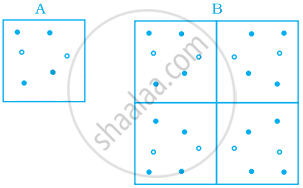
Pattern B consists of four tiles like pattern A. Write a proportion involving red dots and blue dots in pattern A and B. Are they in direct proportion? If yes, write the constant of proportion.
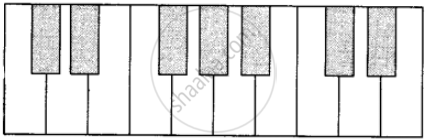
Here is a key board of a harmonium:
- Find the ratio of white keys to black keys on the keyboard.

- What is the ratio of black keys to all keys on the given keyboard.
- This pattern of keys is repeated on larger keyboard. How many black keys would you expect to find on a keyboard with 14 such patterns.
Here is a keyboard of a harmonium: This pattern of keys is repeated on larger keyboard. How many black keys would you expect to find on a keyboard with 14 such patterns.