Advertisements
Advertisements
Question
Write the chemical formula of the following compound in a step-by-step manner –
Sodium bisulphate
Advertisements
Solution
Write the formula of
| Sodium bisulphate | Symbol | valency |
| Sodium | \[\ce{Na}\] | \[\ce{1^+}\] |
| Bisulphate | \[\ce{HSO4}\] | \[\ce{1^-}\] |
Step I – Write each symbol with its valency.
Positive ion is written first
\[\ce{Na}^{1+}\] \[\ce{[HSO4]}^{1-}\]
Step II – Interchange the valencies and ignoring signs.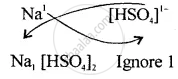
The Formula is \[\ce{NaHSO4}\]
APPEARS IN
RELATED QUESTIONS
Write the molecular formula of the following compounds of Sulphur trioxide.
Find the number and names of elements present in them and calculate their molecular masses.
Write the molecular formula for the oxide and sulphide of following elements of Sodium.
The valency of aluminium is 3. Write the valency of other radicals present in the following compound.
Aluminium chloride
Explain the term ‘variable valency’.
Write the chemical formula of the following compound in a step-by-step manner –
Sodium bromide
Write the chemical formula of the following compound in a step-by-step manner –
Calcium hydroxide
Write the chemical formula of the following compound in a step-by-step manner –
Calcium bicarbonate
Write the chemical formula of the following compound in a step-by-step manner –
Sodium zincate
Write the chemical formula of the following compound in a step-by-step manner –
Iron [II] hydroxide
Complete the statement given below by filling in the blanks with the correct words.
The valency of iron in FeO is _______ of chlorine [chloride] in CaCl2 is ________ and of dichromate in K2 Cr2 O7 is ________.
