Advertisements
Advertisements
Question
Write the chemical formula of the following compound in a step-by-step manner –
Potassium permanganate
Advertisements
Solution
Write the formula of
| Potassium permanganate | Symbol | valency |
| Potassium | \[\ce{K}\] | \[\ce{1^+}\] |
| permanganate | \[\ce{MnO4}\] | \[\ce{1^-}\] |
Step I – Write each symbol with its valency.
Positive ion is written first
\[\ce{K}^{1+}\] \[\ce{[MnO4]}^{1-}\]
Step II – Interchange the valencies and ignoring the (+) and (−) signs.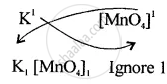
The Formula is \[\ce{KMnO4}\]
APPEARS IN
RELATED QUESTIONS
The valency of aluminium is 3. Write the valency of other radicals present in the following compounds of Aluminium nitride
What is variable valency ? Give two examples of elements showing variable valency.
Write the molecular formulae of Lead (II) oxide – PbO.
Write the molecular formulae of Magnesium carbonate.
Write the chemical formula of the following compound in a step-by-step manner –
Sodium bisulphate
Write the chemical formula of the following compound in a step-by-step manner –
Aluminium hydroxide
Write the chemical formula of the following compound in a step-by-step manner –
Sodium zincate
Complete the statement given below by filling in the blank with the correct word.
The formula of silver [I] chloride is ________.
Complete the statement given below by filling in the blanks with the correct words.
The valency of iron in FeO is _______ of chlorine [chloride] in CaCl2 is ________ and of dichromate in K2 Cr2 O7 is ________.
Match the statements – 1 to 10 below with their correct answers from – A to J.
| Column I | Column II |
| 1. Elements having valency of two. | A: Br1− |
| 2. An anion | B: Divalent |
| 3. A gaseous non-metal | C: Reactants |
| 4. A cation. | D: Ammonium |
| 5. The term used for the substances which take part in the chemical reaction | E: Nitric oxide |
| 6. The meaning of the symbol ‘Δ’ over the arrow in a chemical equation. | F: Nitrogen |
| 7. The chemical name for nitrogen monoxide. | G: Zero |
| 8. A radical containing nitrogen and hydrogen only | H: Nitrous oxide |
| 9. The chemical name for dinitrogen oxide | I: Heat required |
| 10. The valency of noble gases | J: K1+ |
