Advertisements
Advertisements
प्रश्न
Write the chemical formula of the following compound in a step-by-step manner –
Potassium permanganate
Advertisements
उत्तर
Write the formula of
| Potassium permanganate | Symbol | valency |
| Potassium | \[\ce{K}\] | \[\ce{1^+}\] |
| permanganate | \[\ce{MnO4}\] | \[\ce{1^-}\] |
Step I – Write each symbol with its valency.
Positive ion is written first
\[\ce{K}^{1+}\] \[\ce{[MnO4]}^{1-}\]
Step II – Interchange the valencies and ignoring the (+) and (−) signs.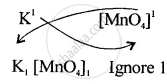
The Formula is \[\ce{KMnO4}\]
APPEARS IN
संबंधित प्रश्न
Write the molecular formula for the oxide and sulphide of following elements of Hydrogen
Write the molecular formulae for the following compounds and name the elements present of Sulphuric acid
The valency of aluminium is 3. Write the valency of other radicals present in the following compounds of Aluminium oxide.
A solution of a substance ‘X’ is used for white washing.
(a) Name the substance ‘X’ and write its formula.
(b) Write the reaction of the substance ‘X’ named in (a) above with water.
Write the molecular formulae of Sodium hydroxide
Write the molecular formulae of Iron (II) sulphide.
Write the chemical formula of the following compound in a step-by-step manner –
Zinc hydroxide
Write the chemical formula of the following compound in a step-by-step manner –
Copper [II] oxide
Write the chemical formula of the following compound in a step-by-step manner –
Iron [III] sulphur
Match the statements – 1 to 10 below with their correct answers from – A to J.
| Column I | Column II |
| 1. Elements having valency of two. | A: Br1− |
| 2. An anion | B: Divalent |
| 3. A gaseous non-metal | C: Reactants |
| 4. A cation. | D: Ammonium |
| 5. The term used for the substances which take part in the chemical reaction | E: Nitric oxide |
| 6. The meaning of the symbol ‘Δ’ over the arrow in a chemical equation. | F: Nitrogen |
| 7. The chemical name for nitrogen monoxide. | G: Zero |
| 8. A radical containing nitrogen and hydrogen only | H: Nitrous oxide |
| 9. The chemical name for dinitrogen oxide | I: Heat required |
| 10. The valency of noble gases | J: K1+ |
