Advertisements
Advertisements
Question
Write short note
Population pyramid and sex ratio
Advertisements
Solution
1. Demographers use population pyramids to describe age and genderwise distribution of population.
2. The Y-axis in the centre of this graph shows age groups while X-axis shows population or percentage of population in specific age groups.
3. The lengths of bars show the number of percentage of population.
4. The left side of graph represents the males while the right side represents the females.
5. The ratio between the number of women and men in the population is called the sex ratio. In India, it is calculated by using the formula:
Sex ratio = `"Total Female population"/"Total Male population"`× 1000
6. The gender distribution in a country is an important demographic characteristic and the sex ratio is an important information about the status of women in a country.
7. On an average, the world population reflects a sex ratio of 990 females per 1000 males.
8. In general, Asia has a low sex ratio.
APPEARS IN
RELATED QUESTIONS
Give geographical reason
Demographic dividend increases when proportion of working population increases.
Name the country with the lowest sex ratio in the world.
“In some countries of the world, the sex ratio is unfavourable to women.” Give one reason.
Favourable sex ratio is found in how many countries.
In which continent, low sex ratio is found?
Study the given graph carefully and answer the following question:
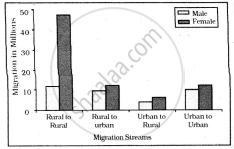
Intra-state Migration by place of Last Residence Indicating Migration Streams India, 2011
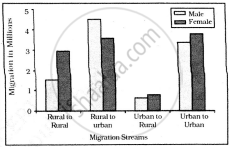
Inter-state Migration by Place of Last Residence Indicating Migration Streams India, 2011
Who dominates rural to rural migration in inter-state migration?
Which of the following is not a reason of unfavourable sex ratio against women?
Arrange the following States/UTs in descending order in terms of their percentage of urban population as per the Census 2011.
- Delhi
- Kerala
- Maharashtra
- Assam
Arrange according to increase in age :
- Adults
- Children
- Old people
- Young people
Which one of the following is the largest linguistic group of India?
