Advertisements
Advertisements
Question
Write chemical reactions of following reagents on methoxyethane:
dilute H2SO4
Advertisements
Solution
\[\ce{\underset{Methoxyethane}{CH3 - O - C2H5} + H2O ->[Δ][H2SO4] \underset{Methanol}{CH3OH} + \underset{Ethanol}{C2H5OH}}\]
APPEARS IN
RELATED QUESTIONS
How do you convert the following:
Ethanol to Propan-2-ol
Write the mechanism of the following reaction :
\[\ce{C2H5OH->[H2SO4][443K]CH2=CH2 + H2O}\]
Give simple chemical test to distinguish between Ethanol and Phenol.
Among the following the one which reacts most readily with ethanol is:
If ethanol dissolves in water, then which of the following would be observed:
Which of the following is correct?
Wood spirit is known as acetone:
Phenol is less acidic than ______.
Phenol can be distinguished from ethanol by the reactions with:
(i) \[\ce{Br2/water}\]
(ii) \[\ce{Na}\]
(iii) Neutral \[\ce{FeCl3}\]
(iv) All the above
What is denatured alcohol?
Suggest a reagent for conversion of ethanol to ethanal.
Name the enzymes and write the reactions involved in the preparation of ethanol from sucrose by fermentation.
Dipole moment of phenol is smaller than that of methanol. Why?
Match the items of column I with items of column II.
| Column I | Column II | |
| (i) | Methanol | (a) Conversion of phenol to o-hydroxysalicylic acid |
| (ii) | Kolbe’s reaction | (b) Ethyl alcohol |
| (iii) | Williamson’s synthesis | (c) Conversion of phenol to salicylaldehyde |
| (iv) | Conversion of 2° alcohol to ketone | (d) Wood spirit |
| (v) | Reimer-Tiemann reaction | (e) Heated copper at 573 K |
| (vi) | Fermentation | (f) Reaction of alkyl halide with sodium alkoxide |
Convert the following:
Propanenitrile to ethanol.
Which reagent can convert acetic acid into ethanol?
Tonics in general contain
Liquor poisoning is due to
Which of the following is known as wood spirit?
How methanol is obtained from methanal.
Give IUPAC names of the following compounds:
\[\begin{array}{cc}
\ce{CH3 - CH - CH - CH - CH2-OH }\\
|\phantom{......}|\phantom{......}|\phantom{.......}\\
\ce{Cl}\phantom{....}\ce{CH3}\phantom{...}\ce{CH3}\phantom{.....}
\end{array}\]
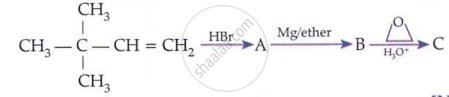
3, 3-dimethyl-1-butene was subject to following reactions: