Advertisements
Advertisements
Question
Write a short note on ammonolysis.
Advertisements
Solution
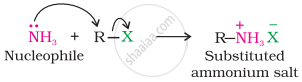
The carbon-halogen bond in alkyl or benzyl halides can be easily cleaved by a nucleophile. Hence, an alkyl or benzyl halide on reaction with an ethanolic solution of ammonia undergoes a nucleophilic substitution reaction in which the halogen atom is replaced by an amino (–NH2) group. This process of cleavage of the C–X bond by an ammonia molecule is known as ammonolysis. The reaction is carried out in a sealed tube at 373 K. The primary amine thus obtained behaves as a nucleophile and can further react with alkyl halide to form secondary and tertiary amines and finally quaternary ammonium salt.
\[\ce{\underset{(1^\circ)}{RNH2} ->[RX] \underset{(2^\circ)}{R2NH} ->[RX] \underset{(3^\circ)}{R3N} ->[RX] \underset{Quaternary ammonium salt}{R4\overset{+}{N}\overset{-}{X}}}\]
The free amine can be obtained from the ammonium salt by treatment with a strong base:
\[\ce{R-\overset{+}{N}H3\overset{-}{X} + NaOH -> R-NH2 + H2O + \overset{+}{N}a\overset{-}{X}}\]
Ammonolysis has the disadvantage of yielding a mixture of primary, secondary and tertiary amines and also a quaternary ammonium salt. However, a primary amine is obtained as a major product by taking large excess of ammonia. The order of reactivity of halides with amines is RI > RBr > RCl.
APPEARS IN
RELATED QUESTIONS
Give reasons for the following: (CH3)2NH is more basic than (CH3)3N in an aqueous solution.
Give reason for the following:
Primary amines have higher boiling point than tertiary amines.
How will you convert Benzene into aniline?
How will you convert Benzene into N, N-dimethylaniline?
Arrange the following in increasing order of their basic strength:
CH3NH2, (CH3)2NH, (CH3)3N, C6H5NH2, C6H5CH2NH2
Complete the following acid-base reaction and name the product:
\[\ce{CH3CH2CH2NH2 + HCl ->}\]
Complete the following acid-base reaction and name the product:
\[\ce{(C2H5)3N + HCl ->}\]
Complete the following reaction:
\[\ce{C6H5N2Cl + H3PO2 + H2O ->}\]
Give reasons CH3NH2 is more basic than C6H5NH2.
Arrange the following in the increasing order of their pKb values:
C6H5NH2, C2H5NH2, C6H5NHCH3
The CORRECT decreasing order of boiling points is:
Which of the following should be most volatile?
Assertion: N-Ethylbenzene sulphonamide is soluble in alkali.
Reason: Hydrogen attached to nitrogen in sulphonamide is strongly acidic.
Dimerisation of carboxylic acids is due to
The hydrogen bond is shortest in
Which of the following have less melting point than amine?
Which one of the following compounds will liberate CO2, when treated with NaHCO3?
Write short note on the following:
Ammonolysis
The correct order of decreasing basic strength of the given amines is:
