Advertisements
Advertisements
Question
With the help of labelled diagramms describe the structures of human sperm and unfertilized ovum.
A couple is unable to conceive. Which modern techniques are available to overcome this problem?
Advertisements
Solution
Structure of human sperm:
i. The human sperm is a haploid, elongated and motile male gamete.
ii. It is microscopic, measuring about 0.060 mm in length.
iii. The body of sperm is divided into four parts, viz., head, neck, middle piece and tail.
a. Head:
It is flat and oval consisting of large haploid nucleus and an acrosome formed from Golgi complex. The acrosome secretes an enzyme hyalourinidase which helps in penetration of egg during fertilization. The anterior half of the nucleus is covered by a fibrous sheath.
b. Neck:
It is a narrow constricted region consisting of two centrioles (proximal and distal) and cytoplasm. The proximal centriole plays an important role in first cleavage of the zygote and distal centriole forms the axial filament present in the tail of the sperm.
c. Middle piece:
Middle piece has many mitochondria spirally coiled around axial filament. The mitochondria provide energy for the sperm during its movement, hence it is called the powerhouse of the sperm.
d. Tail:
The tail is long, slender and tapering. It is made up of cytoplasm. The axial filament passes through the tail.
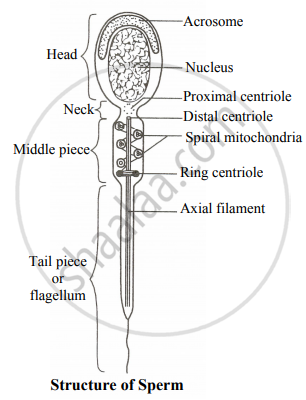
Structure of Ovum:

i. The ovum discharged by the ovary during ovulation is actually a secondary oocyte.
ii. It is round, non-motile, haploid female gamete.
iii. It is the largest cell of the body and measures about 0.1 mm or 100 µ in diameter.
iv. The human egg is almost free of yolk, hence called microlecithal.
v. It shows abundant cytoplasm called ooplasm.
vi. Ooplasm has a large eccentric nucleus called germinal vesicle.
vii. Ovum is surrounded by plasma membrane called vitelline membrane.
viii. The ovum lack centrioles and therefore does not undergo further divisions.
ix. The ovum contains two poles. The pole which shows presence of polar body is called animal pole while the opposite side is termed vegetal pole.
x. The ovum shows two covering layers viz. an outer, thicker, cellular corona radiata and an inner, thinner, non-cellular zona pellucida.
xi. The zona pellucida is secreted by ovum itself while corona radiata is formed of radially elongated follicular cells which are glued together by hyaluronic acid.
If a couple is unable to conceive, the modern techiques available to overcome this problem are:
i. Zygote intra-fallopian transfer (ZIFT): Zygote or blastocyst upto 8- blastomeres is transferred into the fallopian tube, the embryo moves to the uterus where it becomes implanted and continues further development.
ii. Gamete intra−fallopian transfer (GIFT):
In GIFT, ovum collected from a donor is transferred into the fallopian tube of another female who can provide suitable environment for fertilization and development.
APPEARS IN
RELATED QUESTIONS
Give appropriate biological/technical terms for the following:
The accessory gland in human males whose secretion activates the
sperms.
State the reason why testes lie outside the abdomen in a scrotum?
Describe the male reproductive systems in humans.
Given below is the schematic diagram of the sectional view of the human male reproductive system.
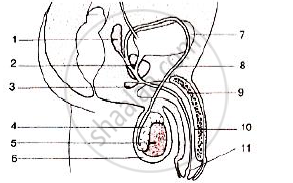
Name the parts numbered 1-11.
Name the Following
The site of production of sperms in man.
Identify the condition in wtrich the testis fails to descend from abdomen into scrotum, leading to sterility.
Secretions from which one of the following are rich in fructose, calcium, and some enzymes?
Match between the following representing parts of the sperm and their functions and choose the correct option.
| Column A | Column B | ||
| A. | Head | i. | Enzymes |
| B. | Middle piece | ii. | Sperm motility |
| C. | Acrosome | iii. | Energy |
| D. | Tail | iv. | Genetic material |
The shared terminal duct of the reproductive and urinary system in the human male is ______.
Cell at the end of first meiotic division male sperm differentiates into ______.
