Advertisements
Advertisements
Question
With the help of labelled diagram explain the exchange of gases between alveolus and capillary.
Advertisements
Solution

External respiration is the process of exchange of gases at the alveolar level. Alveoli consist of a layer of simple squamous epithelium resting on a basement membrane. They are intimately associated with a dense network of capillaries. The capillary wall is also made up of simple squamous epithelium resting on a thin basement membrane. Both the layers are thin walled and have similar structure. Together they form the respiratory membrane through which gaseous exchange occurs i.e. between the alveolar air and the blood. Diffusion of gases will take place from an area of higher partial pressure to an area of lower partial pressure until the partial pressure in the two regions reaches equilibrium. The partial pressure of CO2 of blood entering the pulmonary capillaries is 45 mmHg while partial pressure of CO2 in alveolar air is 40 mmHg.
This difference in partial pressure causes diffusion of CO2 from the capillaries into the alveolus. Similarly, partial pressure of O2 of blood in pulmonary capillaries is 40 mmHg while in alveolar air it is 104 mmHg. Due to this difference O2 diffuses from alveoli to the capillaries.
RELATED QUESTIONS
The size of the chest cavity increases during inhalation.
Distinguish between open circulation and closed circulation.
Define Bohr effect and Haldane effect.
Identify the role of NAD+ in cellular respiration
____________ in mammals do not help in respiration.
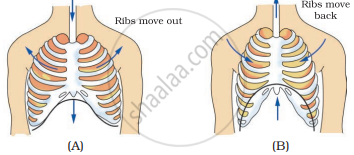
Observe the figures given in figure (A) and (B) and answer the following.
- Which of the figures A or B indicates the process of inhalation and which the process of exhalation?
- In the figure label the arrows and indicate the direction of
- movement of air
- movement of diaphragm
- movement of ribs
Assertion: During inhalation, the diaphragm goes downward.
Reason: The volume of the thoracic cavity decreases.
Mark the true statement among the following with reference to normal breathing.
In HMP shunt, number of molecules of CO2 evolved are ______.
Listed below are four respiratory capacities (1 - 4) and four jumbled respiratory volumes of a normal human adult
| Respiratory Capacities | Respiratory Volumes |
| 1. Residual volume | 2500 mL |
| 2. Vital capacity | 5500 mL |
| 3. Inspiratory sore volume | 1200 mL |
| 4. Total Lung capacity | 4500 mL |
Which one of the following is the correct matching of two capacities and volumes?
