Advertisements
Advertisements
Question
Distinguish between open circulation and closed circulation.
Advertisements
Solution
| Open circulation | Closed circulation | ||
| 1. | In open circulation, blood is circulated through the body cavities (haemocoels). | 1. | In closed circulation, blood circulates the blood vessels and does not come in direct contact with cells and body tissues. |
| 2. | The blood flows with low pressure. | 2. | The blood flows with high pressure. |
| 3. | Exchange of material takes place directly between blood and cells or tissues of the body. | 3. | Exchange of material between blood and body tissues is through intermediate fluid called lymph. |
| 4. | It usually does not contain any respiratory pigment like haemoglobin so it does not transport respiratory gases | 4. | It contains respiratory pigments like haemoglobin for transportation of respiratory gases. |
| 5. | e.g. Arthropods and molluscs | 5. | e.g. All vertebrates, higher molluscs and annelids |
APPEARS IN
RELATED QUESTIONS
Very short answer question.
Why is a gas exchange very rapid at the alveolar level?
In human respiration, chemical energy is released in the form of ______.
Distinguish between inspiration and expiration.
Vital capacity is ______.
During inspiration, the inter-costal muscles ____________.
Blood contains C02 in the form of ____________.
CO2 carried from the tissue cells in the blood is in the form of ______.
Assertion: During inhalation, the diaphragm goes downward.
Reason: The volume of the thoracic cavity decreases.
In Hamburger’s phenomenon, ______.
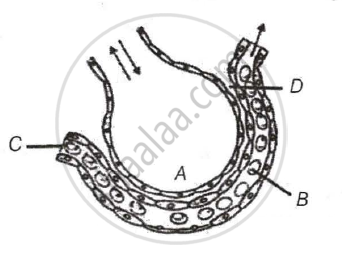
The figure given below shows a small part of human lung where exchange of gas takes place. In which one of the options given below, the one part A, B, C or D is correctly identified along with its function.