Advertisements
Advertisements
Question
Why was it necessary to train Kari to he good?
Advertisements
Solution
Kari was like a naughty boy. He took pleasure in making mischief. Therefore, he had to be trained to be good.
RELATED QUESTIONS
What do you think happens in the end? Does the child find his parents?
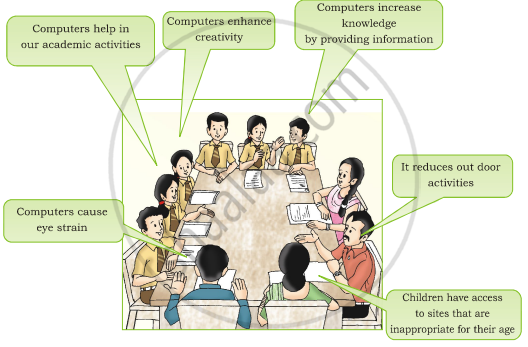
This is a meeting of the school’s Parent-Teacher Association. Some student representatives have also been invited to participate to discuss the role that Information technology/computers play in the growth and development of children.
What does he plant who plants a tree?
He plants, in sap and leaf and wood,
In love of home and loyalty
And far-cast thought of civic good____
His blessing on the neighbourhood,
Who in the hollow of his hand
Holds all the growth of all our land____
A nation's growth from sea to sea
Stirs in his heart who plants a tree.
Read the lines given above and answer the question that follow:
Does the man plant a tree because of his love of society and his nation?
Exceeding peace had made Ben Adhem bold,
And to the presence in the room he said,
"What writest thou?"..... The vision raised its head,
And with a look made of all sweet accord,
Answered, "The names of those who love the Lord."
Read the lines given above and answer the following question.
What did Abou Adhem ask the angel?
Easton, with a little laugh, as if amused, was about to speak again when the other forestalled him. The glum-faced man had been watching the girl’s countenance with veiled glances from his keen, shrewd eyes.
“You’ll excuse me for speaking, miss, but, I see you’re acquainted with the marshall here. If you’ll ask him to speak a word for me when we get to the pen he’ll do it, and it’ll make things easier for me there. He’s taking me to Leavenworth prison. It’s seven years for counterfeiting.”
“Oh!” said the girl, with a deep breath and returning color. “So that is what you are doing out here? A marshal!”
“My dear Miss Fairchild,” said Easton, calmly, “I had to do something. Money has a way of taking wings unto itself, and you know it takes money to keep step with our crowd in Washington. I saw this opening in the West, and—well, a marshalship isn’t quite as high a position as that of ambassador, but—”
Read the extract given below and answer the question that follow.
What is the relationship between Mr. Easton and Ms. Fairchild?
She lighted another match, and then she found herself sitting under a beautiful Christmas-tree. It was larger and more beautifully decorated than the one which she had seen through the glass door at the rich merchant’s. Thousands of tapers were burning upon the green branches, and colored pictures, like those she had seen in the show- windows, looked down upon it all. The little one stretched out her hand towards them, and the match went out.
The Christmas lights rose higher and higher, till they looked to her like the stars in the sky. Then she saw a star fall, leaving behind it a bright streak of fire. “Someone is dying,” thought the little girl, for her old grandmother, the only one who had ever loved her, and who was now dead, had told her that when a star falls, a soul was going up to God.
Read the extract given below and answer the question that follow.
What happened when she stretched her hand to touch?
She again rubbed a match on the wall, and the light shone round her; in the brightness stood her old grandmother, clear and shining, yet mild and loving in her appearance. “Grandmother,” cried the little one, “O take me with you; I know you will go away when the match burns out; you will vanish like the warm stove, the roast goose, and the large, glorious Christmas-tree.” And she made haste to light the whole bundle of matches, for she wished to keep her grandmother there. And the matches glowed with a light that was brighter than the noon-day, and her grandmother had never appeared so large or so beautiful. She took the little girl in her arms, and they both flew upwards in brightness and joy far above the earth, where there was neither cold nor hunger nor pain, for they were with God.
In the dawn of morning there lay the poor little one, with pale cheeks and smiling mouth, leaning against the wall; she had been frozen to death on the last evening of the year; and the New-year’s sun rose and shone upon a little corpse! The child still sat, in the stiffness of death, holding the matches in her hand, one bundle of which was burnt. “She tried to warm herself,” said some. No one imagined what beautiful things she had seen, nor into what glory she had entered with her grandmother, on New-year’s day.
Read the extract given below and answer the question that follow.
Why was there a smile on the girl’s lips? Did the people understand?
Margot stood alone. She was a very frail girl who looked as if she had been lost in the rain for years and the rain had washed out the blue from her eyes and the red from her mouth and the yellow from her hair. She was an old photograph dusted from an album, whitened away, and if she spoke at all her voice would be a ghost. Now she stood, separate, staring at the rain and the loud wet world beyond the huge glass. “What’re you looking at ?” said William. Margot said nothing. “Speak when you’re spoken to.” He gave her a shove. But she did not move; rather she let herself be moved only by him and nothing else. They edged away from her, they would not look at her. She felt them go away. And this was because she would play no games with them in the echoing tunnels of the underground city. If they tagged her and ran, she stood blinking after them and did not follow. When the class sang songs about happiness and life and games her lips barely moved. Only when they sang about the sun and the summer did her lips move as she watched the drenched windows.
Read the extract given below and answer the question that follow.
What was the reaction of the children towards Margot?
Read the extract given below and answer the questions that follow :
Duke: You hear the team’d Bellario, what he writes:
And here, I take it, is the doctor come.
[Enter Portia, dressed like a Doctor of Laws]
Give me your hand. Come you from old Bellario”?
Portia: I did, my lord.
Duke: You are welcome : take your place.
Are you acquainted with the difference
That holds this present question in the court?
(i) Where is this scene set? Why was Portia there?
(ii) What reason had Bellario given for his absence? Whom had he sent in this stead?
(iii) Bellario's letter stated that he had taken some measures to prepare the 'young and learned doctor' to deal with the case. What were they?
(iv) What was the 'difference' between Shylock the Jew and Antonio the merchant that the Duke was unable to resolve?
(v) How does Portia succeed in saving Antonio? What does this reveal of her character?
Complete the following sentences.
i. An ant is the smallest,————————————————————————————————
ii. We know a number of facts about an ant’s life because————————————————————————————————
Imagine you are the king. Narrate the incident of your meeting the hermit. Begin like this: The wise men answered my questions, but I was not satisfied with their answers. One day I decided to go and meet the hermit.
What did Mr Nath thought Nishad had come to his place the second time for?
Name five ancient things collected by Mr Wonka.
Why were the sunrays keen to go down to the earth the next day?
Use the clues given below to complete this crossword puzzle.
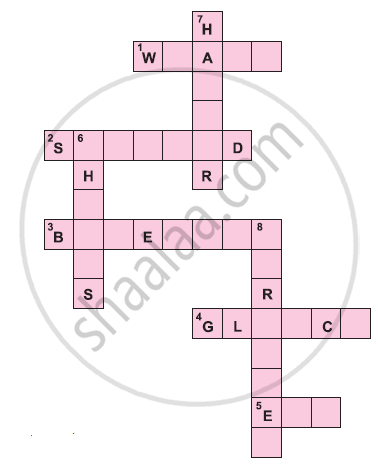
Across
1. very tired
2. had an angry look on the face
3. short trousers
4. a fault in a machine that prevents it from working properly
5. a small and naughty boy-fairy
Down
6. work that must be done every day, often boring
7. a basket with a lid
8. gave a short, high-pitched cry
This story has a lot of rhyming words, as a poem does. Can you write out some parts of it like a poem, so that the rhymes come at the end of separate lines?
For example:
Patrick never did homework. “Too boring,” he said. He played baseball and hockey and Nintendo instead.
Multiple Choice Question:
Who does they refer to here?
Fill in the blanks with the words given in the box.
| how, what, when, where, which |
You should decide soon ______ to start building your house.
When Lorenzo says, 'Fair ladies, you drop manna in the way/of starved people.' he means that Portia and Nerissa have ______.
Read the extract given below and answer the questions that follow:
| Brutus: | I did send to you For certain sums of gold, which you denied me; For I can raise no money by vile means: By heaven, I had rather coin my heart, And drop my blood for drachmas, than to wring From the hard hands of peasants their vile trash By any indirection. |
- To whom are these words addressed?
Why is Brutus angry with this person? [3] - How does this person feel when he hears these words?
What does he say to defend himself? [3] - Why did Brutus need ‘certain sums of gold’?
Why was he unable to raise these sums of money? [3] - Earlier in this scene, Brutus refers to Lucius Pella.
What had he been accused of?
Who had supported him and how? [3] - Mention any two aspects of Brutus’ character that are revealed in the above extract.
What do you understand about the relationship between Brutus and the person he addresses? [4]
