Advertisements
Advertisements
Question
Why is it necessary to know the blood groups before giving transfusion?
Advertisements
Solution
During blood transfusion, it is necessary to know the blood groups before transfusion because it is important that the blood groups of the donor and the recipient are compatible. In case of an
incompatible blood transfusion, the recipient develops antibodies that attack the antigens present on the RBCs of the donor causing the blood cells to clump together which may result in death.
RELATED QUESTIONS
Blood in the pulmonary artery or pulmonary vein (Which one contains less oxyhaemoglobin?)
What is the function of spleen?
Give reason for the following:
Atrial wall is less muscular than the ventricular wall.
Fill in the blanks with suitable words given below:
The two lower chambers of the heart are called ______.
Fill in the blanks with suitable words given below:
The blood loaded with carbon dioxide from the body comes into the ______ of the heart.
Differentiate between:
Open circulatory system and Closed circulatory system.
The process of keeping the blood flowing continuously throughout the body.
______ is an agranulocyte.
Given diagram is a schematic representation of the circulatory system in humans. Study the same and answer the questions that follow:
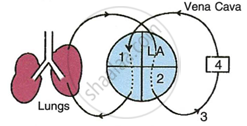 |
- Label the parts 1 and 4 indicated in the diagram.
- Which of the above mentioned number is the thickest artery? Also write its name.
- Mention the number and chamber of the heart which has the thickest muscular wall.
- Which of the above numbers/structures has the maximum number of blood capillaries?
- Draw neat and labelled diagrams of the transverse section of vena cava and the part numbered as 3. Make sure to show the structural differences between these two in the diagram.
