Advertisements
Advertisements
Question
The chief function of lymph nodes is to
Options
produce WBCs
produce hormones
destroy old RBCs
destroy pathogens
Advertisements
Solution
destroy pathogens
RELATED QUESTIONS
Give biological reasons for the following statements:
The left ventricle of the heart has a thicker wall than the right ventricle.
Agranulocytes are :
Note the relationship between the first two words and suggest a suitable word/words for the fourth place:
Coronary artery : Heart :: Hepatic artery : ______
Given below is a highly schematic diagram of the human blood circulatory system.
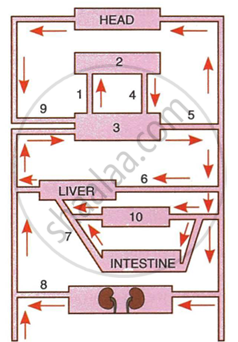 |
- Which part (state the number) represents the heart? Give reason in support of your answer.
- Which numbers represent the following, respectively?
Aorta Superior vena cava Hepatic portal vein Renal Vein Pulmonary artery Stomach
Production of RBCs occurs in ______.
In which organ of our body does blood get oxygenated?
Why is a person having blood group AB called universal recipient and a person with blood group O called a universal donor?
Given below is a schematic representation of the circulatory system in man. Study the same and answer the questions that follow:
(i) Label the parts 1 to 4 indicated in the diagram.
(ii) Give one difference between parts 1 and 2 based on:
(a) their structure
(b) the nature of blood flowing through them.
(iii) What is the specific name of the type of blood circulation that takes place between the heart and the lungs?
(iv) Name the valve found at the beginning of the part labeled 3.
The lymphatic system consists of which of the following?
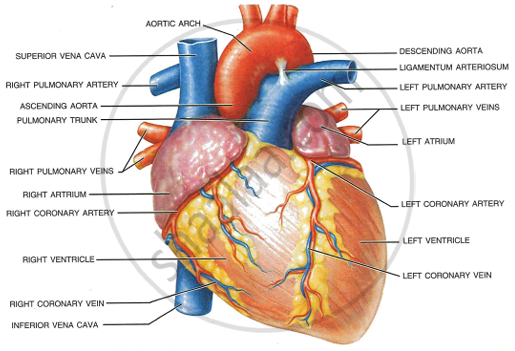 |
Can you answer why the pulmonary artery shown in Fig. is blue in colour?
