Advertisements
Advertisements
Question
Who had these opinion about Einstein?
He was stupid and would never succeed in life.
Advertisements
Solution
Einstein’s headmaster thought that he was stupid and would never succeed at anything in life.
RELATED QUESTIONS
Answer of these question in a short paragraph (30–40 words).
Who helped her to continue with music? What did he do and say?
Thinking about the Poem
“…whenever we are told to hate our brothers…” When do you think this happens?
Why? Who ‘tells’ us? Should we do as we are told at such times? What does the poet say?
Look at the following sentences. They each have two clauses, or two parts each with their own subject and verb or verb phrase. Often, one part (italicised) tells us when or why something happened.
• I reached the market when most of the shops had closed. (Tells us when I reached.)
• When Rahul Dravid walked back towards the pavilion, everyone stood up. (Tells us when everyone stood up.)
• The telephone rang and Ganga picked it up. (Tells us what happened next.)
• Gunjan has been with us ever since the school began. (Tells us for how long he has been with us.)
I. Identify the two parts in the sentences below by underlining the part that gives us the information in brackets.
1. Where other girls wore traditional Indian dresses, Santosh preferred shorts.
(Contrasts her dress with that of others)
2. She left home and got herself enrolled in a school in Delhi. (Tells us what happened after the first action.)
3. She decided to fight the system when the right moment arrived. (Tells us when she was going to fight the system.)
4. Little Maria had not yet celebrated her tenth birthday when she was packed off to train in the United States. (Tells us when Maria was sent to the U.S.)
On the basis of your understanding of the poem, answer the following questions
by ticking the correct choice.
The setting of the poem is ___________.
Read the following conversation:
Malavika and Deepak are looking through some photographs of Malavika’s family.
| Malavika: | Now ... this is my brother Shantanu. Shantanu is in Class VIII. Shantanu is brilliant at playing tennis. Shantanu is also good at singing. Shantanu sings a lot. |
| Deepak: | Shantanu sounds interesting. I’d like to meet Shantanu. I’m looking for someone to play tennis with. |
| Malavika: | Well ... why don’t you come around tonight and meet Shantanu? My parents will be out. My parents always go out on Tuesdays. |
Improve the above conversation by using suitable pronouns where required.
What does he plant who plants a tree? a
He plants a friend of sun and sky;b
He plants the flag of breezes free;
The shaft of beauty, towering high;
He plants a home to heaven anigh;
For song and mother-croon of bird
In hushed and happy twilight heard____
The treble of heaven's harmony_____
These things he plants who plants a tree.
Read the lines given above and answer the question that follow:
Bangle sellers are we who bear
Our shining loads to the temple fair...
Who will buy these delicate, bright
Rainbow-tinted circles of light?
Lustrous tokens of radiant lives,
For happy daughters and happy wives.
Read the lines given above and answer the question that follow.
How are the bangles described in the first stanza of the poem?
The athletes had come from all over the country
To run for the gold, for the silver and bronze
Many weeks and months of training
All coming down to these games.
The spectators gathered around the old field
To cheer on all the young women and men
The final event of the day was approaching
Excitement grew high to begin.
Read the lines given above and answer the following question:
What do the words ‘gold’, ‘silver’ and ‘bronze’ stand for in the poem?
It was my business to cross the bridge, explore the bridge head 3 beyond and find out to what point the enemy had advanced. I did this and returned over the bridge. There were not so many carts now and very few people on foot, but the old man was still there.’’Where do you come from?” I asked him.
“From San Carlos,” he said, and smiled.
That was his native town and so it gave him pleasure to mention it and he smiled.
“I was taking care of animals,” he explained.
“Oh,” I said, not quite understanding.
“Yes,” he said, “I stayed, you see, taking care of animals. I was the last one to leave the town of San Carlos.”
He did not look like a shepherd nor a herdsman and I looked at his black dusty clothes and his gray dusty face and his steel rimmed spectacles and said, “What animals were they?”
“Various animals,” he said, and shook his head. “I had to leave them.”
Read the extract given below and answer the question that follow.
What is the narrator’s job?
The horse was nearly life-size, moulded out of clay, baked, burnt, and brightly coloured, and reared its head proudly, prancing its forelegs in the air and flourishing its tail in a loop; beside the horse stood a warrior with scythelike mustachios, bulging eyes, and aquiline nose. The old image-makers believed in indicating a man of strength by bulging out his eyes and sharpening his moustache tips, and also decorated the man’s chest with beads which looked today like blobs of mud through the ravages of sun and wind and rain (when it came), but Muni would insist that he had known the beads to sparkle like the nine gems at one time in his life.
Read the extract given below and answer the question that follow.
Describe the horse.
When there was a strong wind, the pine trees made sad, eerie sounds that kept most people to the main road. But Mr. Oliver was not a nervous or imaginative man. He carried a torch – and on the night I write of, its pale gleam, the batteries were running down – moved fitfully over the narrow forest path. When its flickering light fell on the figure of a boy, who was sitting alone on a rock, Mr. Oliver stopped.
Boys were not supposed to be out of school after seven P.M. and it was now well past nine. What are you doing out here, boy, asked Mr. Oliver sharply, moving closer so that he could recognize the miscreant.
Read the extract given below and answer the question that follow.
What was Mr Oliver’s reaction?
Discuss the following topic in groups.
Retell an episode in the story which is a good example of irony in a situation.
Bring out a contrast between Mr. Purcell and the customer.
Why was Tilloo escorted back home?
What made the farmer’s wife blind with rage?
What is the butterfly busy doing?
There are twelve words hidden in this table. Six can be found horizontally and the remaining six vertically. All of them are describing words like ‘good’, ‘happy’, etc. The first letters of the words are given below:
Horizontal: H R F F S G
Vertical: A W S F L Q 2020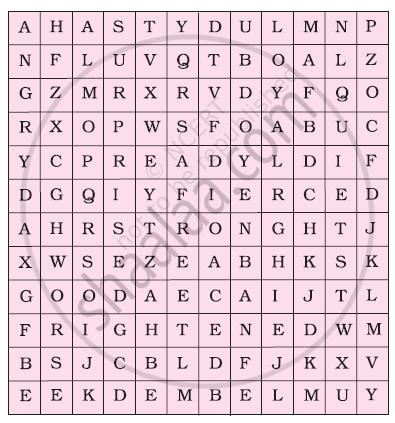
What does Prospero intend to do with his book before his interaction with Alonso in Act V of the play, The Tempest?
In the short story, The Story of an Hour, what according to the doctor did Mrs. Mallard die of?
In the poem, Birches, how are the crystal shells shed?
