Advertisements
Advertisements
Question
Which phrase in the poem expresses Dad’s self-confidence best?
Advertisements
Solution
“Right just. Leave it to me.” “Easy as winking to a climber like me.”
RELATED QUESTIONS
Tick the right answer.
When a government bans something, it wants it (stopped/started).
Answer the following question in one or two sentences.
Why was Kezia afraid of her father?
In what way is Iswaran an asset to Mahendra?
How does the guru mange to save his disciple’s life?
Look for information on how to find out whether a snake is harmful.
India's Major concerns
Read the following paragraph. Then work in pairs and list the different ways in which you can contribute to save Mother Earth. As an individual you can make a major contribution towards reducing India's over all emission level.

How to save the Environment at Home
There are plenty of small steps that people can take at home to help save the environment. While the eco-footprint of each step is small, thousands of people doing the same thing can make a difference. In making some small changes to the way that you do things at home, you are gradually making a difference, even as an individual. You will kill costs and improve your health at the same time, so helping to save the environment isn't an entirely altruistic exercise after all!
|
SAVE MOTHER EARTH CAMPAIGN |
For oft, when on my couch I lie
In vacant or in pensive mood,
They flash upon that inward eye
Which is the bliss of solitude;
And then my heart with pleasure fills,
And dances with the daffodils.
Read the lines given above and answer the question that follow.
What does he mean by the ‘inward eye’?
A free bird leaps on the back
Of the wind and floats downstream
Till the current ends and dips his wing
In the orange suns rays
And dares to claim the sky.
Read the above lines and answer the question that follow.
Explain with reference to the context.
Of the seven hundred villages dotting the map of India, in which the majority of India’s five hundred million live, flourish and die, Kritam was probably the tiniest, indicated on the district survey map by a microscopic dot, the map being meant more for the revenue official out to collect tax than for the guidance of the motorist, who in any case could not hope to reach it since it sprawled far from the highway at the end of a rough track furrowed up by the iron-hooped wheels of bullock carts. But its size did not prevent its giving itself the grandiose name Kritam, which meant in Tamil coronet or crown on the brow of the subcontinent. The village consisted of fewer than thirty houses, only one of them built from brick and cement and painted a brilliant yellow and blue all over with
gorgeous carvings of gods and gargoyles on its balustrade, it was known as the Big House. The other houses, distributed in four streets, were generally of bamboo thatch, straw, mud and other unspecified material. Muni’s was the last house in the fourth street, beyond which stretched the fields. In his prosperous days Muni had owned a flock of sheep and goats and sallied forth every morning driving the flock to the highway a couple of miles away.
Read the extract given below and answer the question that follow.
Name the village in which Muni lived.
Was the customer interested in the care and feeding of the doves he had bought? If not, why not?
Why did the author went to the shoe shop for the last time?
According to Charlie, what lives the longest.
What do you know about Golu?
What type of shopkeeper was Mr. Purcell?
What happened to the reptiles in the forest once?
Multiple Choice Question:
‘And its wings fill’. What do the ‘wings’ bring to your mind?
What information about snakes do you get in the lesson Desert Animals?
Look at the following picture. One asks a question, the other answers it. Then the answer is noted in a form as shown below.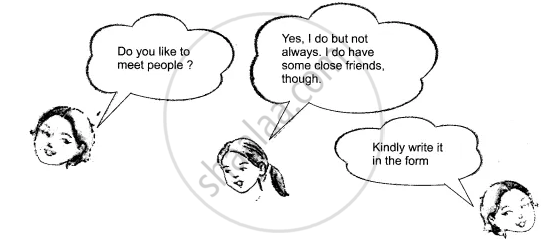
| Questions | Yes/No | Additional Response |
|
1. Do you like to meet people? |
Yes I do, but not always | I do have some close friends, though. |
|
2. Do you like the area you live in? |
No, I Don't | But I have no choice |
Write appropriate question words in the blank spaces in the following dialogue.
Neha: ______ did you get this book?
Sheela: Yesterday morning.
Neha: ______ is your sister crying?
Sheela : Because she has lost her doll.
Neha: ______ room is this, yours or hers?
Sheela: It’s ours
Neha: ______ do you go to school?
Sheela: We walk to the school. It is nearby.
Read the extract given below and answer the questions that follow:
| Portia: | ... Lorenzo, I commit into your hands The husbandry and manage of my house Until my lord's return: for mine own part, I have toward heaven breathed a secret vow To live in prayer and contemplation, Only attended by Nerissa here, Until her husband and my lord's return. |
- Who does Portia refer to as 'my lord'?
Where is her lord?
Why had he left in such haste? [3] - What does Portia ask Lorenzo to do? Why does she make this request? [3]
- Explain, in your own words, the ‘secret vow’ that Portia speaks of. [3]
- What instruction does Portia give to her servant, a little later in the scene? [3]
- What do we learn about Portia’s real intention from her conversation with Nerissa?
Which Portia do you prefer- the modest Portia of the Casket scene or the businesslike Portia we meet in this scene?
Give one reason for your response. [4]
