Advertisements
Advertisements
Question
Recently, the answers to a test held nationwide were leaked to a group of unscrupulous people. The investigative agency has arrested the mastermind and nine other people A, B, C. D, E, F, G, H and I in this matter. Interrogating them, the following facts have been obtained regarding their operation. Initially, the mastermind obtains the correct answer key. All the others create their answer key from one or two people who already possess the same. These people are called his/her "sources".
If the person has two sources, then he/she compares the answer keys obtained for both sources. If the key to a question from both sources is identical, it is copied, otherwise it is left blank.
If the person has only one source, He/she copies the source's answer into his/her copy. Finally, each person compulsorily replaces one of the answers (not a blank one) with a wrong answer in his/her answer key.
The paper contained 200 questions, so the investigative agency has ruled out the possibility of two or more of them introducing wrong answers to the same question. The investigative agency has a copy of the correct answer key and has tabulated the following data. This data represents question numbers.
| Name | Wrong Answer(s) | Blank Answer(s) |
| A | 45 | - |
| B | 96 | 46,90,25 |
| C | 2756 | 17,46,90 |
| D | 17 | - |
| E | 4690 | - |
| F | 1446 | 92,90 |
| G | 25 | - |
| H | 4692 | - |
| I | 27 | 17,26,90 |
How many people (excluding the mastermind) needed to make answer keys before C could make his answer key?
Options
2
3
4
5
Advertisements
Solution
4
Explanation:
On the basis of given information, the following result can be obtained. Initially, mastermind obtained correct answer key
W.A. = Wrong answer
B.A. = Blank answer
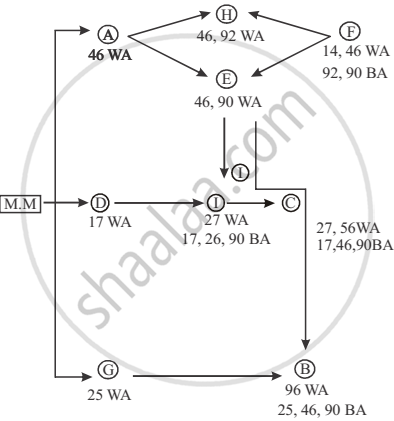
(1) The result shows that A, D and G obtained the answer key from mastermind.
(2) E and H obtained the answer key from A.
(3) F obtained the answer key from both E and H.
(4) I obtained the answer key from both E and D.
(5) C obtained the answer key from I only.
(6) B obtained the answer key from E and G.
And about the wrong answer
(1) A, D and G replaced the answers 46, 17 and 25 respectively.
(2) H replaced the answer 92.
(3) E replaced the answer 90.
(4) F replaced the answer 14.
(5) I replaced the answer 27.
(6) C replaced the answer 56.
(7) B replaced the answer 96.
From persons I, E, A and D needed to make answer keys before C could make his answer key.
APPEARS IN
RELATED QUESTIONS
The question in this section is based on a set of conditions. Choose the response that most accurately and completely answer the question.
A panel reviews six contract bids - H, J, K, R, S, and T. No- two bids have the same cost. Exactly one of the bids is accepted. The following conditions must hold:
1. The accepted bid is either K or R and is either the second or the third lowest in cost.
2. H is lower in cost than each of J and K
3. If J is the fourth lowest in cost, then J is lower in cost than each of S and T.
4. If J is not the fourth lowest in cost, then J is higher in cost than each of S and T.
5. Either R or S is the fifth lowest in cost.
Which one of the following could be an accurate list of the bids in order from lowest to highest in cost?
The question is based on a set of conditions. Choose the response that most accurately and completely answer the question.
Mercotek carried out a study to compare the productivity of its night shift with that of its day shift Every week the company’s six crews–F, G, H, R, and T-were ranked first (most productive) to sixth (least productive). There were notices. For any given week, either G and T were the two night-shift crews or else S and H were- the four other crew(s) were-the the day-shift crews for that week.
The following relationships held for every week of the study:
F is more productive than G.
R is more productive than S.
R is more productive than T.
S is more productive than H. and G is more productive than T.
If F is ranked third for a given week of the study, then which one of the following could also be true of that week?
Answer the following questions based on the statements given below:
(i) There are 3 poles on each side of the road.
(ii) These six poles are labelled A, B, C, D, E and F
(iii) The poles are of different colours namely Golden, Silver, Metallic, Black, Bronze and White.
(iv) The poles are of different heights.
(v) E, the tallest pole, is exactly opposite to the Golden coloured pole.
(vi) The shortest pole is exactly opposite to the Metallic coloured pole.
(vii) F, the Black coloured pole, is located between A and D.
(viii) C, the Bronze coloured pole, is exactly opposite to A.
(ix) B, the Metallic coloured pole, is exactly opposite to F.
(x) A, the White coloured pole, is taller than C but shorter than D and B.
Which is the second tallest pole?
The question is based on a set of conditions. Choose the response that most accurately and completely answer the question.
At the snack café at a party, Ali, Bina, Champak and Diya are eating cookies. There are five kinds of cookies to choose from – chocolate chip cookies, oatmeal cookies, sugar cookies, peanut butter cookies and raisin cookies. Each of these four people eats at least two kinds of cookies. Their choices are governed by the following rules:
At most two of them eat oatmeal cookies
At least two of them eat sugar cookies
Ali does not eat any sugar cookies
Bina and Champak do not eat the same type of cookies Bina eats chocolate chip cookies
Champak eats sugar cookies
No one eats both raisin cookies and sugar cookies
If someone eats raisin cookies, they also eat peanut butter cookies
Which one of the following must be true?
Read the information given below to answer the question.
(i) In a family of six person, there are people from three generations. Each person has separate profession and also each one likes different colours. There are two couples in the family.
(ii) Charan is a CA and his wife neither is a doctor nor likes green colour.
(iii) Engineer likes red colour and his wife is a teacher.
(iv) Vanita is mother-in-law of Namita and she likes orange colour.
(v) Mohan is grandfather of Raman and Raman, who is a principal likes black colour.
(vi) Sarita is granddaughter of Vanita and she likes blue colour. Sarita's mother likes white colour.
How many ladies are there in the family?
The question is based on a set of conditions. Choose the response that most accurately and completely answer the question.
There are five flagpoles lined up next to each other in a straight row in front of a school. Each flagpole flies one flag (red, white, or blue) and one pennant (green, white, or blue). The following are conditions that affect the placement of flags and pennants on the poles: On a given flagpole, the pennant and the flag cannot be the same colour. Two adjacent flagpoles cannot fly the same colour flags. Two adjacent flagpoles cannot fly the same colour pennants. No more than two of any colour flag or pennant may fly at one time.
If the 1st and 4th flags are blue, and the 3rd pennant is white, then which one of the following must be true?
The question is based on a set of conditions. Choose the response that most accurately and completely answer the question.
There are five flagpoles lined up next to each other in a straight row in front of a school. Each flagpole flies one flag (red, white, or blue) and one pennant (green, white, or blue). The following are conditions that affect the placement of flags and pennants on the poles: On a given flagpole, the pennant and the flag cannot be the same colour. Two adjacent flagpoles cannot fly the same colour flags. Two adjacent flagpoles cannot fly the same colour pennants. No more than two of any colour flag or pennant may fly at one time.
If the 2nd flag is red and the 3rd flag is white, and the 4th pennant is blue, then which one of the following must be true?
Recently, the answers to a test held nationwide were leaked to a group of unscrupulous people. The investigative agency has arrested the mastermind and nine other people A, B, C. D, E, F, G, H and I in this matter. Interrogating them, the following facts have been obtained regarding their operation. Initially, the mastermind obtains the correct answer key. All the others create their answer key from one or two people who already possess the same. These people are called his/her "sources".
If the person has two sources, then he/she compares the answer keys obtained for both sources. If the key to a question from both sources is identical, it is copied, otherwise it is left blank.
If the person has only one source, He/she copies the source's answer into his/her copy. Finally, each person compulsorily replaces one of the answers (not a blank one) with a wrong answer in his/her answer key.
The paper contained 200 questions, so the investigative agency has ruled out the possibility of two or more of them introducing wrong answers to the same question. The investigative agency has a copy of the correct answer key and has tabulated the following data. This data represents question numbers.
| Name | Wrong Answer(s) | Blank Answer(s) |
| A | 45 | - |
| B | 96 | 46,90,25 |
| C | 2756 | 17,46,90 |
| D | 17 | - |
| E | 4690 | - |
| F | 1446 | 92,90 |
| G | 25 | - |
| H | 4692 | - |
| I | 27 | 17,26,90 |
Which of the following statement is true?
Read the following information carefully and answer the questions given below.
(i) Five friends A, B, C, D and E travelled to five different cities of Chennai, Kolkata, Delhi, Bengaluru and Hyderabad by different modes of transport viz. bus, train, aeroplane, car and boat from Mumbai.
(ii) The person who travelled to Delhi did not travel by boat.
(iii) C went to Bengaluru by car and B went to Kolkata by aeroplane.
(iv) D travelled by boat whereas E travelled by train.
(v) Mumbai is not connected by bus to Delhi and Chennai.
The person travelling to Hyderabad went by which of the following modes?
Read the following information carefully and answer the question given below.
Shopper's Stop offers exactly 10 types of perfumes - both domestic and export varieties of Woods, Proposal, Rose, Neesh and Hydra. Shopper’s Stop is having a sale on some of these types of perfumes. The following conditions must apply:
i. Export Rose is on sale: domestic Proposal is not.
ii. If both types of Rose are on sale, then all Hydra is.
iii. If both types of Woods are on sale, then no Neesh is
iv. If neither type of Woods is on sale, then domestic Rose is.
v. If either type of Neesh is on sale, then no Hydra is.
If domestic Hydra is not on sale, then which one of the following must be true?
