Advertisements
Advertisements
प्रश्न
Recently, the answers to a test held nationwide were leaked to a group of unscrupulous people. The investigative agency has arrested the mastermind and nine other people A, B, C. D, E, F, G, H and I in this matter. Interrogating them, the following facts have been obtained regarding their operation. Initially, the mastermind obtains the correct answer key. All the others create their answer key from one or two people who already possess the same. These people are called his/her "sources".
If the person has two sources, then he/she compares the answer keys obtained for both sources. If the key to a question from both sources is identical, it is copied, otherwise it is left blank.
If the person has only one source, He/she copies the source's answer into his/her copy. Finally, each person compulsorily replaces one of the answers (not a blank one) with a wrong answer in his/her answer key.
The paper contained 200 questions, so the investigative agency has ruled out the possibility of two or more of them introducing wrong answers to the same question. The investigative agency has a copy of the correct answer key and has tabulated the following data. This data represents question numbers.
| Name | Wrong Answer(s) | Blank Answer(s) |
| A | 45 | - |
| B | 96 | 46,90,25 |
| C | 2756 | 17,46,90 |
| D | 17 | - |
| E | 4690 | - |
| F | 1446 | 92,90 |
| G | 25 | - |
| H | 4692 | - |
| I | 27 | 17,26,90 |
How many people (excluding the mastermind) needed to make answer keys before C could make his answer key?
पर्याय
2
3
4
5
Advertisements
उत्तर
4
Explanation:
On the basis of given information, the following result can be obtained. Initially, mastermind obtained correct answer key
W.A. = Wrong answer
B.A. = Blank answer
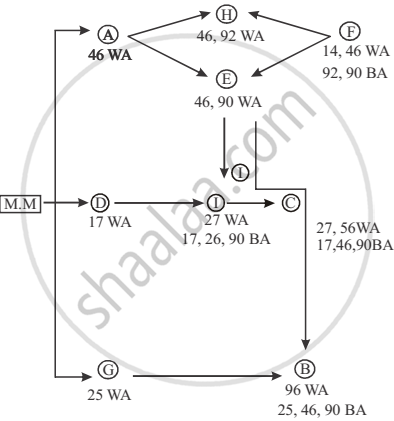
(1) The result shows that A, D and G obtained the answer key from mastermind.
(2) E and H obtained the answer key from A.
(3) F obtained the answer key from both E and H.
(4) I obtained the answer key from both E and D.
(5) C obtained the answer key from I only.
(6) B obtained the answer key from E and G.
And about the wrong answer
(1) A, D and G replaced the answers 46, 17 and 25 respectively.
(2) H replaced the answer 92.
(3) E replaced the answer 90.
(4) F replaced the answer 14.
(5) I replaced the answer 27.
(6) C replaced the answer 56.
(7) B replaced the answer 96.
From persons I, E, A and D needed to make answer keys before C could make his answer key.
APPEARS IN
संबंधित प्रश्न
Read the information carefully to answer the question.
A tourist can tour utmost four places out of A, B, C, D, E, F and G. Out of four, not more than two can come under holiday tour and at least two must come under business trip. The break up is as follows:
Four members have to be nominated to a Committee and there are six candidates: A, B, C, D, E and F. The following restrictions hold good:
(A) If A is nominated, then D does not find any place.
(B) If B is nominated, then either E or F has to be nominated, but not both.
(C) If C is nominated, then both D and E have to be nominated.
Which one of the following is an acceptable combination?
Read the following information and answer the questions that follow.
Five adults A, B, C, D and E are sitting at Bharat Provision Store. In the group, there is one Manager, one Accountant, one Supplier of provisions The Accountant, who has a child earns least money. A, who is married to C's sister, earns more than Manager D is an unmarried lady does not do any work. There is one married couple in a group of which B is husband E is the brother of C and is neither a Supplier nor an Accountant. No lady is a Supplier or Manager. C is neither a Supplier nor an 'Accountant'.
Who is the sister of C?
The question in this section is based on a set of conditions. Choose the response that most accurately and completely answer the question.
A panel reviews six contract bids - H, J, K, R, S, and T. No- two bids have the same cost. Exactly one of the bids is accepted. The following conditions must hold:
1. The accepted bid is either K or R and is either the second or the third lowest in cost.
2. H is lower in cost than each of J and K
3. If J is the fourth lowest in cost, then J is lower in cost than each of S and T.
4. If J is not the fourth lowest in cost, then J is higher in cost than each of S and T.
5. Either R or S is the fifth lowest in cost.
Which one of the following could be an accurate list of the bids in order from lowest to highest in cost?
The question in this section is based on the passage. The question is to be answered on the basis of what is stated or implied in the passage. For the question, more than one of the choices could conceivably answer the question. However, you are to choose the best answer; that is, the response that most accurately and completely answer the question.
Most people acknowledge that not all governments have a moral right to govern and that there are sometimes morally legitimate reasons for disobeying the law, as when a particular law prescribes behaviour that is clearly immoral. It is also commonly supposed that such cases are special exceptions and that, in general, the fact that something is against the law counts as a moral, as well as legal, ground for not doing it; i.e., we generally have a moral duty to obey a low simply because it is the law. But the theory known as philosophical anarchism denies this view, arguing instead that people who live under the jurisdiction of governments have no moral duty to those governments to obey their laws. Some commentators have rejected this position because of what they take to be its highly counter-intuitive' implications:
(a) that no existing government is morally better than any other (since all are, in a sense, equally illegitimate), and
(b) that, lacking any moral obligation to obey any laws, people may do as they please without scruple. In fact, however, philosophical anarchism does not entail these claims.
First, the conclusion that no government is morally better than any other does not follow from the claim that nobody owes moral obedience to any government. Even if one denies that there is a moral obligation to follow the laws of any government, one can still evaluate the morality of the policies and actions of various governments. Some governments do more good than harm, and others more harm than good, to their subjects. Some violate the moral rights of individuals more regularly, systematically, and seriously than others. in short, it is perfectly consistent with philosophical anarchism to hold that governments vary widely in their moral stature.
Which one of the following could be true?
Read the following and answer the questions:
Six persons— P, Q, R, S, T and W work in an Organisation. Each of them likes different colours, viz., Black, White, Blue, Green, Red and Yellow and their salaries are also different. The person who earns maximum does not like Blue or White colour. The person who earns the least does not like Black or Red colour. R likes Yellow colour and his salary is the second maximum. P likes White colour and earns more than T but less than W. Q likes Black colour who earns less than P but more than T. S likes Blue colour and T likes Red colour.
Who among them earns least?
Answer the following questions based on the statements given below:
(i) There are 3 poles on each side of the road.
(ii) These six poles are labelled A, B, C, D, E and F
(iii) The poles are of different colours namely Golden, Silver, Metallic, Black, Bronze and White.
(iv) The poles are of different heights.
(v) E, the tallest pole, is exactly opposite to the Golden coloured pole.
(vi) The shortest pole is exactly opposite to the Metallic coloured pole.
(vii) F, the Black coloured pole, is located between A and D.
(viii) C, the Bronze coloured pole, is exactly opposite to A.
(ix) B, the Metallic coloured pole, is exactly opposite to F.
(x) A, the White coloured pole, is taller than C but shorter than D and B.
Which is the second tallest pole?
Answer the questions on the basis of the information given below.
The head of a newly formed Government desires to appoint five of the six elected ministers P, Q, R, S, T and U to portfolios of Foreign, Industry and Commerce, Agriculture, Rural Development and Human Resources. U does not want any portfolio if S gets one of the five. R wants either Foreign or Human Resources or no portfolio. Q says that if S gets Industry and Commerce or Rural Development then she must get the other one. T insists on a portfolio if P gets one.
Which of the following is a valid assignment?
The question is based on a set of conditions. Choose the response that most accurately and completely answer the question.
There are five flagpoles lined up next to each other in a straight row in front of a school. Each flagpole flies one flag (red, white, or blue) and one pennant (green, white, or blue). The following are conditions that affect the placement of flags and pennants on the poles: On a given flagpole, the pennant and the flag cannot be the same colour. Two adjacent flagpoles cannot fly the same colour flags. Two adjacent flagpoles cannot fly the same colour pennants. No more than two of any colour flag or pennant may fly at one time.
If the 1st flag and the 2nd pennant are the same colour, the 2 and flag and the 3rd pennant are the same colour, the 3rd flag and the 4th pennant are the same colour, and the 4th flag and the 5th pennant are the same colour, then which one of the following must be true?
The question is based on a set of conditions. Choose the response that most accurately and completely answer the question.
A science student has exactly four flasks - 1, 2, 3 and 4 - originally containing a red, a blue, a green, and an orange chemical, respectively. An experiment consists of mixing exactly two of these chemicals together by completely emptying the contents of one of the flasks into another of the flasks. The following conditions apply: The product of an experiment cannot be used in further experiments. Mixing the contents of 1 and 2 produces a red chemical. Mixing the contents of 2 and 3 produces an orange chemical. Mixing the contents of 3 with the contents of either 1 or 4 produces a blue chemical. Mixing the contents of 4 with the contents of either 1 or 2 produces a green chemical.
If the student will perform exactly two experiments and after the first experiment exactly one of the resulting three non-empty flasks contains an orange chemical, then in the second experiment the student could mix together the contents of flasks
Read the following information carefully and answer the question given below.
Nine players - G, H, I, J, K, L, M, N and O – have to be put in three teams. Each team will consist of three players and each player will appear only once in a team. The teams must be arranged according to the following conditions.
i. I and N must be in the same team.
ii. K and L must be in the same team.
iii. O and J cannot be in the same team.
iv. M must be in the second team.
v. Either J or M or both must be in the team with H
The 3rd team could consist of the following except
