Advertisements
Advertisements
प्रश्न
Recently, the answers to a test held nationwide were leaked to a group of unscrupulous people. The investigative agency has arrested the mastermind and nine other people A, B, C. D, E, F, G, H and I in this matter. Interrogating them, the following facts have been obtained regarding their operation. Initially, the mastermind obtains the correct answer key. All the others create their answer key from one or two people who already possess the same. These people are called his/her "sources".
If the person has two sources, then he/she compares the answer keys obtained for both sources. If the key to a question from both sources is identical, it is copied, otherwise it is left blank.
If the person has only one source, He/she copies the source's answer into his/her copy. Finally, each person compulsorily replaces one of the answers (not a blank one) with a wrong answer in his/her answer key.
The paper contained 200 questions, so the investigative agency has ruled out the possibility of two or more of them introducing wrong answers to the same question. The investigative agency has a copy of the correct answer key and has tabulated the following data. This data represents question numbers.
| Name | Wrong Answer(s) | Blank Answer(s) |
| A | 45 | - |
| B | 96 | 46,90,25 |
| C | 2756 | 17,46,90 |
| D | 17 | - |
| E | 4690 | - |
| F | 1446 | 92,90 |
| G | 25 | - |
| H | 4692 | - |
| I | 27 | 17,26,90 |
Which one of the following must have two sources?
पर्याय
A
B
C
D
Advertisements
उत्तर
B
Explanation:
On the basis of given information, the following result can be obtained. Initially, mastermind obtained correct answer key
W.A. = Wrong answer
B.A. = Blank answer
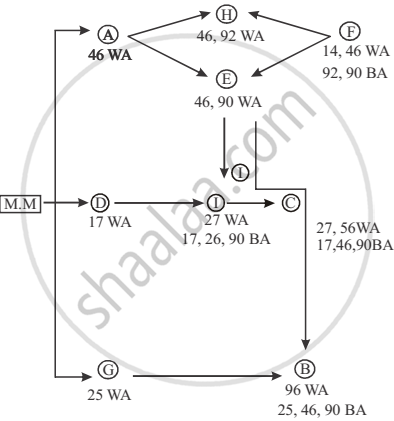
(1) The result shows that A, D and G obtained the answer key from mastermind.
(2) E and H obtained the answer key from A.
(3) F obtained the answer key from both E and H.
(4) I obtained the answer key from both E and D.
(5) C obtained the answer key from I only.
(6) B obtained the answer key from E and G.
And about the wrong answer
(1) A, D and G replaced the answers 46, 17 and 25 respectively.
(2) H replaced the answer 92.
(3) E replaced the answer 90.
(4) F replaced the answer 14.
(5) I replaced the answer 27.
(6) C replaced the answer 56.
(7) B replaced the answer 96.
Only B have two sources. Because B obtained the answer key E and G.
APPEARS IN
संबंधित प्रश्न
Read the following information carefully and answer the question given below:
Five friends Satish, Rajesh, Rehman, Rakesh and Vineet- each presents one paper to their class on Physics, Zoology, Botany, English or Geology - one day a week, Monday through Friday.
(i) Vineet does not present English and does not give his presentation on Tuesday.
(ii) Rajesh makes the Geology presentation and does not do it on Monday or Friday.
(iii) The Physics presentation is made on Thursday.
(iv) Rehman makes his presentation, which is not in English, on Wednesday.
(v) The Botany presentation is on Friday and not by Rakesh.
(vi) Satish makes his presentation on Monday.
What, day is the English presentation made?
Read the information given below to answer the question.
(i) In a family of six person, there are people from three generations. Each person has separate profession and also each one likes different colours. There are two couples in the family.
(ii) Charan is a CA and his wife neither is a doctor nor likes green colour.
(iii) Engineer likes red colour and his wife is a teacher.
(iv) Vanita is mother-in-law of Namita and she likes orange colour.
(v) Mohan is grandfather of Raman and Raman, who is a principal likes black colour.
(vi) Sarita is granddaughter of Vanita and she likes blue colour. Sarita's mother likes white colour.
What is the profession of Namita?
Read the information given below to answer the question.
(i) In a family of six person, there are people from three generations. Each person has separate profession and also each one likes different colours. There are two couples in the family.
(ii) Charan is a CA and his wife neither is a doctor nor likes green colour.
(iii) Engineer likes red colour and his wife is a teacher.
(iv) Vanita is mother-in-law of Namita and she likes orange colour.
(v) Mohan is grandfather of Raman and Raman, who is a principal likes black colour.
(vi) Sarita is granddaughter of Vanita and she likes blue colour. Sarita's mother likes white colour.
Which of the following is the correct pair of two couples?
The question is based on a set of conditions. Choose the response that most accurately and completely answer the question.
There are five flagpoles lined up next to each other in a straight row in front of a school. Each flagpole flies one flag (red, white, or blue) and one pennant (green, white, or blue). The following are conditions that affect the placement of flags and pennants on the poles: On a given flagpole, the pennant and the flag cannot be the same colour. Two adjacent flagpoles cannot fly the same colour flags. Two adjacent flagpoles cannot fly the same colour pennants. No more than two of any colour flag or pennant may fly at one time.
If the 1st flag and the 2nd pennant are the same colour, the 2 and flag and the 3rd pennant are the same colour, the 3rd flag and the 4th pennant are the same colour, and the 4th flag and the 5th pennant are the same colour, then which one of the following must be true?
Recently, the answers to a test held nationwide were leaked to a group of unscrupulous people. The investigative agency has arrested the mastermind and nine other people A, B, C. D, E, F, G, H and I in this matter. Interrogating them, the following facts have been obtained regarding their operation. Initially, the mastermind obtains the correct answer key. All the others create their answer key from one or two people who already possess the same. These people are called his/her "sources".
If the person has two sources, then he/she compares the answer keys obtained for both sources. If the key to a question from both sources is identical, it is copied, otherwise it is left blank.
If the person has only one source, He/she copies the source's answer into his/her copy. Finally, each person compulsorily replaces one of the answers (not a blank one) with a wrong answer in his/her answer key.
The paper contained 200 questions, so the investigative agency has ruled out the possibility of two or more of them introducing wrong answers to the same question. The investigative agency has a copy of the correct answer key and has tabulated the following data. This data represents question numbers.
| Name | Wrong Answer(s) | Blank Answer(s) |
| A | 45 | - |
| B | 96 | 46,90,25 |
| C | 2756 | 17,46,90 |
| D | 17 | - |
| E | 4690 | - |
| F | 1446 | 92,90 |
| G | 25 | - |
| H | 4692 | - |
| I | 27 | 17,26,90 |
How many people (excluding the mastermind) needed to make answer keys before C could make his answer key?
Six people A, B, C, D, E and F live on a six-story building each on one floor. The following statements describe where they stay.
(i) B lives on floor 6.
(ii) A is equally far from C and E.
(iii) F is an engineer.
(iv) D is two floors above F.
(v) C does not live next to an engineer.
If statement (v) is disregarded which floor does A stay on?
Read the following information carefully and answer the questions given below.
(i) Five friends A, B, C, D and E travelled to five different cities of Chennai, Kolkata, Delhi, Bengaluru and Hyderabad by different modes of transport viz. bus, train, aeroplane, car and boat from Mumbai.
(ii) The person who travelled to Delhi did not travel by boat.
(iii) C went to Bengaluru by car and B went to Kolkata by aeroplane.
(iv) D travelled by boat whereas E travelled by train.
(v) Mumbai is not connected by bus to Delhi and Chennai.
Which of the following combinations of place and mode is not correct?
Read the following information carefully and answer the question given below.
Nine players - G, H, I, J, K, L, M, N and O – have to be put in three teams. Each team will consist of three players and each player will appear only once in a team. The teams must be arranged according to the following conditions.
i. I and N must be in the same team.
ii. K and L must be in the same team.
iii. O and J cannot be in the same team.
iv. M must be in the second team.
v. Either J or M or both must be in the team with H
All of the following could be in the same team as K, except
Read the following information carefully and answer the question given below.
Nine players - G, H, I, J, K, L, M, N and O – have to be put in three teams. Each team will consist of three players and each player will appear only once in a team. The teams must be arranged according to the following conditions.
i. I and N must be in the same team.
ii. K and L must be in the same team.
iii. O and J cannot be in the same team.
iv. M must be in the second team.
v. Either J or M or both must be in the team with H
If J and K are in the 3rd team, which of the following players must be in 2nd?
Read the following information carefully and answer the question given below.
Shopper's Stop offers exactly 10 types of perfumes - both domestic and export varieties of Woods, Proposal, Rose, Neesh and Hydra. Shopper’s Stop is having a sale on some of these types of perfumes. The following conditions must apply:
i. Export Rose is on sale: domestic Proposal is not.
ii. If both types of Rose are on sale, then all Hydra is.
iii. If both types of Woods are on sale, then no Neesh is
iv. If neither type of Woods is on sale, then domestic Rose is.
v. If either type of Neesh is on sale, then no Hydra is.
If domestic Hydra is the only type of domestic perfume on sale, then which one of the following CANNOT be true?
