Advertisements
Advertisements
प्रश्न
Recently, the answers to a test held nationwide were leaked to a group of unscrupulous people. The investigative agency has arrested the mastermind and nine other people A, B, C. D, E, F, G, H and I in this matter. Interrogating them, the following facts have been obtained regarding their operation. Initially, the mastermind obtains the correct answer key. All the others create their answer key from one or two people who already possess the same. These people are called his/her "sources".
If the person has two sources, then he/she compares the answer keys obtained for both sources. If the key to a question from both sources is identical, it is copied, otherwise it is left blank.
If the person has only one source, He/she copies the source's answer into his/her copy. Finally, each person compulsorily replaces one of the answers (not a blank one) with a wrong answer in his/her answer key.
The paper contained 200 questions, so the investigative agency has ruled out the possibility of two or more of them introducing wrong answers to the same question. The investigative agency has a copy of the correct answer key and has tabulated the following data. This data represents question numbers.
| Name | Wrong Answer(s) | Blank Answer(s) |
| A | 45 | - |
| B | 96 | 46,90,25 |
| C | 2756 | 17,46,90 |
| D | 17 | - |
| E | 4690 | - |
| F | 1446 | 92,90 |
| G | 25 | - |
| H | 4692 | - |
| I | 27 | 17,26,90 |
Both G and H were sources to
पर्याय
F
B
A
None of the above
Advertisements
उत्तर
None of the above
Explanation:
On the basis of given information, the following result can be obtained. Initially, mastermind obtained correct answer key
W.A. = Wrong answer
B.A. = Blank answer
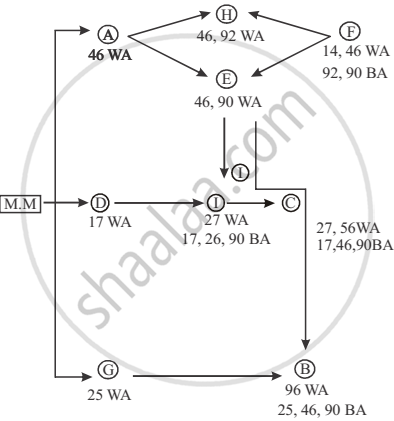
(1) The result shows that A, D and G obtained the answer key from mastermind.
(2) E and H obtained the answer key from A.
(3) F obtained the answer key from both E and H.
(4) I obtained the answer key from both E and D.
(5) C obtained the answer key from I only.
(6) B obtained the answer key from E and G.
And about the wrong answer
(1) A, D and G replaced the answers 46, 17 and 25 respectively.
(2) H replaced the answer 92.
(3) E replaced the answer 90.
(4) F replaced the answer 14.
(5) I replaced the answer 27.
(6) C replaced the answer 56.
(7) B replaced the answer 96.
G was the source to B and H was the source to F separately.
APPEARS IN
संबंधित प्रश्न
The following question has two statements P and Q. They may look factually absurd. You have to ignore this absurdly and concentrate only upon the logic involved in its statement.
Mark the answer as
P: Jackals live in forests. Cities are in forests. Therefore jackals live in cities.
Q: Some tables are grass. All stools are grass. Therefore all tables are stools.
Read the following information for a question and chose the most appropriate option:
P and Q are good at driving the Motorcycle and Jeep. R and P are good at driving Jeep and Lorry. R, S, and T are good at driving Motor Cycle and Lorry. T and R are good at driving buses and Tempo. S and Q are good at driving Bus and Jeep.
Who is good at driving Tempo, Motor Cycle, Lorry but not Jeep?
Instructions for Question: Read the information given below to answer the question.
A, B, C, D, E, F, G, and H want to have dinner on a round table and they have worked out the following seating arrangements.
(a) A will sit beside C.
(b) H will sit beside A.
(c) C will sit beside E.
(d) F will sit beside H.
(e) E will sit beside G.
(f) D will sit beside F.
(g) G will sit beside B.
(h) B will sit beside D.
Which of the following is correct?
Ornithologist : Bird :: Archealogist : ?
Safe : Secure :: Protect : ?
In the following questions find which one word cannot be formed from the letters of the given words using each letter only once:
ORGANISATION
In the following questions find which one word cannot be formed from the letters of the given words using each letter only once:
MEASUREMENT
Cloth : Mill :: Newspaper : ?
Mediators recognize that the law is generally in place to uphold mediator - client confidentiality, however, there are situations that may occur where the mediator is under obligation to break that confidence. This obligation can vary depending upon where the mediator is practicing and it may occur as a result of their employment contract or of the law. Where such an issue does occur, the mediator is expected to firstly try and discuss the presenting issue with their client; however, in situations where the factors under consideration are particularly urgent, it is accepted that this cannot always be the case.
The question has a main statement, followed by four statements labeled I, II, III, and IV. Choose the ordered pair of statements, where the first statement implies the second, and the two statements are logical with the main statement.
Whenever Vijay reads late into the night, his grandfather reprimands him.
- His grandfather does not reprimand Vijay.
- Vijay reads late into the night.
- Vijay reads early in the morning.
- Vijay's grandfather reprimands him in the morning.
