Advertisements
Advertisements
प्रश्न
Instructions for Question: Read the information given below to answer the question.
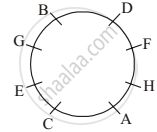
A, B, C, D, E, F, G, and H want to have dinner on a round table and they have worked out the following seating arrangements.
(a) A will sit beside C.
(b) H will sit beside A.
(c) C will sit beside E.
(d) F will sit beside H.
(e) E will sit beside G.
(f) D will sit beside F.
(g) G will sit beside B.
(h) B will sit beside D.
Which of the following is correct?
पर्याय
B will be to the immediate left of D
H will be to the immediate right of A
C will be to the immediate right of F
B will be to the immediate left of H
Advertisements
उत्तर
H will be to the immediate right of A
Explanation:
APPEARS IN
संबंधित प्रश्न
The following question has two statements P and Q. They may look factually absurd. You have to ignore this absurdly and concentrate only upon the logic involved in its statement.
Mark the answer as
P: Jackals live in forests. Cities are in forests. Therefore jackals live in cities.
Q: Some tables are grass. All stools are grass. Therefore all tables are stools.
Read the following information for a question and chose the most appropriate option:
P and Q are good at driving the Motorcycle and Jeep. R and P are good at driving Jeep and Lorry. R, S, and T are good at driving Motor Cycle and Lorry. T and R are good at driving buses and Tempo. S and Q are good at driving Bus and Jeep.
Who is good at driving all the vehicles?
Instructions for Question: Read the information given below to answer the question.
(i) Mohan‘s reading schedule consists of reading only subject on a given day of the week.
(ii) The subjects are Physics, Chemistry, Mathematics, Biology, and Social Science.
(iii) Monday to Saturday are reading days including one day only for play. Sunday is a complete holiday for Mohan.
(iv) Mathematics day is neither on the first day nor on the last day but earlier than the Chemistry day.
(v) Biology day is on the immediate next day of Chemistry day.
(vi) Physics day is on the immediate previous day of the play day. (vii) Biology day and Social Science day have a gap of two days between them.
(viii) Social Science day is on the immediate next day of the play day.
Which of the following is the correct statement?
Instructions for Question:
The following question has a main statement followed by four statements: 1, 2, 3, 4. Choose the ordered pair of statements where the first statement implies the second, and the two statements are logically consistent with the main statement.
Main statement: Either X or Y will take the only computer in the room.
1. X took the computer.
2. Y did not take the computer.
3. X did not take the computer.
4. Y took the computer.
The ordered pair of statements is:
Answer the question based on the information given.
"Some men are certainly intelligent, others are certainly not intelligent, but of intermediate men, we should say, 'intelligent'? Yes, I think, so or no, I shouldn't be inclined to call him intelligent."
Which of the following most accurately reflects the intention of the writer of the above?
Choose the most appropriate option:
A 2100 member team consisting of Team Leaders and Athletes is attending a National Athletic Meet. For every 20 Athletes, there is one Team Leader. How many Team Leaders would be there in the team?
Find the odd one out from the following:
Read the following information carefully and answer the question given below.
Seven film buffs -Aamna, Archana, Aradhana, Anu, Aahana, Anuja, and Aashna - attend a showing of classic movies. Three films are shown, one directed by Satyajit Ray, one by Stanley Kubrick, and one by Steven Spielberg. Each of the film buff see only one of the three films. The films are shown only once, one film at a time.
The following restrictions must apply:
- Exactly twice as many of the film buffs see the Stanley Kubrick film as the Satyajit Ray film.
- Aamna and Aahana do not see the same film as each other.
- Archana and Anu do not see the same film as each other.
- Anuja and Aashna see the same film as each other.
- Aradhana sees the Stanley Kubrick film.
- Aamna sees either the Satyajit Ray film or the Steven Spielberg film.
If exactly one film buff sees the Steven Spielberg film, then which one of the following must be true?
Read the following short passage and choose the best answer to the questions that follow each passage.
With social media emerging as one of the most popular hangouts for Indians, brand endorsement deals in the country are getting hugely influenced by how active celebrities are on Twitter, Facebook Instagram, and blogs.
Which of the following substantially weakens the argument given in the above statement?
The question below is given a statement followed by two courses of action. The course of action is a step for administrative decisions to be taken for improvement, follow-up, or further action in regard to the problem, policy, etc. On the basis of the information given in the statement, you have to assume everything in the statement to be true, then decide which of the given suggested courses of action is/are logically worth pursuing.
Statement The committee has criticised the institute for its failure to implement a dozen regular programs despite an increase in the staff strength and not drawing up a firm action plan for studies and researches.
Courses of Action
I. The broad objectives of the institute should be redefined to implement a practical action plan.
II. The institute should give a report on reasons for not having implemented the planned programs.
