Advertisements
Advertisements
प्रश्न
Instructions for Question: Read the information given below to answer the question.
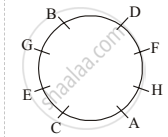
A, B, C, D, E, F, G, and H want to have dinner on a round table and they have worked out the following seating arrangements.
(a) A will sit beside C.
(b) H will sit beside A.
(c) C will sit beside E.
(d) F will sit beside H.
(e) E will sit beside G.
(f) D will sit beside F.
(g) G will sit beside B.
(h) B will sit beside D.
Which of the following is wrong?
पर्याय
A will be to the immediate right of C
D will be to the immediate left of B
E will be to the immediate right of A
F will be to the immediate left of D
Advertisements
उत्तर
E will be to the immediate right of A
Explanation:
APPEARS IN
संबंधित प्रश्न
Find the odd-man-out:
Instructions for Question: Read the information given below to answer the question.
(i) Mohan‘s reading schedule consists of reading only subject on a given day of the week.
(ii) The subjects are Physics, Chemistry, Mathematics, Biology, and Social Science.
(iii) Monday to Saturday are reading days including one day only for play. Sunday is a complete holiday for Mohan.
(iv) Mathematics day is neither on the first day nor on the last day but earlier than the Chemistry day.
(v) Biology day is on the immediate next day of Chemistry day.
(vi) Physics day is on the immediate previous day of the play day. (vii) Biology day and Social Science day have a gap of two days between them.
(viii) Social Science day is on the immediate next day of the play day.
Which day is Social Science day?
The question is based on a situation. Read the situation and answer the question that follows
Between 1960 and 1970, ivory poachers in the African nation of Zinbaku killed over 6,500 elephants. During that period, the total elephant population in Zinbaku fell from about 35,000 to just under 30,000. In 1970, new anti-poaching measures were implemented in Zinbaku, and between 1970 and 1980 over 800 poachers were arrested and expelled from the country. Nevertheless, by 1980, the elephant population in Zinbaku had fallen to about 21,000.
Which of the following, if true, would best help to explain the apparent paradox presented above?
Read the information given below and answer the question that follows.
The faces of a cube are painted in different colors. Blackface is opposite to red. Whiteface is between black and red. Green face is adjacent to grey and blue face is adjacent to green. What colour will be on the face opposite to the white face of the cube?
Read the following case and answer the question.
Sakshi is the Vice-President in an electrical equipment company in Delhi. One day, her subordinate Bhaskar requested that Kishen, a project manager, be transferred to the Mumbai office from the Delhi office. In Mumbai, Kishen would work alone as a researcher. Bhaskar gave the following reasons for his request "Kishen is known for fighting frequently with colleagues of his team. He cannot accept criticism and feels rejected and get hostile. He is overbearing and is generally a bad influence on the team. Sakshi called upon Samir, another project manager and sought further information on Kishen. Samir recalled that a former colleague, Lalit (who was also Kishen's former boss) has made few remarks on Kishen in his appraisal report. In his opinion, Kishen was not fit for further promotion as he was emotionally unstable to work in groups in spite of the fact that he had seven years of work experience. Lalit has described Kishen as to author it alive to work under anyone. Lalit has further told Samir that Kishen had an ailing wife and an old mother, who does not want to stay with his wife.
Consider the following solutions to the problem mentioned above
I. Sakshi should transfer Kishen to Mumbai office.
II. Sakshi should try and verify the facts from other sources as well.
III. Kishen should be sacked.
IV. Kishen should be demoted.
V. Sakshi should suggest Kishen visit a family counsellor.
Which of the following statements, if true would weaken the decision to sack Kishen the most?
Cuisine from the North of China is one of the most popular kinds of food in India. But this is not the case for Southern Chinese cuisine. In fact, in a recent survey, Southern Chinese cuisine was voted one of the least popular styles of cooking in the country.
Which one of the following, if true, most helps to resolve the apparent paradox described above?
In the question given below, there is a statement followed by two conclusions numbered I and II. You have to assume everything in the statement to be true, then consider the two conclusions together and decide which of them logically follows beyond a reasonable doubt from the information given in the statement.
Statement
- Sealed tenders are invited from competent contractors experienced in executing construction jobs.
Conclusions
- Tenders are invited only from experienced contractors.
- It is difficult to find competent tenders in construction jobs.
The following question, two statements are given followed by two or three Conclusions I, II, and III.
You have to consider the two statements to be true even if they seem to be at variance from commonly known facts. You have to decide which of the given conclusions if any follow from the given statements
Statements
- Most of the 64 number of buses go to my office.
- This is the 64 number bus.
Conclusions
- This bus goes to my office.
- This bus does not go to my office.
The question has a main statement, followed by four statements labeled I, II, III, and IV. Choose the ordered pair of statements, where the first statement implies the second, and the two statements are logical with the main statement.
Whenever Vijay reads late into the night, his grandfather reprimands him.
- His grandfather does not reprimand Vijay.
- Vijay reads late into the night.
- Vijay reads early in the morning.
- Vijay's grandfather reprimands him in the morning.
In making a decision about an important question, it is desirable to distinguish between a 'strong' argument and a 'weak' argument. A 'strong' argument must be both important and directly related to the question. A 'weak' argument may not be directly related to the question and may be of minor importance or may be related to the trivial aspect of the question. The question below is followed by two arguments numbered I and II. You have to decide which of the arguments is 'strong' and which is 'weak'.
Statement
- Should there be a total ban on the use of plastic bags?
Arguments
- No. instead the thickness of plastic bags, which can be used without much damage to the environment, should be specified.
- Yes, the use of plastic bags causes various problems like water pollution and waterlogging, and hence, it is necessary to ban it.
