Advertisements
Advertisements
Question
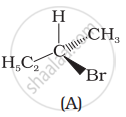
Which of the following structures is enantiomeric with the molecule (A) given below:
Options
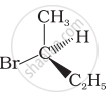
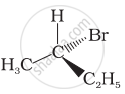
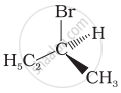
Advertisements
Solution
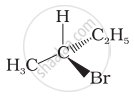
Explanation:
The stereoisomers related to each other are non-superimposable on their mirror images. Such isomers are called enantiomers. Enantiomers possess identical physical properties.
APPEARS IN
RELATED QUESTIONS
Draw the structures of major monohalo products in each of the following reaction:

Name the following halide according to the IUPAC system and classify it as an alkyl, allyl, benzyl (primary, secondary, tertiary), vinyl or aryl halide:
CH3CH2CH(CH3)CH(C2H5)Cl
Name the following halide according to the IUPAC system and classify it as an alkyl, allyl, benzyl (primary, secondary, tertiary), vinyl or aryl halide:
CH3CH2C(CH3)2CH2I
Name the following halide according to the IUPAC system and classify it as an alkyl, allyl, benzyl (primary, secondary, tertiary), vinyl or aryl halide:
CH3CH = CHC(Br)(CH3)2
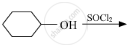
Draw the structure of major monohalo product in each of the following reactions :
When two halogen atoms are attached to the same carbon atom then it is:
Identify the compound Y in the following reaction.

Which of the following is an example of vic-dihalide?
The position of \[\ce{-Br}\] in the compound in \[\ce{CH3CH = CH(Br)(CH3)2}\] can be classified as ______.
Which of the products will be major product in the reaction given below? Explain.
\[\ce{CH3CH = CH2 + HI -> \underset{(A)}{CH3CH2CH2I} + \underset{(B)}{CH3CHICH3}}\]
Classify the following compound as a primary, secondary and tertiary halide.
4-Bromopent-2-ene
Why are haloalkanes more reactive towards nucleophilic substitution reactions than haloarenes and vinylic halides?
Name the following halide according to the IUPAC system and classify them as alkyl, allyl, benzyl (primary, secondary, tertiary), vinyl, or aryl halide:
\[\ce{CH3CH2C(CH3)2CH2I}\]
Write the structure of the following organic halogen compound.
1,4-Dibromobut-2-ene
Name the following halide according to the IUPAC system and classify it as alkyl, allyl, benzyl (primary, secondary, tertiary), vinyl or aryl halide:
CH3CH2C(CH3)2CH2I
Name the following halide according to IUPAC system and classify them as alkyl, allyl, benzyl (primary, secondary, tertiary), vinyl or aryl halides:
\[\ce{CH3CH2C(CH3)2CH2I}\]
Name the following halides according to IUPAC system and classify them as alkyl, allyl, benzyl (primary, secondary, tertiary), vinyl or aryl halides:
CH3C(Cl)(C2H5 )CH2CH3
Write the structure of the following organic halogen compound.
4-tert-Butyl-3-iodoheptane
What should be the correct IUPAC name for diethylbromomethane?
