Advertisements
Advertisements
Question
Which of the following solutions will have the highest conductivity at 298 K?
Options
0.01 M HCl solution
0.1 M HCl solution
0.01 M CH3COOH solution
0.1 M CH3COOH solution
Advertisements
Solution
0.1 M HCl solution
Explanation:
0.1 M HCl solution, conductivity is higher for strong electrolyte, conductivity decreases with dilution.
APPEARS IN
RELATED QUESTIONS
State Kohlrausch Law.
How can you determine limiting molar conductivity, 0 m for strong electrolyte and weak electrolyte?
In the plot of molar conductivity (∧m) vs square root of concentration (c1/2) following curves are obtained for two electrolytes A and B : 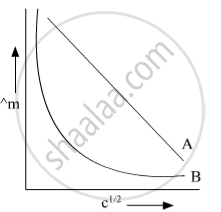
Answer the following:
(i) predict the nature of electrolytes A and B.
(ii) What happens on the extrapolation of ∧m to concentration approaching for electrolytes A and B?
Kohlrausch law of independent migration of ions states ____________.
\[\ce{\Lambda^0_m(NH4OH)}\] is equal to ______.
Which of the following halogen acids is the strongest reducing agent?
The molar conductivity of CH3COOH at infinite dilution is 390 Scm2/mol. Using the graph and given information, the molar conductivity of CH3COOK will be:

The variation of molar conductivity with concentration of an electrolyte (X) m aqueous solution is shown in the given figure.

The electrolyte X is ______.
Conductivity of 2 × 10⁻³ M methanoic acid is 8 × 10⁻⁵ S cm−1. Calculate its molar conductivity and degree of dissociation if `∧_"m"^0` for methanoic acid, is 404 S cm2 mol−3.
The specific conductance of 2.5 × 10⁻⁴ M formic acid is 5.25 × 10⁻⁵ ohm-1 cm-1. Calculate its molar conductivity and degree of dissociation.
Given `λ°_("H"^+)` = 349.5 ohm-1 cm2 mol-1 and
`λ°_("HCOO"^-) = 50.5 " ohm"^-1 "cm"^2 "mol"^-1`
