Advertisements
Advertisements
Question
How can you determine limiting molar conductivity, 0 m for strong electrolyte and weak electrolyte?
Advertisements
Solution

For strong electrolyte, plot of m
against c, extrapolated to the y-axis, gives the value of m for
strong electrolyte. For weak electrolyte, intercept is not obtained as o m
cannot be extra apolated to zero conc. hence limiting molar conductivity of weak electrolyte is obtained from that of strong electrolytes. Using Kohlrausch law of independent migration of ions.
`λ_m^0(CH_3COOH) = lamda^0CH_3COONa + lamda_{HCl}^circ - lamda_{NaCl}^circ`
`lamda_m^circ(CH_3COOH) = lamda_{CH_3COO-}^circ + lamda_{H^+}^circ`
APPEARS IN
RELATED QUESTIONS
The molar conductivity of cation and anion of salt BA are 180 and 220 mhos respectively. The molar conductivity of salt BA at infinite dilution is_____________ .
(a) 90 mhos.cm2
(b) 110 mhos.cm2.mol-1
(c) 200 mhos.cm2.mol-1
(d) 400 mhos.cm2.mol-1
The conductivity of 0.001 mol L-1 solution of CH3COOH is 3.905× 10⁻⁵ S cm-1. Calculate its molar conductivity and degree of dissociation (α) Given λ°(H+)= 349.6 S cm2 mol-1 and λ°(CH3COO)= 40.9S cm2mol-1.
Define limiting molar conductivity.
Define the following terms: Molar conductivity (⋀m)
10.0 grams of caustic soda when dissolved in 250 cm3 of water, the resultant gram molarity of solution is _______.
(A) 0.25 M
(B) 0.5 M
(C) 1.0 M
(D) 0.1 M
In the plot of molar conductivity (∧m) vs square root of concentration (c1/2) following curves are obtained for two electrolytes A and B : 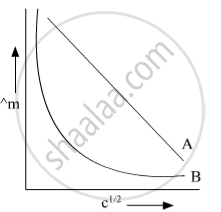
Answer the following:
(i) predict the nature of electrolytes A and B.
(ii) What happens on the extrapolation of ∧m to concentration approaching for electrolytes A and B?
Solutions of two electrolytes ‘A’ and ‘B’ are diluted. The Λm of ‘B’ increases 1.5 times while that of A increases 25 times. Which of the two is a strong electrolyte? Justify your answer. Graphically show the behavior of ‘A’ and ‘B’.
Which of the following increases with the increase in the concentration of the solution?
Assertion (A) : Conductivity decreases with decrease in concentration of electrolyte.
Reason (R) : Number of ions per unit volume that carry the current in a solution decreases on dilution.
Discuss the variation of conductivity and molar conductivity with concentration.
