Advertisements
Advertisements
Question
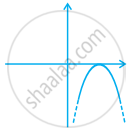
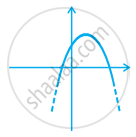
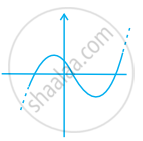
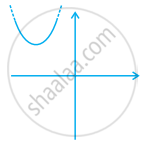
Which of the following is not the graph of a quadratic polynomial?
Options
Advertisements
Solution

Explanation:
For any quadratic polynomial ax2 + bx + c, a ≠ 0
The graph of the corresponding equation y = ax2 + bx + c has one of the two shapes either open upwards like ∪ or open downwards like ∩ depending on whether a > 0 or a < 0. These curves are called parabolas.
So, option (d) cannot be possible.
Also, the curve of a quadratic polynomial crosses the X-axis on at most two points but in option (d) the curve crosses the X-axis on the three points, so it does not represent the quadratic polynomial.
APPEARS IN
RELATED QUESTIONS
Find the zeros of the polynomial `f(x) = x^2 + 7x + 12` and verify the relation between its zeroes and coefficients.
Find the zeroes of the quadratic polynomial `f(x) = x^2 + 3x ˗ 10` and verify the relation between its zeroes and coefficients.
One zero of the polynomial `3x^3+16x^2 +15x-18 is 2/3` . Find the other zeros of the polynomial.
If one zero of the polynomial `x^2-4x+1 is (2+sqrt3)` , write the other zero.
Find the zeroes of the polynomial `x^2 + x – p(p + 1) `
Find ∝ , β are the zeros of polynomial ∝ +β= 6 and ∝β 4 then write the polynomial.
If 3 is a zero of the polynomial `2x^2 + x + k`, find the value of k.
If the sum of the zeros of the quadratic polynomial `kx^2-3x + 5` is 1 write the value of k..
If the zeroes of the quadratic polynomial x2 + (a + 1) x + b are 2 and –3, then ______.
10. The zeroes of the quadratic polynomial x² + kx + k, k? 0.
If the zeroes of the quadratic polynomial ax² + bx + c, c # 0 are equal, then ______.
If one of the zeroes of the cubic polynomial x3 + px² + qx + r is -1, then the product of the other two zeroes is ______.
If 4x² – 6x – m is divisible by x – 3, the value of m is exact divisor of ______.
If the graph of a polynomial intersects the x-axis at exactly two points, it need not be a quadratic polynomial.
The zeroes of the polynomial 3x2 + 11x – 4 are ______.
The graph of y = f(x) is shown in the figure for some polynomial f(x).

The number of zeroes of f(x) is ______.
The given linear polynomial y = f(x) has

If α and β are the zeroes of the polynomial x2 + x − 2, then find the value of `alpha/beta+beta/alpha`