Advertisements
Advertisements
Question
Which of the following cannot be true for a polyhedron?
Options
V = 4, F = 4, E = 6
V = 6, F = 8, E = 12
V = 20, F = 12, E = 30
V = 4, F = 6, E = 6
Advertisements
Solution
V = 4, F = 6, E = 6
Explanation:
Euler’s Formula for any polyhedron = F + V – E = 2
Where, F = Faces and V = Vertices and E = Edges
Given, F = 6, V = 4 and E = 6
L.H.S. = F + V – E
= 6 + 4 – 6
= 10 – 6 = 4 ≠ R.H.S.
APPEARS IN
RELATED QUESTIONS
Verify Euler’s formula for the following three-dimensional figures:
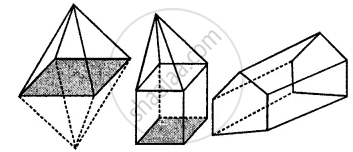
If the sum of number of vertices and faces in a polyhedron is 14, then the number of edges in that shape is ______.
Look at the shapes given below and state which of these are polyhedra using Euler’s formula.

Look at the shapes given below and state which of these are polyhedra using Euler’s formula.

Look at the shapes given below and state which of these are polyhedra using Euler’s formula.

Look at the shapes given below and state which of these are polyhedra using Euler’s formula.

Using Euler’s formula, find the value of unknown x in the following table.
| Faces | 7 |
| Vertices | 10 |
| Edges | x |
Using Euler’s formula, find the value of unknown p in the following table.
| Faces | p |
| Vertices | 6 |
| Edges | 12 |
Using Euler’s formula, find the value of unknown q in the following table.
| Faces | 6 |
| Vertices | q |
| Edges | 12 |
Using Euler’s formula, find the value of unknown r in the following table.
| Faces | 8 |
| Vertices | 11 |
| Edges | r |
