Advertisements
Advertisements
Question
Which of the following represents the solubility of sugar in water at 20°C ?
Options
21 g
204 g
37 g
164 g
Advertisements
Solution
204 g
Solubility of a substance in water is defined as the maximum amount of solute that can be dissolved in 100 g of water at a given temperature. The solubility of sugar in water at 20⁰C is 204 g.
APPEARS IN
RELATED QUESTIONS
All kinds of matter
What is the scientific name of particles which make up mater?
The best evidence for the existence and movement of particles in liquids was provided by :
During respiration, glucose and oxygen enter our body cells and waste products carbon dioxide and water leave the body cells by the process of :
Explain why, hydrogen and oxygen are considered elements whereas water is not considered an element.
Which one of the following is not a metalloid ?
Which of the following does not have a fixed melting point/boiling point ?
A, B and C are all liquids. Liquid A has a comparatively low boiling point. On heating, liquid A vaporises completely without leaving behind any residue. Liquid A is being used increasingly as a fuel in motor vehicles either alone or by mixing with petrol. Liquid B has a very high boiling point. It also vaporises completely on heating, without leaving any residue. Liquid B is a conductor of electricity and used in making thermometers. Liquid C has a moderate boiling point. On heating, liquid C vaporises leaving behind a white solid D which is used in cooking vegetables. The condensation of vapours from C give a liquid E which turns anhydrous CuSO4 to blue.
(a) Which liquid could be an element ? Name this element.
(b) Which liquid could be a mixture ? Name this mixture.
(c) Which liquid could be a compound ? Name this compound.
(d) What could the solid D be ?
(e) What do you think is liquid E ?
Out of a colloid, solution and a suspension :
which one has the smallest particles ?
When the solid A is added to water, it dissolves with the evolution of a lot of heat and making little explosions to form two products B and C. The properties of products B and C are entirely different from those of solid A as well as water. Moreover, products B and C cannot be reconverted into solid A and water. When another solid D is added to water, it dissolves with the absorption of a little heat to form a product E which cools down. The product E shows the properties of both, solid D as well as water. Moreover, product E can be converted into solid D and water.
(a) What type of change occurs when solid A is dissolved in water ? Why ?
(b) What type of change occurs when solid D is dissolved in water ? Why ?
(c) Name a metal which you think could behave like solid A. Also name the products B and C.
(d) Name the solid D if it is the one which is used in making ordinary dry cells.
(e) Name the process by which D can be recovered from E.
The solubility of ammonium chloride in water at various temperatures is given below :
| Temperature | : | 10°C | 20°C | 40°C | 60°C | 80°C |
| Solubility | : | 24 g | 37 g | 41 g | 55 g | 66 g |
What mass of ammonium chloride would be needed to make a saturated solution of ammonium chloride in fifty grams of water at 40°C ?
Name the process you would use to separate a mixture of water and alcohol.
Write a method to separate a mixture of sand and potash alum.
How will you separate a mixture of iron filings, chalk powder and common salt ?
How is cream separated from milk ?
Justify your answer.
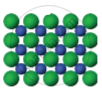
| Figure 1 | Figure 2 | Figure 3 |
 |
 |
 |
The arrangement of particles in three different phases of matter is shown above.
- Which state is represented by Fig. 1?
- In which state will the inter-particle attraction be maximum?
- Which one of them cannot be contained in an open vessel?
- Which one can take the shape of its container?
A teabag placed in a cup of hot water will diffuse into the water.
Evaporation does form bubbles.
Define the term matter.
Define the term matter.
