Advertisements
Advertisements
Question
When and why does a plant breeder employ the emasculation technique?
Advertisements
Solution
Plant breeders employed this technique to prevent pollination within the same flower or to pollinate stigmas with pollen of the desired variety. To remove the anthers, the flowers are covered with a bag before they open. This ensures that the flower is pollinated by pollen grains obtained from desirable varieties only. Later, the mature, viable, and stored pollen grains are dusted on the bagged stigma by breeders to allow artificial pollination to take place and obtain the desired plant variety.
APPEARS IN
RELATED QUESTIONS
Describe the characteristic features of wind pollinated flowers.
Name the part of the flower which the tassels of the corn- cob represent.
Why angiosperm anthers are called dithecous?
What are chasmogamous flowers?
Can cross-pollination occur in cleistogamous flowers? Give reasons for your answer.
What is the bagging technique?
The transfer of pollen grains from the anther to the stigma of the same or of another flower of the same kind is known as ______.
Fill in the blanks:
The two kinds of pollination are __________ and __________.
Give one word/term for the following:
When stigma and anthers do not grow up to the same height, which favors only cross-pollination.
Give one word/term for the following:
Pollination of flowers by birds.
Mention any two contrivances in flowers which favour cross-pollination.
State four features of flowers pollinated by insects.
Give four adaptations shown by flowers pollinated by wind.
- Nucellus
- Antipodals
- Synergids
- Micropyle
Put a tick mark (✓) against the correct alternative in the following statements
Pollen is produced in the
Differentiate Between Cross Pollination and Self Pollination:
The question has four options. Choose the correct answer:
Pollination by insect is known as
Both chasmogamous and cleistogamous flowers are present in ______.
Even in absence of pollinating agents seed-setting is assured in ______.
Which of these is a condition that makes flowers invariably autogamous?
Heterostyly as a contrivance for cross-pollination is found in ______.
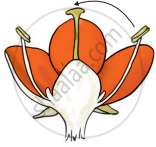
Which type of pollination does the figure indicate?
Give any four floral adaptations for chiropterophily.
Which one of the following flower is hypohydrophilous?
Anemophily is the process of pollination by which agent?
Which of the following is classified as biotic agents of pollination?
Entomophily refers to pollination by which agency?
Chiropterophily involves pollination by which organisms?
