Advertisements
Advertisements
Question
What type of chemical reaction is represented by the following equation?
\[\ce{PQ + RS -> PS + RQ}\]
Advertisements
Solution
Double displacement reaction
APPEARS IN
RELATED QUESTIONS
Give an example of a double displacement reaction other than the one given in the following Activity.
•Take about 3 mL of sodium sulphate
solution in a test tube.
• In another test tube, take about 3 mL of
barium chloride solution.
• Mix the two solutions given in the following fig.
• What do you observe?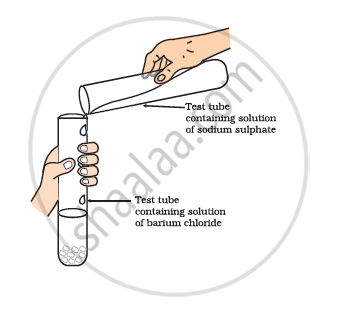
What is the difference between displacement and double displacement reactions? Write equations for these reactions.
Explain the following type of chemical reaction, giving two examples for it:
Double displacement reaction
Solutions of copper sulphate, iron sulphate and zinc sulphate are prepared and marked I, II and III respectively. Few pieces of aluminium are added to each solutions. After some time a change will be observe in
(A) I and II
(B) II and III
(C) III and I
(D) All the three
(i) What is observed when a solution of potassium iodide is added to a solution of lead nitrate taken in a test tube?
(ii) What type of reaction is this?
(iii) Write a balanced chemical equation to represent the above reaction.
When hydrogen sulphide gas is passed through a blue solution of copper sulphate, a black precipitate of copper sulphide is obtained and the sulphuric acid so formed remains in the solution. The reaction is an example of a:
In a double displacement reaction such as the reaction between sodium sulphate solution and barium chloride solution:
- exchange of atoms takes place
- exchange of ions takes place
- a precipitate is produced
- an insoluble salt is produced
The correct option is:
Identify the type of reaction taking place in the following case and write the balanced chemical equation for the reaction.
Potassium iodide reacts with lead nitrate to produce potassium nitrate and lead iodide.
Differentiate between displacement reaction and a neutralization reaction.
Classify the following reaction into –
- Direct combination
- Decomposition
- Displacement
- Double decomposition
The reaction is – Zinc sulphate reacts with ammonium hydroxide to give ammonium sulphate and zinc hydroxide.
Which of the following represents a precipitation reaction?
The following reaction is an example of:
\[\ce{4NH3_{(g)} + 5O2_{(g)} -> 4NO_{(g)} + 6H2O_{(g)}}\]
(i) displacement reaction
(ii) combination reaction
(iii) redox reaction
(iv) neutralisation reaction
Barium chloride on reacting with ammonium sulphate forms barium sulphate and ammonium chloride. Which of the following correctly represents the type of reaction involved?
(i) Displacement reaction
(ii) Precipitation reaction
(iii) Combination reaction
(iv) Double displacement reaction
In the double displacement reaction between aqueous potassium iodide and aqueous lead nitrate, a yellow precipitate of lead iodide is formed. While performing the activity if lead nitrate is not available, which of the following can be used in place of lead nitrate?
In a double displacement reaction ______.
Add potassium chromate (K2CrO4) into the solution of barium sulphate (BaSO4).
- What was the colour of the precipitate formed? Also, write the name of the precipitate.
- Write down the balanced equation for this reaction.
- Will you call this reaction a displacement reaction or a double displacement reaction? Why?
Write the method of preparation of Ca(OH)2. What happens when CO2 is passed through it? Write balanced chemical equation for the reaction involved.
