Advertisements
Advertisements
Question
What should be the ratio of area of cross section of the master cylinder and wheel cylinder of a hydraulic brake so that a force of 15 N can be obtained at each of its brake shoe by exerting a force of 0.5 N on the pedal ?
Advertisements
Solution
Let the ratio of area of cross - section of the master cylinder and wheel cylinder be A1 : A2
Force on pedal , F1 = 0.5 N
Force on break shoe , F2 = 15 N
By the principle of hydraulic machine,
Pressure on narrow piston = pressure on wider piston
or , `F_1/A_1 = F_2/A_2`
or , `F_1/F_2 = A_1/A_2`
or , `A_1/A_2 = 0.5/15`
or , `A_1/A_2 = 1/30`
Thus , the required ratio is 1:30
RELATED QUESTIONS
At a given place, a barometer records 70 cm of Hg. If the mercury in the barometer is replaced by water, what would be resulting in reading? (Density of Hg = 13600 kg/m3; Density of water = 1000 kg/m3)
The pressure in the water pipe on the ground floor of a building is 40000 pascals, whereas on the first floor it’s 10000 pascals. Find the height of the first floor. (Acceleration due to gravity g = 10 ms−2)
State two applications of Pascal's law.
State the principle on which Brahma press depends.
Unit of pressure is
Pascal’s law is used in
Match the following:
| 1. | Hydraulic press | a. | Archimedes |
| 2. | Cartesian Diver | b. | Floatation |
| 3. | Hydrostatic Balance | c. | Pascal’s law |
| 4. | Hydrometer | d. | Buoyancy |
A hydraulic press can lift 100 kg when a mass 'm' is placed on the smaller piston. It can lift ______ kg when the diameter of the larger piston is increased by 4 times and that of the smaller piston is decreased by 4 times keeping the same mass 'm' on the smaller piston.
Consider a water tank shown in the figure. It has one wall at x = L and can be taken to be very wide in the z direction. When filled with a liquid of surface tension S and density ρ, the liquid surface makes angle θ(θ << 1) with the x-axis at x = L. If y(x) is the height of the surface then the equation for y(x) is:
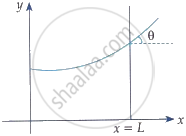
(take θ(x) = sin θ(x) = tan θ(x) = `dy/dx`, g is the acceleration due to gravity)
