Advertisements
Advertisements
Questions
What is meant by the term ‘broad spectrum antibiotics’? Explain.
Define the following: Broad spectrum antibiotics
Advertisements
Solution 1
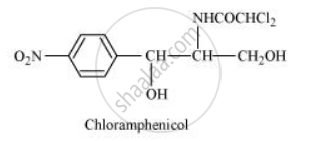
Antibiotics that are effective against a wide range of gram-positive and gram-negative bacteria are known as broad spectrum antibiotics. Chloramphenicol is a broad spectrum antibiotic.

It can be used for the treatment of typhoid, dysentery, acute fever, pneumonia, meningitis, and certain forms of urinary infections. Two other broad spectrum antibiotics are vancomycin and ofloxacin. Ampicillin and amoxicillin −synthetically modified from penicillin − are also broad spectrum antibiotics.
Solution 2
Broad spectrum antibiotics are effective against several different types or wide range of harmful bacteria. For example, tetracycline, chloramphenicol and of loxacin. Chloramphenicol can be used in case of typhoid, dysentry, acute fever, urinary infections, meningitis and pneumonia.
Solution 3
Broad spectrum antibiotic: Antibiotics that are effective against a wide range of gram-positive and gram-negative bacteria are known as broad spectrum antibiotics. Chloramphenicol is a broad spectrum antibiotic.
RELATED QUESTIONS
How do antiseptics differ from disinfectants? Give one example of each.
Name a substance which can be used as an antiseptic as well as disinfectant.
What is tincture of iodine? What is its use?
Which of the following statements is not correct.
Compounds with antiseptic properties are:
(i) \[\ce{CHCl3}\]
(ii) \[\ce{CHI3}\]
(iii) Boric acid
(iv) 0.3 ppm aqueous solution of \[\ce{Cl2}\]
Which of the following are sulpha drugs?
(i) Sulphapyridine
(ii) Prontosil
(iii) Salvarsan
(iv) Nardil
What is the average molecular mass of drugs?
Which type of drugs come under antimicrobial drugs?
What is the harmful effect of hyperacidity?
Aspirin is pain relieving antipyretic drug but can be used to prevent heart attack. Explain.
What is the scientific explanation for the feeling of depression?
Match the medicines given in Column I with their use given in Column II.
| Column I | Column II |
| (i) Ranitidine | (a) Tranquilizer |
| (ii) Furacine | (b) Antibiotic |
| (iii) Phenelzine | (c) Antihistamine |
| (iv) Chloramphenicol | (d) Antiseptic |
| (e) Antifertility drug |
Match the classes of drugs given in Column I with their action given in Column II.
| Column I | Column II |
| (i) Analgesics | (a) Inhibit the growth of microorganisms can be given orally |
| (ii) Antiseptics | (b) Treatment of stress |
| (iii) Antihistamines | (c) Applied to inanimate objects |
| (iv) Antacids | (d) Prevents the interaction of histamine with its receptor |
| (v) Tranquilisers | (e) Pain killing effect |
| (vi) Antibiotics | (f) Applied to diseased skin surfaces |
| (vii) Disinfectants | (g) Treatment of acidity |
Aspirin is chemically
Which of the following is known as broad spectrum antibiotics?
Which statement is false?
Which of the following was the first antiseptic used in surgery?
Tincture of iodine is the common name for ______.
