Advertisements
Advertisements
Question
What is the area of a triangle with base 4.8 cm and height 3.6 cm?
Advertisements
Solution
We have the base of a triangle = 4.8 cm
Height of a triangle = 3.6 cm
∴ Area of a triangle = `1/2` × base × height
= `1/2xx4.8xx3.6`
= `(4.8xx3.6)/2`
= `17.28/2`
= 8.64 cm2
RELATED QUESTIONS
For what value of k are the points (k, 2 – 2k), (–k + 1, 2k) and (–4 – k, 6 – 2k) are collinear ?
Find the area of the triangle whose vertices are: (2, 3), (-1, 0), (2, -4)
Find values of k if area of triangle is 4 sq. units and vertices are (−2, 0), (0, 4), (0, k).
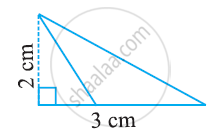
Find the area of the following triangle:
For what value of a the point (a, 1), (1, –1) and (11, 4) are collinear?
Show that the following points are collinear:
A(8, 1), B(3, –4) and C(2, –5)
In ∆PQR, PR = 8 cm, QR = 4 cm and PL = 5 cm. 
Find:
(i) the area of the ∆PQR
(ii) QM.
Ratio of areas of ∆MNO, ∆MOP and ∆MPQ in the following figure is ______.

In the following figure, area of ΔPQR is 20 cm2 and area of ΔPQS is 44 cm2. Find the length RS, if PQ is perpendicular to QS and QR is 5 cm.

In the following figure, triangle AEC is right-angled at E, B is a point on EC, BD is the altitude of triangle ABC, AC = 25 cm, BC = 7 cm and AE = 15 cm. Find the area of triangle ABC and the length of DB.

