Advertisements
Advertisements
प्रश्न
What is the area of a triangle with base 4.8 cm and height 3.6 cm?
Advertisements
उत्तर
We have the base of a triangle = 4.8 cm
Height of a triangle = 3.6 cm
∴ Area of a triangle = `1/2` × base × height
= `1/2xx4.8xx3.6`
= `(4.8xx3.6)/2`
= `17.28/2`
= 8.64 cm2
संबंधित प्रश्न
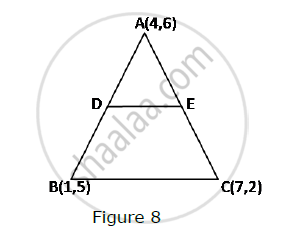
In Fig. 8, the vertices of ΔABC are A(4, 6), B(1, 5) and C(7, 2). A line-segment DE is drawn to intersect the sides AB and AC at D and E respectively such that `(AD)/(AB)=(AE)/(AC)=1/3 `Calculate th area of ADE and compare it with area of ΔABCe.
Let A (4, 2), B (6, 5) and C (1, 4) be the vertices of ΔABC.
(i) The median from A meets BC at D. Find the coordinates of point D.
(ii) Find the coordinates of the point P on AD such that AP: PD = 2:1
(iii) Find the coordinates of point Q and R on medians BE and CF respectively such that BQ: QE = 2:1 and CR: RF = 2:1.
(iv) What do you observe?
(v) If A(x1, y1), B(x2, y2), and C(x3, y3) are the vertices of ΔABC, find the coordinates of the centroid of the triangle.
Show that the following points are collinear:
A(–5, 1), B(5, 5) and C(10, 7)
Find a relation between x and y, if the points A(x, y), B(–5, 7) and C(–4, 5) are collinear.
Find the value of x for which the points (x, −1), (2, 1) and (4, 5) are collinear ?
Find BC, if the area of the triangle ABC is 36 cm2 and the height AD is 3 cm.

The table given below contains some measures of the right angled triangle. Find the unknown values.
| Base | Height | Area |
| 5 feet | ? | 20 sq.feet |
In a triangle ABC, if `|(1, 1, 1),(1 + sin"A", 1 + sin"B", 1 + sin"C"),(sin"A" + sin^2"A", sin"B" + sin^2"B", sin"C" + sin^2"C")|` = 0, then prove that ∆ABC is an isoceles triangle.
Find the area of the triangle whose vertices are (-2, 6), (3, -6), and (1, 5).
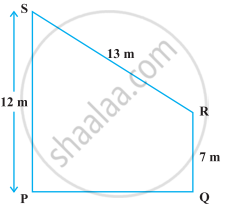
Find the area of the trapezium PQRS with height PQ given in the following figure.