Advertisements
Advertisements
प्रश्न
What is the area of a triangle with base 4.8 cm and height 3.6 cm?
Advertisements
उत्तर
We have the base of a triangle = 4.8 cm
Height of a triangle = 3.6 cm
∴ Area of a triangle = `1/2` × base × height
= `1/2xx4.8xx3.6`
= `(4.8xx3.6)/2`
= `17.28/2`
= 8.64 cm2
संबंधित प्रश्न
A(4, - 6), B(3,- 2) and C(5, 2) are the vertices of a 8 ABC and AD is its median. Prove that the median AD divides Δ ABC into two triangles of equal areas.
If A(4, –6), B(3, –2) and C(5, 2) are the vertices of ∆ABC, then verify the fact that a median of a triangle ABC divides it into two triangle of equal areas.
If the coordinates of two points A and B are (3, 4) and (5, – 2) respectively. Find the coordniates of any point P, if PA = PB and Area of ∆PAB = 10
In each of the following find the value of 'k', for which the points are collinear.
(8, 1), (k, -4), (2, -5)
Find the equation of the line joining (3, 1) and (9, 3) using the determinants.
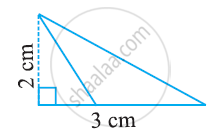
Find the area of the following triangle:
Prove that the points A(7, 10), B(–2, 5) and C(3, –4) are the vertices of an isosceles right triangle.
If the area of triangle ABC formed by A(x, y), B(1, 2) and C(2, 1) is 6 square units, then prove that x + y = 15 ?
The table given below contains some measures of the right angled triangle. Find the unknown values.
| Base | Height | Area |
| 5 feet | ? | 20 sq.feet |
A(6, 1), B(8, 2) and C(9, 4) are three vertices of a parallelogram ABCD. If E is the midpoint of DC, find the area of ∆ADE.
