Advertisements
Advertisements
Question
What is Gauss's law?
Advertisements
Solution
The contained electric charge is exactly proportional to the net flow of an electric field in a closed surface.
APPEARS IN
RELATED QUESTIONS
A spherical rubber balloon carries a charge, uniformly distributed over the surface. As the balloon is blown up and increases in size, the total electric flux coming out of the surface ______.
According to Gauss' theorem, the electric field of an infinitely long straight wire is proportional to ______
Gauss' law helps in ____________.
For a uniformly charged plane sheet, the variation of electric field (E) with distance (d) is correctly shown graphically in graph.
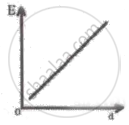
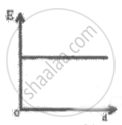
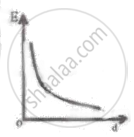
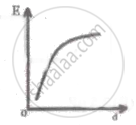
Electric field intensity at a point outside uniformly charged thin infinite plane sheet is 'E1 '. The electric field intensity at a point near and outside the surface of a positively charged conductor of any shape is 'E2'. The relation between magnitude of E1 and E2 is ______.
(assumed air as the medium)
In the figure, a very large plane sheet of positive charge is shown. P1 and P2 are two points at distance l and 2l from the charge distribution. If σ is the surface charge density, then the magnitude of electric fields E1 and E2 at P1 and P2 respectively are ______.

A 2-m long thin and straight metal wire carries a positive charge of 3 µ C. (a) What is the linear charge density on the wire? (b) Hence, find the electric intensity at a point 1.5 m away from the centre of the wire.
For a charged cylindrical conductor of cross-sectional radius R, what is the relation between the surface charge density and linear charge density?
What is a Gaussian surface?
For the chosen surface, how is the flux evaluated when \[\vec E\] is parallel to \[d\vec A\]?
Which equation is applied in the final step to solve for \[E\]?
Which Gaussian surface matches cylindrical symmetry from the symmetry-to-surface map?
Which example and Gaussian surface are associated with planar symmetry?
For an infinitely long, straight wire, what does \[\lambda\] represent, and what is its SI unit?
What Gaussian surface is used for an infinite line charge?
Which expression gives the electric field due to an infinite line charge?
How does the electric field of an infinite line charge vary with distance \[r\]?
For a uniformly charged thin insulating infinite plane sheet, what does \[\sigma\] represent, and what is its SI unit?
What charge is enclosed by a pillbox with face area \[A\] that straddles an infinite plane sheet of surface charge density \[\sigma\]?
What is the direction of the electric field due to an infinite plane sheet?
What is the electric field just outside a single conducting plate with surface charge density \[\sigma\]?
Which expression for the outside field of a uniformly charged thin spherical shell uses its surface charge density \[\sigma\]?
What is the electric field outside a solid non-conducting uniformly charged sphere, where \[r > R\]?
