Advertisements
Advertisements
Question
Two charges of magnitudes −4Q and + 2Q are located at points (2a, 0) and (5a, 0) respectively. What is the electric flux due to these charges through a sphere of radius 4a with its centre at the origin?
Advertisements
Solution
The sphere of radius 4a is enclosed within Only the negative charge Q1 = −4Q. Outside the sphere is the positive charge Q2 = +2Q, which is placed at a distance of 5a from the origin. Only a part of the electric flux lines originating at Q2 through the sphere and completely exit at other points. As a result, the electric flux through the sphere is solely caused by Q1.
Therefore, the net electric flux through the sphere = `Q_1/epsilon_0 = (-4Q)/epsilon_0`.
Because the sphere is not centred on Q1, the minus sign indicates that the flux is directed into the sphere but not radially.
APPEARS IN
RELATED QUESTIONS
According to Gauss' theorem, the electric field of an infinitely long straight wire is proportional to ______
Gauss' law helps in ____________.
For a uniformly charged plane sheet, the variation of electric field (E) with distance (d) is correctly shown graphically in graph.
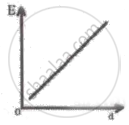
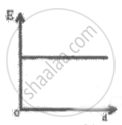
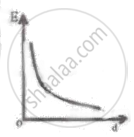
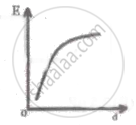
A sphere encloses an electric dipole with charges ± 3 x 10⁻⁶ C. What is the total electric flux across the sphere?
A metal sphere of radius 1 m is charged with 10-2 C in air. Its bulk modulus is 1011/4π2. The volume strain in the sphere is ______
(ε0 = permittivity of free space)
If the radius of the spherical Gaussian surface is increased then the electric flux due to a point charge enclosed by the surface ______
Find the magnitude of the electric field just above the middle of a large, flat, horizontal metal sheet carrying a charge density of 90 nC/m2.
A 2-m long thin and straight metal wire carries a positive charge of 3 µ C. (a) What is the linear charge density on the wire? (b) Hence, find the electric intensity at a point 1.5 m away from the centre of the wire.
For a charged cylindrical conductor of cross-sectional radius R, what is the relation between the surface charge density and linear charge density?
What is a Gaussian surface?
What is the first step in the 5-Step Method to Apply Gauss's Law?
For an infinitely long, straight wire, what does \[\lambda\] represent, and what is its SI unit?
What charge is enclosed by a coaxial cylinder of length \[l\] around a wire with linear charge density \[\lambda\]?
Which expression gives the electric field due to an infinite line charge?
What is the total flux through the two flat faces of area \[A\] for the pillbox around an infinite plane sheet?
What charge is enclosed by a pillbox with face area \[A\] that straddles an infinite plane sheet of surface charge density \[\sigma\]?
What is the electric field due to a uniformly charged thin insulating infinite plane sheet?
What is the direction of the electric field due to an infinite plane sheet?
What is the electric field just outside a single conducting plate with surface charge density \[\sigma\]?
What Gaussian surface is used for a uniformly charged thin spherical shell?
