Advertisements
Advertisements
Questions
What is carbon dating?
What is meant by carbon dating?
Advertisements
Solution
- Carbon consumption of animals and plants stops after death and only the decaying processes of C-14 take place continuously.
- The ratio of C-14 to C-12 changes constantly with time as C-12 is nonradioactive in dead plants and animals.
- The time passed since the death of a plant or animal can be calculated by carbon dating i.e. by measuring the radioactivity of C-14 and the ratio of C-14 to C-12 present in the remains of the dead organism.
RELATED QUESTIONS
Which of the following pairs of two vegetables represent the correct homologous structures?
(A) Sweet potato and potato
(B) Sweet potato and tomato
(C) Carrot and potato
(D) Radish and carrot
Select two pairs from the following which exhibit divergent evolution. Give reasons for your answer.
(i) Forelimbs of cheetah and mammals
(ii) Flippers of dolphins and penguins
(iii) Wings of butterflies and birds
(iv) Forelimbs of whales and mammals
Which of the following is a correct set of homologous organs?
(a) Forelimbs of frog, bird and lizard
(b) Spine of cactus and thorn of bougainvillea
(c) Wings of bat and wings of butterfly
(d) Wings of a bird and wings of a bat
Can the wing of a butterfly and the wing of a bat be considered homologous organs? Why or why not?
Give the importance of fossil in support of organic evolution
Explain with an example for the given, how the following provides evidence in favor of evolution in organisms :
Analogous organs
What are homologous organs?
One pair of organs in the following animals are not homologous. This is :
(a) forelimbs in humans and lizard
(b) forelimbs in lizard and frog
(c) wings in butterfly and bat
(d) wings in bat and bird
Read the following statement and justify the same in your own words with the help of a suitable example.
There is evidence of foetal science among chordates.
Write a short note based on the information known to you.
Connecting link
Explain with suitable examples importance of anatomical evidence in evolution.
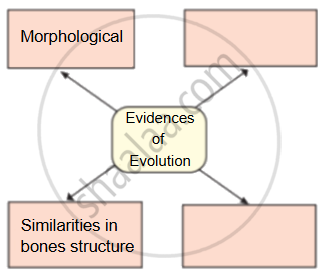
Complete the following chart:
The decaying process of C-14 occurs continuously in dead organisms only.
Observe the following images and answer the questions.

- Which evolutionary evidences are indicated in the given picture?
- How are they formed?
- Which method is used to measure their age or their time?
Select the CORRECT set of homologous organs.
The fossil remains of Archaeopteryx is a connecting link between ______
The bones of forelimbs of whale, bat, cheetah and man are similar in structure, because ______.
Appearance of antibiotic-resistant bacteria is an example of ______.
