Advertisements
Advertisements
Question
What is a cell constant? What are its units? How is it determined experimentally?
Advertisements
Solution
For a given cell, the ratio of separation (l) between the two electrodes divided by the area of cross-section (a) of the electrode is called the cell constant.
Cell constant = `"l"/"a"`
The unit of cell constant is m-1 (SI unit) or cm-1 (C.G.S unit).
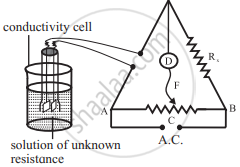
1) The cell constant is determined using the 1 M, 0.1 M or 0.01 M KCl solutions. The conductivity of KCl solution is well tabulated at various temperatures.
2) The resistance of KCl solution is measured by Wheatstone bridge as shown in the figure.
3) AB is the uniform wire. Rx is the variable known resistance placed in one arm of Wheatstone bridge. The conductivity cell containing KCl solution of unknown resistance is placed in the other arm of Wheatstone bridge.
4) D is a current detector. F is the sliding contact that moves along AB. A.C. represents the source of alternating current.
5) The sliding contact is moved along AB until no current flows. The detector D shows no deflection. The null point is, thus, obtained at C.
6) According to Wheatstone bridge principle,
`("R"_(("solution")))/(l("AC")) = "R"_"x"/(l("BC"))`
Hence, `"R"_(("solution")) = (l("AC"))/(l("BC")) xx "R"_"x"`
7) By measuring lengths AC and BC and knowing Rx , resistance of KCl solution can be calculated.
8) The cell constant is given by
Cell constant = kKCl × `"R"_(("solution"))`
The conductivity of KCl solution is known. The cell constant, thus, can be calculated.
RELATED QUESTIONS
0.05 M NaOH solution offered a resistance of 31.6 Ω in a conductivity cell at 298 K. If the cell constant of the cell is 0.367 cm-1, calculate the molar conductivity of NaOH solution.
Answer the following in brief.
Explain the effect of dilution of the solution on conductivity.
Answer the following:
What is Kohlrausch law of independent migration of ions? How is it useful in obtaining molar conductivity at zero concentration of a weak electrolyte? Explain with an example.
Kohlrausch law is applicable for the solution _______.
Write three important steps required to determine molar conductivity.
The CORRECT unit of molar conductivity is ____________.
What will be the concentration of NaCl solution, if the molar conductivity and conductivity of NaCl solution is 124.3 Ω−1 cm2 mol−1 and 1.243 × 10⁻⁴ Ω−1 cm2 respectively?
The molar conductance of 0.001 M acetic acid is 50 ohm−1 cm2 mol−1. The limiting molar conductance is 250 ohm−1 cm2 mol−1. What is its degree of ionization?
Conductivity of KCI solution is 0.0027 Ω−1 m−1 at 25°C. The resistance of the solution is 82.4 Ω. The cell constant is ____________ m−1.
The SI unit of resistivity and molar conductivity are respectively ____________.
The resistance of a conductivity cell containing 0.001 M KCl solution at 298 K is 1500 Ω. What is the cell constant if conductivity of 0.001 M KCI solution at 298 K is 0.146 × 10⁻³ S cm−1?
What is the common unit of conductivity if the dimensions are expressed in centimeter?
In 2 hours, a certain current liberates 0.504 g hydrogen. How many grams of copper can be deposited by the same current flowing for the same time in a CuSO4 solution?
(Molar mass of Cu = 63.5 g mol−1, H2 = 2.0 g mol−1)
What is the relation between cell constant, conductivity and electrical resistance?
The distance between electrodes of a conductivity cell is 0.98 cm and area of cross section is 1.96 cm2. What is the cell constant?
Conductivity of a conductor is ____________.
A conductivity cell dipped in 0.01 M AgNO3 solution gives a resistance of 3160 ohms. If cell constant is 0.47 cm−1, what is the conductivity of AgNO3 solution?
What is the value of cell constant if conductance and conductivity of a solution is same?
If the conductivity of 0.08 M KCl solution is 2 × 10⁻² Ω-1, what is the molar conductivity of the solution?
A conductivity cell dipped in 0.5 M KCl gives a resistance of 250 ohms. If the conductivity of KC I solution is 6.68 × 10⁻³ S cm-1, what is the cell constant?
If the resistivity of 0.1 M KCI solution is 50 Ω cm, what is it's molar conductivity?
The value of [H3O+] in mol lit–1 of 0.001 M acetic acid solution (Ka = 1.8 × 10⁻⁵) is ______.
Specific conductance of 0.1 M sodium chloride solution is 1.06 × 10⁻² ohm−1 cm−1. Its molar conductance in ohm−1 cm2 mol−1 is ______.
Calculate molar conductivity for 0.5 M BaCl2 if its conductivity at 298K is 0.01 Ω–1 cm–1.
A conductivity cell filled with 0.02 M AgNO3 gives at 25°C resistance of 947 ohms. If the cell constant is 2.3 cm-1, what is the molar conductivity of 0.02 M AgNO3 at 25°C?
What is the SI unit of molar conductivity?
Write the relation between molar conductivity and molar ionic conductivities for the electrolytes:
- Na2SO4
- AlCl3
Which of the following expressions correctly represents molar conductivity?
