Advertisements
Advertisements
प्रश्न
What is a cell constant? What are its units? How is it determined experimentally?
Advertisements
उत्तर
For a given cell, the ratio of separation (l) between the two electrodes divided by the area of cross-section (a) of the electrode is called the cell constant.
Cell constant = `"l"/"a"`
The unit of cell constant is m-1 (SI unit) or cm-1 (C.G.S unit).
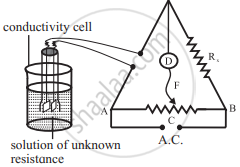
1) The cell constant is determined using the 1 M, 0.1 M or 0.01 M KCl solutions. The conductivity of KCl solution is well tabulated at various temperatures.
2) The resistance of KCl solution is measured by Wheatstone bridge as shown in the figure.
3) AB is the uniform wire. Rx is the variable known resistance placed in one arm of Wheatstone bridge. The conductivity cell containing KCl solution of unknown resistance is placed in the other arm of Wheatstone bridge.
4) D is a current detector. F is the sliding contact that moves along AB. A.C. represents the source of alternating current.
5) The sliding contact is moved along AB until no current flows. The detector D shows no deflection. The null point is, thus, obtained at C.
6) According to Wheatstone bridge principle,
`("R"_(("solution")))/(l("AC")) = "R"_"x"/(l("BC"))`
Hence, `"R"_(("solution")) = (l("AC"))/(l("BC")) xx "R"_"x"`
7) By measuring lengths AC and BC and knowing Rx , resistance of KCl solution can be calculated.
8) The cell constant is given by
Cell constant = kKCl × `"R"_(("solution"))`
The conductivity of KCl solution is known. The cell constant, thus, can be calculated.
संबंधित प्रश्न
Choose the most correct option.
Two solutions have the ratio of their concentrations 0.4 and ratio of their conductivities 0.216. The ratio of their molar conductivities will be ______.
Kohlrausch law is applicable for the solution _______.
SI unit of conductivity is _______.
The molar conductivity and conductivity of AgNO3 solution is 121.4 Ω–1 cm2 mol–1 and 2.428 × 10⁻³ Ω–1 cm–1 at 25 °C. What is molar concentration of AgNO3 solution?
Give SI unit of resistivity.
Write relation between electrolytic conductivity and molar conductivity.
The CORRECT unit of molar conductivity is ____________.
A conductivity cell having cell constant 8.76 cm−1, placed in 0.01 M solution of an electrolyte offered a resistance of 1000 ohms. What is the specific conductance of electrolytes?
Which among the following solution has the highest conductivity (k) value?
Conductivity of KCI solution is 0.0027 Ω−1 m−1 at 25°C. The resistance of the solution is 82.4 Ω. The cell constant is ____________ m−1.
The molar conductivities at zero concentration for Ca2+ and CaCl2 are 104 and 256.8 Ω−1 cm2 mol−1 respectively. The molar conductivity at zero concentration for Cl− is ____________.
The molar conductivities at infinite dilution for sodium acetate, HCI and NaCl are 91 S cm2 mol-1, 425.9 S cm2 mol-1 and 126.4 S cm2 mol-1 respectively. The molar conductivity of acetic acid at infinite dilution is ______.
Which of the following graph represents the variation of `∧` with `sqrt"c"` for acetic acid solution?
What is the cell constant of `"N"/10 "KCl"` solution at 25°C, if conductivity and resistance of a solution is 0.0112 Ω−1 cm−1 and 55.0 Ω respectively?
Conductivity of a conductor is ____________.
A conductivity cell dipped in 0.01 M AgNO3 solution gives a resistance of 3160 ohms. If cell constant is 0.47 cm−1, what is the conductivity of AgNO3 solution?
What is the value of cell constant if conductance and conductivity of a solution is same?
What will be the concentration of NaCl solution, if the molar conductivity and conductivity of NaCl solution is 124.3 Ω-1 cm2 mol-1 and 1.243 × 10⁻⁴ Ω-1 cm2 respectively?
If the conductivity of 0.08 M KCl solution is 2 × 10⁻² Ω-1, what is the molar conductivity of the solution?
A conductivity cell dipped in 0.5 M KCl gives a resistance of 250 ohms. If the conductivity of KC I solution is 6.68 × 10⁻³ S cm-1, what is the cell constant?
If the resistivity of 0.1 M KCI solution is 50 Ω cm, what is it's molar conductivity?
Specific conductance of 0.1 M sodium chloride solution is 1.06 × 10⁻² ohm−1 cm−1. Its molar conductance in ohm−1 cm2 mol−1 is ______.
What is the SI unit of conductivity?
Molar conductivities at infinite dilution of Mg2+ and Br- are 105.8 Ω-1 cm2 mol-1 and 78.2 Ω-1 cm2 mol-1 respectively. Calculate molar conductivity at zero concentration of MgBr2.
Explain the determination of molar conductivity of a weak electrolyte at infinite dilution or zero concentration using Kohlrausch's law.
Write the relation between molar conductivity and molar ionic conductivities for the electrolytes:
- Na2SO4
- AlCl3
When electric current is passed through acidified water, 112 mL of hydrogen gas at STP collected at the cathode in 965 seconds. The current passed in amperes is ______.
Which of the following expressions correctly represents molar conductivity?
