Advertisements
Advertisements
Question
Advertisements
Solution
Circulatory system: It is a system of organs that takes part in the flow of materials in the body of an organism inside an extracellular fluid.
Circulatory system in humans:
(a) The right atrium receives deoxygenated blood from all the parts of the body through large veins called vena cava.
(b) When the right atrium is full of blood, it contracts and the blood is forced into right ventricle.
(c) When the right ventricle is full of blood, it contracts and the blood is pumped into the pulmonary trunk.
(d) From right ventricle, the pulmonary artery carries the blood to the lungs for oxygenation.
(e) The oxygenated blood returns to the heart via pulmonary veins that empty into the left auricle.
(f) When the left auricle contracts, the blood passes into the left ventricle by the opening of bicuspid valve.
(g) On contraction of the left ventricle, the blood is pumped into the artery called aorta.
(h) The aorta branches into vessels which transports blood to the heart and all the body parts.
APPEARS IN
RELATED QUESTIONS
The diagram below represents the human heart in one phase of its function. Study the diagram carefully and answer the questions that follow:
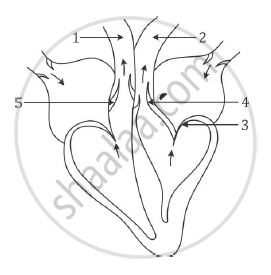
(i) Name the phase.
(ii) Which part of the heart is contracting in this phase? Give a reason to support your answer.
(iii) Name the parts labelled 1 to 4.
(iv) What type of blood flows through ‘2’?
(v) State the function of the part numbered ‘5’.
(vi) Name the membrane that covers the heart.
Agranulocytes are :
What are the average values of blood pressure in a normal adult human?
Differentiate between members of the following pairs with reference to the aspect asked within bracket:
artery and vein (type of blood primarily flowing through)
Draw well labeled diagrams of part Artery and Superior vena cava to show the structural.
Choose the correct alternative.
What is the minimum number of the plasma membrane that oxygen has to diffuse across to pass from air in the alveolus to haemoglobin inside a RBC?
Use your brain power!
How is the air that we inhale purified in our body?
_____ gas is transported to all parts of the body.
Identify the CORRECT statement/s regarding blood clotting.
______ is an agranulocyte.
