Advertisements
Advertisements
Question
What can happen to Hasmukh’s farm after some years?
Advertisements
Solution
Hasmukh’s farm will lose fertility after some years because Hasmukh is using chemical fertilizers. Hasmukh is in danger of falling into a debt trap as he has taken loans to buy tractors, seeds, and fertilizers. In the future, he may not be able to properly work on his farm.
APPEARS IN
RELATED QUESTIONS
Have you eaten roti made from bajra or jowar? Did you like these?
Which are the different festivals related to farming, celebrated in different seasons? Find out more about anyone such festival and write in your notebook –
The name of the festival, in which season is it celebrated, in which states of India, what special foods are made, is it celebrated only at home with the family, or together with many people.
Talk to the elders in your family and find out if there were some special foods cooked earlier that are not cooked anymore?
Find out about the crops - cereals, vegetables, pulses - that are grown in your area. Of those, is there anything that is famous across the country?
Hasmukh said, “With profits from our fields, we can progress.” What is your understanding of ‘progress’?
What kind of progress would you like to see in your area?
Have there been any changes near your area, which may be difficult to call ‘progress’? What changes are these? What are the different opinions about them?
Visit a farm near your area. Observe and talk to the people there. Write a report.
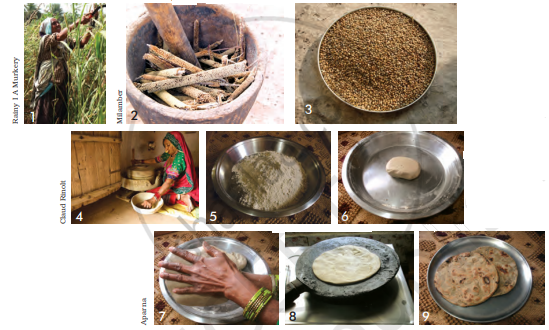
What can you see in each picture on the next page?
In picture 2 you can see the bajra cobs in the mortar (okhli, used for crushing). The cobs are crushed with a pestle (moosli) and the seeds are separated from the cob. You can see the separated seeds in picture 3. Now this work is also done by big machines, like threshers. We call both these different ‘technologies’ – using our hands or big machines – to crush the seeds.
What technology could have been used to cut the stem in picture 1? What do you think is being done in the grinder (chakki ) in picture 4? What ways (technologies) would have been used to do the work shown in pictures 5 and 6? You can see that the dough is ready in picture 6. When do you think a sieve (chhalni ) would have been used? Discuss each step in detail, in any language you wish to use.
What do you think is being done in the grinder (chakki) in picture 4?
